Breakout Prop Alternatives: 6 Firms With Higher Leverage
Affiliate link: PropRubric may earn a commission if you buy, at no extra cost to you. It never changes a score or a ranking.
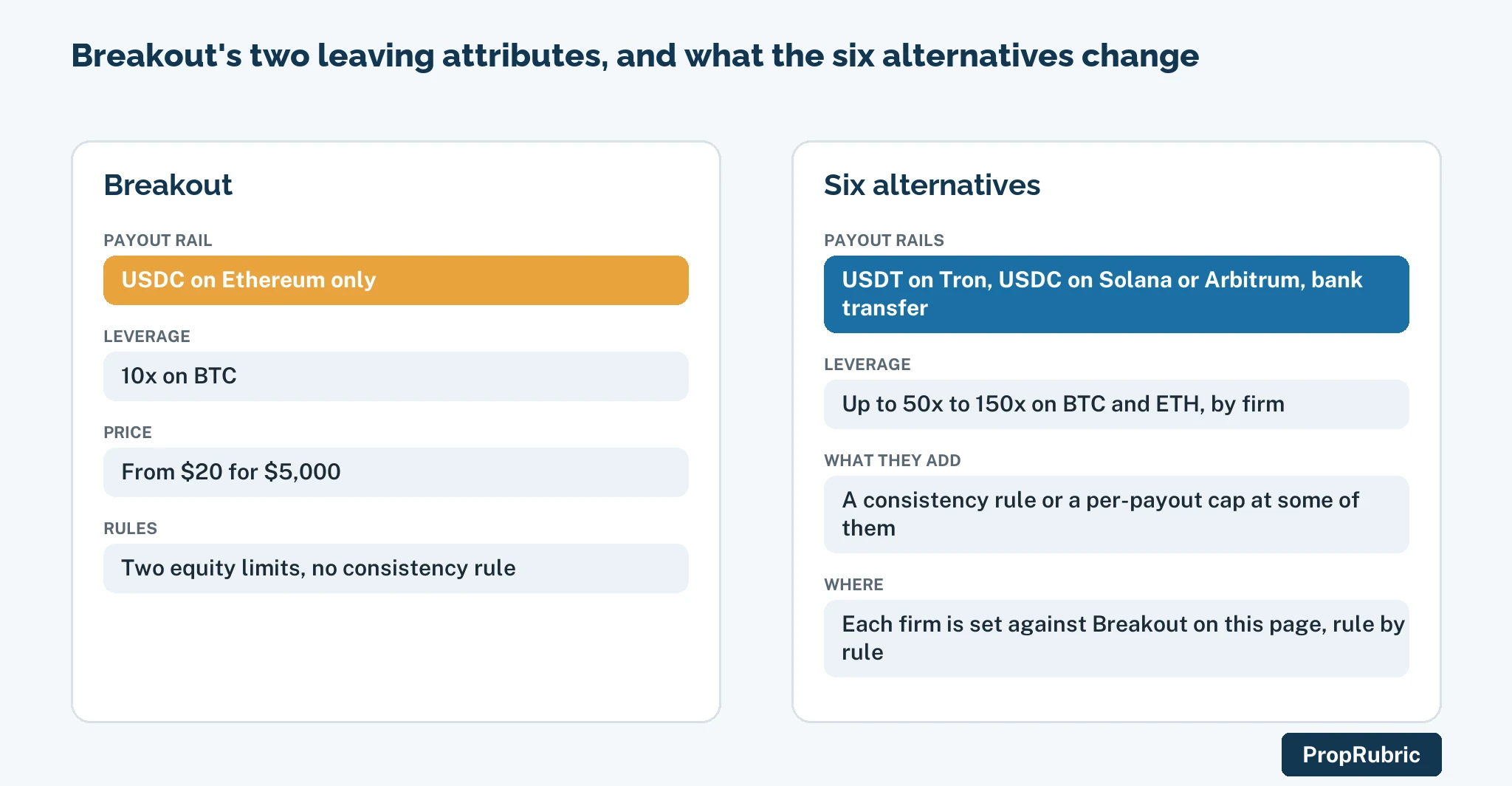
The closest Breakout Prop alternatives are HyroTrader, Crypto Fund Trader and Velotrade. HyroTrader pays in USDT or USDC at up to 150x on BTC and ETH and 50x to 100x on most pairs, and Crypto Fund Trader pays in USDT, BTC, ETH or by bank at up to 1:100. Velotrade pays weekly in USDC or USDT on Arbitrum with a hash per transfer. Six firms are compared against Breakout below on the two values traders leave it for, its single payout rail, USDC on Ethereum, and its leverage of 10x on BTC and 2x to 5x on most coins, then on price, drawdown, split and venue.
The reasons traders look for an alternative come first, each firm gets a card, a fit list matches each firm to a trader, and the page ends with the cases in which Breakout is still the better choice.
Kraken Prop is not on the list, because it is the same programme sold through a different storefront, and the firm’s full record is in the Breakout review.
| firm | payout rail | leverage (BTC / most alts) | entry fee ($5,000) | daily limit | maximum drawdown | split | venue | Visit |
|---|---|---|---|---|---|---|---|---|
| Breakout (baseline) | USDC on Ethereum only; on demand from $50; approval 12–24 h | 10x / 5x to 2x | $20 | 3% at 00:30 UTC | 6% / 5% / 3% static | 80% → 90% | Breakout Terminal | Visit Breakout → |
| HyroTrader | USDT or USDC on Solana or Tron; on demand once the funded account is in profit, up to 5% of the initial balance per request; within 24 h | up to 150x on BTC and ETH; 50x to 100x on most pairs | $59 | 3% / 4% / 5% by model, static from the day’s starting equity at 00:00 UTC | 5% / 6% / 10% static | 80% → 90% (Zero-Step 80%) | your Bybit or BloFin demo account, or the Hyro platform | Visit HyroTrader → |
| Crypto Fund Trader | USDT (ERC-20, TRC-20), BTC, ETH or bank; after 15 traded days | up to 1:100 on Bybit and on Advanced MT5 or Match-Trader accounts; 1:5 on smaller and Instant accounts | $40 | 5% (2-Phase) / 4% at 00:05 UTC | 10% static / 6% trailing | 80% → 90% | MT5, Match-Trader or Bybit | Visit Crypto Fund Trader → |
| Velotrade | USDC or USDT on Arbitrum; weekly; Arbiscan link per payout | 10x / 2x (challenge); 5x funded | $40 | 5% / 4% / 3% at 00:30 UTC | 10% / 7% / 3% static | 80% → 90% | own platform | Visit Velotrade → |
| Propr | USDC on chain; on demand from $20 | 10x / 2x | $25 | 3% (1-step) / 5% at 00:00 UTC | 6% / 5% / 3% static; 8% trailing (2-step) | 80% | own platform, Hyperliquid routing | Visit Propr → |
| HyperPNL | USDC on chain by smart contract; one request a day | up to 20x | $42 | 3% / 5% from equity at 00:00 UTC | 5% / 9% static | 80% | own platform, Hyperliquid order book | Visit HyperPNL → |
| Mubite | USDC on Ethereum, bank transfer or Mubite Points; on demand once funded and in profit, then every 14 days | 1:100 on Bybit or Cleo | $65 | 5%, reset not published | 8–10% static | 80% → 90% | Bybit or Cleo | Visit Mubite → |
What are the best alternatives to Breakout?
PropRubric found six crypto prop firms that differ from Breakout on its two leaving attributes, the payout rail and the leverage cap, and each one changes at least one of them.
- HyroTrader: USDT or USDC on Solana or Tron within 24 hours, with a transaction ID on Solana payouts, at up to 150x on BTC and ETH and 50x to 100x on most pairs, from $59.
- Crypto Fund Trader: USDT on two networks, BTC, ETH or a bank transfer, on 715 pairs at up to 1:100 on Bybit and its larger MT5 and Match-Trader accounts, from $40.
- Velotrade: USDC or USDT on Arbitrum every week with an Arbiscan link, at 10x on BTC in the challenge, from $40.
- Propr: USDC on chain on demand from $20, at 10x on BTC, ETH and SOL, with orders that can route to Hyperliquid, from $25.
- HyperPNL: USDC by smart contract to its own wallet, one request a day, at up to 20x, from $42.
- Mubite: 1:100 on Bybit or Cleo with a static floor, from $44, paying USDC on Ethereum like Breakout, or by bank transfer or in Mubite Points.
Five add a payout coin or a network that Breakout does not offer, and Mubite adds a bank transfer and Mubite Points beside the same USDC on Ethereum. Four of the six raise the leverage above 10x, and the reasons traders want those two things changed are Breakout’s own numbers.
Why do traders look for Breakout alternatives?
Traders look for Breakout alternatives for six reasons, and the first two are the firm’s own published values rather than complaints.
- Payouts arrive in USDC on Ethereum and nothing else. Breakout’s pricing page states “Payouts are processed in USDC on Ethereum (ERC-20)”, so a trader without an Ethereum wallet, or one who wants USDT, BTC or a bank transfer, has no option, and a transfer to a wallet on the wrong network is lost.
- Leverage is capped at 10x on BTC and 2x to 5x on most coins. The firm applies leverage per market with no setting for the trader, 10x on BTC since 12 August 2026, 5x on about 20 majors and 2x to 3x on the rest.
- The daily limit is 3% on every plan. Classic, Pro and Turbo all carry a 3% daily loss limit, the lowest common figure among the crypto-first firms, where 2-step plans elsewhere allow 5%.
- Turbo’s floor is 3%. The cheapest plan has half of Classic’s room, and a static 3% floor on a $5,000 account is $150.
- No exchange account. Breakout runs its own terminal with no Bybit, Kraken Pro or API connection, so a trader who wants an exchange interface in the challenge looks elsewhere.
- The Spark plan sold out. The $50,000 single-limit plan was marked sold out on 29 September 2026 and sits on a waitlist, which sends traders who wanted one trailing floor and no daily limit to other firms.
- Traders report the rail and the leverage. A r/Daytrading thread from 2025 in which a poster describes testing “5 futures and 2 crypto prop firms”, which ranked for the comparison queries on 1 October 2026, names leverage and payout currency among the differences; PropRubric did not verify the poster’s accounts and records the thread as a report.
The first reason is the one every alternative fixes, and the table above shows how each firm fixes it; the cards below compare each alternative with Breakout value against value.
How do the alternatives compare with Breakout?
The six alternatives compare with Breakout on the same values, and each card follows one order: where the firm comes from, what it does differently from Breakout, what it costs against Breakout’s $20 at $5,000, and the catch, which is the thing Breakout does better.
HyroTrader: USDT or USDC within 24 hours at Bybit’s leverage
HyroTrader is a crypto-first prop firm provided by a UAE free-zone company, with a British Virgin Islands company running the funded phase, on your own Bybit or BloFin demo account or its own Hyro platform. HyroTrader differs from Breakout on both leaving attributes. HyroTrader pays USDT or USDC on Solana or Tron within 24 hours with a transaction ID on Solana payouts, against USDC on Ethereum with a 12-to-24-hour approval.
HyroTrader accounts trade at up to 150x on BTC and ETH and 50x to 100x on most pairs, against 10x on BTC. HyroTrader costs $59 for $5,000 on its 2-step against Breakout’s $20, and refunds that fee with the first payout.
The catch at HyroTrader is a consistency rule in the evaluation, with no day counting for more than 40% of the target, and a cap of 5% of the initial balance on each payout request, two rules Breakout does not have. The two firms are set side by side in HyroTrader vs Breakout and the firm’s record is in the HyroTrader review.
Crypto Fund Trader: USDT, BTC, ETH or bank at up to 1:100 on 715 pairs
Crypto Fund Trader is a crypto-first prop firm run by SWISS RLCRATES AG in Zug, Switzerland, on MT5, Match-Trader or a Bybit venue. Crypto Fund Trader differs from Breakout on the payout rail, five methods including USDT on two networks, BTC, ETH and a bank transfer against one. Crypto Fund Trader also differs on leverage, up to 1:100 on crypto on Bybit and its larger MT5 and Match-Trader accounts against 10x, and on the daily limit, 5% on the 2-Phase against 3%.
Crypto Fund Trader costs $40 for $5,000 on its 1-Phase against Breakout’s $20, and $199 for a $100,000 Break account against $330 on Turbo. The catch at Crypto Fund Trader is the first payout after 15 traded days or 30 calendar days against Breakout’s on-demand payout from $50, and a $10,000 cap on the profit of one day or one trade.
The two firms differ most on platform breadth against payout timing, and the firm’s record is in the Crypto Fund Trader review.
Velotrade: weekly USDC or USDT on Arbitrum with a hash per payout
Velotrade is a crypto-first prop firm from Hong Kong whose published payouts each carry an Arbiscan link. Velotrade differs from Breakout on the payout rail, USDC or USDT on Arbitrum against USDC on Ethereum. Velotrade also differs on the floor, static on every plan with the 2-step recalculated at the start of Phase 2, and on the daily limit, 5% on the Classic 2-step against 3%, while matching Breakout’s 10x on BTC in the challenge.
Velotrade costs $40 for $5,000 on its Pro 1-step against Breakout’s $20. The catch at Velotrade is the payout schedule, weekly on request after 14 days plus five qualifying days against Breakout’s on demand, 2x on most altcoins, and five qualifying days per phase against Breakout’s none; the firm’s record is in the Velotrade review.
Propr: USDC on chain on demand from $20, with on-chain routing
Propr is a crypto-first prop firm from the British Virgin Islands whose orders can route to Hyperliquid, with each trade labelled A-book or B-book. Propr differs from Breakout on the payout rail, USDC on chain through a transparency dashboard against USDC on Ethereum through a leaderboard, and on the venue, Hyperliquid routing against a closed terminal. Propr matches Breakout’s 10x on BTC and its absence of a per-trade cap, a consistency rule and minimum days.
Propr costs $25 for $5,000 on its Turbo 1-step against Breakout’s $20. The catch at Propr is a full profit sweep on every payout with no partial withdrawals, 2x on most altcoins, and a 2-step whose floor trails the equity high; the firm’s record is in the Propr review.
HyperPNL: USDC by smart contract, one request a day, at up to 20x
HyperPNL is a crypto-first prop firm that fills orders against Hyperliquid’s live order book and pays by smart contract. HyperPNL differs from Breakout on leverage, up to 20x on crypto against 10x. HyperPNL also differs on the payout mechanism, USDC sent on chain by smart contract with a claimed time under three seconds against a 12-to-24-hour approval, and on the daily reset, from equity at 00:00 UTC against the balance at 00:30 UTC.
HyperPNL costs $42 for $5,000 on its 1-step against Breakout’s $20. The catch at HyperPNL is the account size, which stops at $25,000 against Breakout’s $200,000, a payout minimum of 1% of the account size, and the exclusion of US residents; the firm’s record is in the HyperPNL review.
Mubite: 1:100 on Bybit or Cleo with a static floor
Mubite is a crypto-first prop firm run by Mubite s.r.o. in Prague, with prices and depth from Bybit on its Bybit accounts and from Binance on its Cleo accounts, on a simulated funded account. Mubite differs from Breakout on leverage, 1:100 on Bybit or Cleo against 10x, on the venue, an exchange-priced account against a closed terminal, and on the daily limit, 5% against 3%, while matching Breakout’s static floor.
Mubite costs $65 for $5,000 on its refundable 2-step against Breakout’s $20. The catch at Mubite is a payout cap of 5% of the account size per request, a 3% cap on the loss of one trade, a funded consistency score of 25% to 40%, and 10 to 13 minimum days. The firm’s record is in the Mubite review.
Which Breakout alternative fits which trader?
You should pick the alternative by the attribute you are leaving, and six conditions cover the six firms.
- If you want a payout coin other than USDC, choose Crypto Fund Trader for USDT, BTC, ETH or a bank transfer, or HyroTrader for USDT on Solana or Tron.
- If you want USDT or USDC with a public transaction ID on Solana payouts, choose HyroTrader, and keep its 40% consistency rule and 5% per-request payout cap in mind.
- If you want the highest leverage, choose HyroTrader at up to 150x on BTC and ETH on Bybit or BloFin, or Crypto Fund Trader and Mubite at up to 1:100.
- If you want on-chain proof of every payout, choose Velotrade on Arbitrum or Propr on Hyperliquid.
- If you want Breakout’s rulebook with a different rail, choose Propr, which also has no per-trade cap, no consistency rule and no minimum days.
- If you want a 5% daily limit on a 2-step, choose Crypto Fund Trader or Velotrade, because Breakout sells no 2-step and no plan above 3%; leaving isn’t always the right move, and the four cases below are the ones in which it is not.
When is Breakout still the better choice?
Breakout is still the better choice in four cases, and each one is a value none of the six alternatives matches in full.
- You want the cheapest standing entry. Breakout’s Turbo costs $20 for $5,000 and $330 for $100,000, below every alternative’s cheapest plan at the same size, Crypto Fund Trader’s Break account included: $199 upfront plus a $328 activation fee after passing, with a consistency rule.
- You want no per-trade cap, no consistency rule and no minimum days together. Only Propr matches all three; Mubite caps one trade, HyroTrader applies a consistency rule and minimum days, Velotrade requires qualifying days, and Crypto Fund Trader caps the day’s profit.
- You want a floor that payouts do not move and a daily limit you can compute. Breakout’s static floor “never changes, regardless of how much profit you make”, and its daily floor is a number for the next 24 hours from the 00:30 UTC balance.
- You want an exchange group behind the firm. Breakout’s funded accounts are provided by Payward Oceanic Ltd., a Kraken group company, and the same programme is sold inside Kraken Pro as Kraken Prop with payouts to a Kraken wallet in USD or USDG, the one rail change that needs no other firm.
The six firms, Breakout and every other crypto prop firm PropRubric tracks are ranked on five criteria on the shortlist of the best crypto prop firms. The firm whose payout terms are documented least like Breakout’s is Bitfunded, which publishes a payout frequency but no network and states its fee refund two different ways.