Consistency Rules at Crypto Prop Firms: Who Uses Them
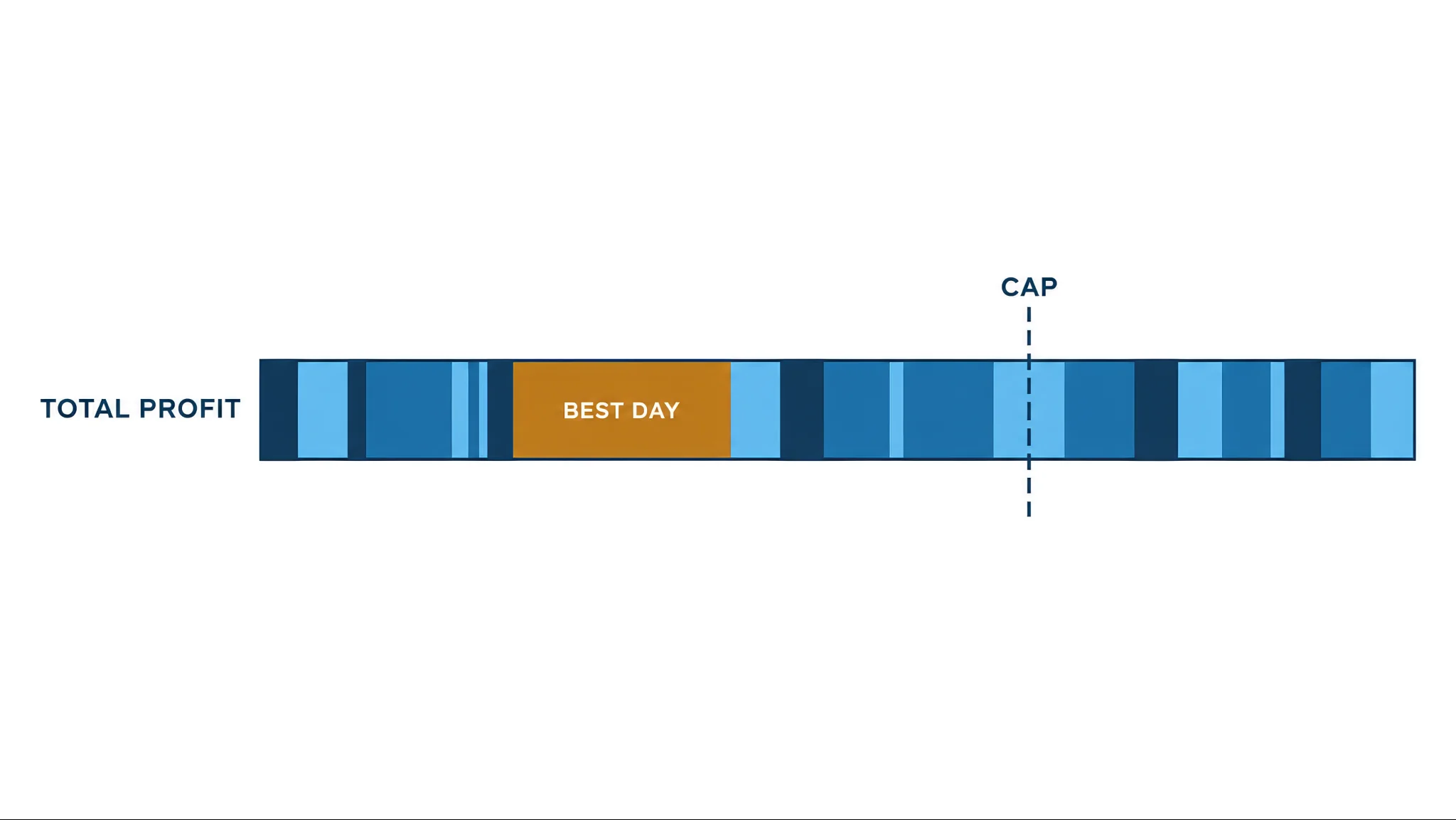
A consistency rule at a crypto prop firm caps the share of your profit that may come from one trading day, usually 30% to 50%. Nineteen of the 28 crypto prop firms PropRubric tracks apply one, or a daily profit cap in its place, on at least one plan; seven apply no such rule, and two publish nothing either way. The rule is defined against its two formula forms, calculated on a $900 and a $10,000 result, tested against a 24/7 market in which one bitcoin day can carry a month.
The rule is then sorted into four kinds, listed firm by firm with the phase it applies to and what a breach costs, and turned into five habits for spreading a target over enough days.
The firms with no consistency rule close the page, because “no consistency rule” is the question most readers bring to this page, and the rule is one column of the table that compares crypto prop firm rules across every firm PropRubric tracks.
| firm | rule | cap | applies to | consequence |
|---|---|---|---|---|
| HyroTrader | Profit Distribution Rule: best day ÷ profit target | 40% (50% per trade on Zero-Step) | evaluation phases only | excess not counted toward the target; not a breach |
| Crypto Fund Trader | single-day profit cap | 40% | Break accounts, final stage | payout review |
| Breakout | none | — | — | — |
| Kraken Prop | none | — | — | — |
| Bitfunded | not stated (the FAQ sets 2 closed trades per payout period instead) | — | — | — |
| Mubite | Funded Score: best day ÷ total funded profit | 25% Instant · 30% One-Step · 40% Two-Step | funded only; none in the challenge | withdrawals pause until the share falls |
| Klein Funding | Stability Score: best day ÷ total profit or target | 45% 2-phase · 30% 1-phase (Bybit plans) | evaluation and funded | payout delayed, not a breach |
| WenCrypto | consistency score: biggest day ÷ total profit | 20% | funded pay-later plan and the Genesis instant account, before each withdrawal | withdrawal delayed |
| Fundedbit | best day ÷ profit of all profitable days, at payout | 40% (1-step) / 20% (Fast Track) | funded only; none on the 2-step | payout blocked |
| PropW | Consistency Ratio: best day ÷ cumulative net profit | 40% One-Step · 45% Two-Step | scholarship application | keep trading, no reset |
| Cointracts | Profit Day Ratio: best day ÷ total of positive days | 50% (strictly below) | funded, checked at the first payout | payout blocked |
| TradeXProp | consistency score (evaluation offer card) | 45% | funded accounts (“new funded with Consistency Rule”); not stated on the crypto pages | not published |
| HyperPNL | none | — | — | — |
| Propr | none | — | — | — |
| SizeProp | none | — | — | — |
| Upscale | single-day cap | 30% | Turbo accounts and the API option | payout blocked until under 30% |
| Velotrade | none | — | — | — |
| Dolvero | best day ÷ the profit that funds you | 15% | promotion gate | promotion delayed, never a fail |
| Tradeify 247 | consistency score: best day ÷ total realized profit (Instant Funding); best day ÷ evaluation profit (One Step Daily) | 20% Instant · 40% One Step Daily · none on 1-Step and 2-Step | Instant Funding before each payout; One Step Daily evaluation | payout or pass waits until met, not a breach |
| E8 Markets | best-day rule (E8 One); 2% daily profit cap (E8 Pro) | 40% · 2% a day counted | funded (One); target and profit (Pro) | payout delayed; slower target |
| FTMO | best-day rule (orders before 12 Oct 2026); consistency rule against total profit (orders from 12 Oct 2026) | 50% (both rules); 30% on the Instant Account | 1-Step and Instant Account | pass or payout delayed until met, never a fail |
| The5ers | best-day rule | 50% | Summer Plan only (2-step funded; 1-step both) | fail |
| BrightFunded | none (“we do not currently enforce a consistency rule”) | — | — | — |
| AquaFunded | best day ÷ total profit per payout period | 15% (20% on Instant Funding Pro bought from 8 Sep 2026) or 50% by model; none on Instant Flex | funded stage | payout delayed, not a breach |
| RebelsFunding | not stated (the FAQ sets minimum real trades per program instead) | — | — | — |
| Funded Trader Markets | best day ÷ target (challenge); best day ÷ total profit (funded) | 50% · 45% | 1-Step Nitro | fail / payout blocked |
| Goat Funded Trader | none on evaluation models; $3,000 daily profit cap instead; on accounts bought from 8 Oct 2026 a payout needs the largest win to be at least the largest loss | Instant GOAT, HERO, Stride and Goat Blitz (funded) 15% · Instant PRO 20% · none on Instant Premium | funded | profit above the cap removed; payout waits until met |
| FundingPips | consistency score: best day ÷ total profit | 15% Zero · 35% Master | Zero before each reward; Master on on-demand rewards and the monthly cycle (evaluations bought from 15 Aug 2026) | reward blocked until the score falls |
What is a consistency rule at a crypto prop firm?
Myfxbook’s guide to consistency rules gives the same definition for the whole industry: “The most common version limits the percentage of total profit or the profit target that may come from the trader’s best day”.
Marcel Hambálek of For Traders, in the firm’s guide to prop trading rules, classes rules of this kind among the “risk parameters written into a firm’s terms and conditions, applied to a simulated trading account”.
A consistency rule on that account does not limit how much you may earn; it limits how unevenly you may earn it, and the arithmetic that decides a breach has two forms.
How is a consistency rule calculated?
A consistency rule at a crypto prop firm is calculated as the best day’s net result divided by the total positive result over the period, multiplied by 100. The same rule can be turned around to give the minimum total a best day needs before a payout or a pass.
Formula
best-day share = best day’s profit ÷ total profit × 100 example: $400 ÷ $900 × 100 = 44.4%, above a 40% cap minimum total before payout = best day’s profit ÷ cap example: $400 ÷ 0.40 = $1,000, so $100 more of profit on other days clears the rule
The two forms answer two different questions, and a trader uses both. The share form answers “have I breached?”: a $1,000 day on a $2,000 total is 50%, which fails every rule below 50% and passes Cointracts’ rule only if the day is strictly below half of the positive days’ total. The minimum-total form answers “how much more do I need?”: a $1,000 day under a 40% rule needs a $2,500 total, so $1,500 must come from other days, and under Mubite’s 25% Instant Funding score the same day needs $4,000.
Tradeify’s worked example for a single futures firm, “$1,000 / 0.20 = $5,000 total balance needed”, is the minimum-total form at a 20% cap, and both forms can be run against every crypto firm’s cap in a few seconds with a calculator.
Which figure is the best day measured against?
Ten firms measure the best day against the total profit, Cointracts and Fundedbit against positive days only and three against the profit target, and the choice of figure changes the result on the same trades.
Against the total profit. PropW’s Consistency Ratio divides the best day by the cumulative net profit, so losing days lower the total and raise every winning day’s share. Mubite, Klein Funding, WenCrypto, Upscale, E8 One, Goat Funded Trader’s Instant models, FTMO’s 1-Step orders placed from 12 October 2026, Funded Trader Markets’ funded accounts and Tradeify 247 measure against a total of the same kind. A total of positive days only is the basis at Cointracts, at Fundedbit and on FTMO’s older 1-Step orders, so a losing day leaves that total unchanged.
Against the profit target. HyroTrader counts one day for at most 40% of the target on One-Step and Two-Step evaluations and one trade for at most 50% on Zero-Step, and profit above the cap stays in the account without counting toward the target. Funded Trader Markets’ Nitro challenge caps a day at 50% of the target, and Dolvero’s 15% is taken on the profit that gets the account funded, so the denominator is fixed in advance and a losing day does not move it.
The denominator is the detail that decides whether a bad week helps or hurts the ratio: against the total, a $200 losing day after a $400 best day turns a $900 total into $700 and a 44.4% share into 57.1%; against the target, nothing changes. Whichever figure the rule uses, a market that never closes gives one day more weight than a forex day can carry.
How does a consistency rule work on a 24/7 crypto market?
A consistency rule on a 24/7 crypto market counts every calendar day as a trading day, and three effects follow: the firm’s reset time defines where one day ends, one bitcoin day can hold most of a month’s result, and weekends count.
| moment | what the rule sees | example under a 40% rule |
|---|---|---|
| Monday to Thursday, four days of $150 | four days, $600 total | best-day share 25% |
| Friday 5 February 2026, BTC −13.2% in one session | a short earns $700 in one day | $700 of $1,300 = 53.8%: breached |
| the same $700 split across the 00:05 UTC reset at Crypto Fund Trader | two days of $350 | $350 of $1,300 = 26.9%: cleared |
| Saturday, $100 of profit | the sixth day counts | the total rises to $1,400; the best day’s share falls to 50% |
Firstly, a “day” is the firm’s day, and the reset time that cuts it is published by most crypto-first firms. The reset is 00:05 UTC at Crypto Fund Trader, 00:00 UTC at HyperPNL, Propr and Upscale, 00:30 UTC at Breakout and Velotrade, and Mubite checks its rules at 23:59 GMT+1, so a position closed across the reset splits its result into two days. Secondly, bitcoin moved 5% or more on 16 days in the year to 29 September 2026 and fell 13.2% on 5 February 2026, per the FRED Coinbase daily series.
A trader who catches one such bitcoin day with a normal position can breach a 40% rule on the same trades that would pass a forex rule. Finally, Saturday and Sunday are trading days at every crypto-first firm, which gives the trader two extra days a week to spread the total.
The rule’s kind decides how that total is counted, and the Break account’s rule sits beside Crypto Fund Trader’s other limits in that firm’s own rulebook.
What are the types of consistency rule at crypto prop firms?
Crypto prop firms use four kinds of consistency rule, and the 19 firms that apply one divide among them as follows.
- Best day against the profit at payout or pass (the total profit, or at Fundedbit, Cointracts and under FTMO’s older Best Day Rule the profit of positive days): Crypto Fund Trader 40% on Break accounts, Fundedbit 40% on the funded 1-step and 20% on the funded Fast Track, E8 One 40% when funded, FTMO 50% under the Best Day Rule on 1-Step orders placed before 12 October 2026 and 50% of total profit from that date (30% on its Instant Account), Cointracts 50% when funded, Tradeify 247 40% at the pass on One Step Daily, Upscale 30% on Turbo and API accounts, The5ers 50% on its Summer Plan, Goat Funded Trader 15% or 20% on its Instant models, and AquaFunded 15% or 50% on its funded stages (20% on Instant Funding Pro bought from 8 September 2026, none on Instant Flex).
- Best day against the profit target in the evaluation: HyroTrader at 40% of the target a day (50% a trade on Zero-Step), the excess not counted rather than failing the account, Funded Trader Markets’ Nitro at 50% of the target, falling to 45% of total profit when funded, and Dolvero’s 15% of the profit that funds you, which delays promotion and never fails the account.
- Named scores that delay a payout rather than fail an account: Mubite’s Funded Score at 25%, 30% or 40% by plan, Klein Funding’s Stability Score at 45% or 30%, WenCrypto’s 20% consistency score on its pay-later plan and Genesis account, FundingPips’ 15% score on Zero and 35% on Master accounts, TradeXProp’s 45% consistency score on funded accounts, PropW’s Consistency Ratio at 40% or 45% by plan, and Tradeify 247’s 20% consistency score on Instant Funding, each of which pauses withdrawals until more days dilute the best one.
- Daily profit caps that replace the ratio: Crypto Fund Trader’s $10,000 maximum profit per day and per trade, Goat Funded Trader’s $3,000 daily cap on funded accounts, and E8 Pro’s rule that only 2% a day counts toward the target, so an 8% target takes at least four days.
The consequence separates the kinds more than the percentage does. A 50% rule of the kind that fails an evaluation (Funded Trader Markets’ Nitro, The5ers’ Summer Plan) costs the fee, while a 40% score that pauses a payout (Mubite, E8 One) costs time.
FTMO’s rule, which FTMO says cannot be breached, also costs time, and HyroTrader’s 40% of the target costs days, because the excess stops counting. The table at the top of the page records the consequence of each rule for each firm. Which firms use which kind is the next question, firm by firm.
Which crypto prop firms use a consistency rule?
Nineteen crypto prop firms apply a consistency rule or a daily profit cap on at least one plan, seven apply none, and two state nothing, per the firms’ own documents.
| group | firms |
|---|---|
| rule in the evaluation (a breach fails the challenge) | HyroTrader 40% of the target, Zero-Step 50% per trade (not a breach) · FTMO 1-Step 50% (not a breach; new orders from 12 Oct 2026 measured against total profit) · The5ers Summer Plan 1-step 50% · Funded Trader Markets Nitro 50% of target · Klein Funding Bybit plans 45% / 30% (not a breach) · Tradeify 247 One Step Daily 40% (not a breach) |
| rule on the funded account or at payout | Crypto Fund Trader Break 40% · Mubite 25% / 30% / 40% · Fundedbit 1-step 40%, Fast Track 20% · Cointracts 50% · Upscale Turbo and API 30% · E8 One 40% · WenCrypto pay-later and Genesis 20% · AquaFunded 15% / 20% / 50% by model (none on Instant Flex) · FundingPips Zero 15%, Master 35% · TradeXProp 45% · PropW 40% / 45% · Dolvero 15% (promotion) · Funded Trader Markets Nitro funded 45% · The5ers Summer Plan 2-step 50% · Tradeify 247 Instant Funding 20% |
| daily profit cap instead | Crypto Fund Trader $10,000 a day and per trade · Goat Funded Trader $3,000 a day (funded; Instant models 15–20%) · E8 Pro 2% a day counted |
| no consistency rule on any plan | Breakout · Kraken Prop · HyperPNL · Propr · SizeProp · Velotrade · BrightFunded |
| not stated in the pages read | Bitfunded · RebelsFunding |
Fifteen of the rules bind only after funding, which means the fee is safe and the payout is what waits, and six bind in the evaluation, where a breach costs the fee. No crypto-first rule fails a challenge outright since HyroTrader’s 40% moved to the profit target and stopped counting the excess instead, but the firms that cap the evaluation are still the ones to size the first week for. Every rule in the table is a column beside the daily limit, the maximum drawdown and the per-trade cap in the table of crypto prop firm rules compared, where the four rules can be read together for one firm.
How do you pass a consistency rule?
You pass a consistency rule with five habits, and each habit follows from the formula on this page.
- Set a daily profit ceiling before the first trade. Divide the target by the number of days you plan to trade: a $1,000 target over five days under a 40% rule means no day above $400, and stopping at the ceiling is cheaper than diluting a big day later.
- Run the minimum-total form after every big day. A $700 day under a 40% rule needs a $1,750 total, so write down the $1,050 still to earn on other days before requesting a payout or expecting a pass.
- Split a position across the reset when a day runs hot. Closing half before 00:05 UTC at Crypto Fund Trader and half after turns one day’s result into two, and the firm’s own reset time is the only clock that counts.
- Treat losing days as a cost to the ratio, not a reset of it. Against a total-profit denominator, a losing day raises every winning day’s share, so a hot day followed by a losing day moves closer to the cap, not further from it.
- Match the plan to the rule. A strategy that earns in bursts fits a firm with no rule in the evaluation (Breakout, Velotrade, SizeProp) or a score that only delays payouts (Mubite, Klein Funding), not a 50% rule that fails the challenge (Funded Trader Markets’ Nitro, The5ers’ Summer Plan).
The five habits keep one day under the cap, and for a trader whose edge arrives in bursts the better move is a firm with no cap at all.
Which crypto prop firms have no consistency rule?
Seven crypto prop firms apply no consistency rule on any plan, Breakout, Kraken Prop, HyperPNL, Propr, SizeProp, Velotrade and BrightFunded, and at each of them a single day may carry the entire target or the entire payout.
Seven more firms sell at least one plan with no rule beside plans that carry one, and three replace the ratio with a daily profit cap; the full list, with the limit that still applies on each plan and the source for every firm, is the page on crypto prop firms with no consistency rule. Whether a firm with no consistency rule is the best fit depends on the other seven rule kinds, which is why the ranked list of the best crypto prop firms scores rule leniency as one of five criteria rather than by this rule alone, as set out in how PropRubric verifies crypto prop firm rules.