Crypto Fund Trader vs Breakout: Fees, Rules and Payouts
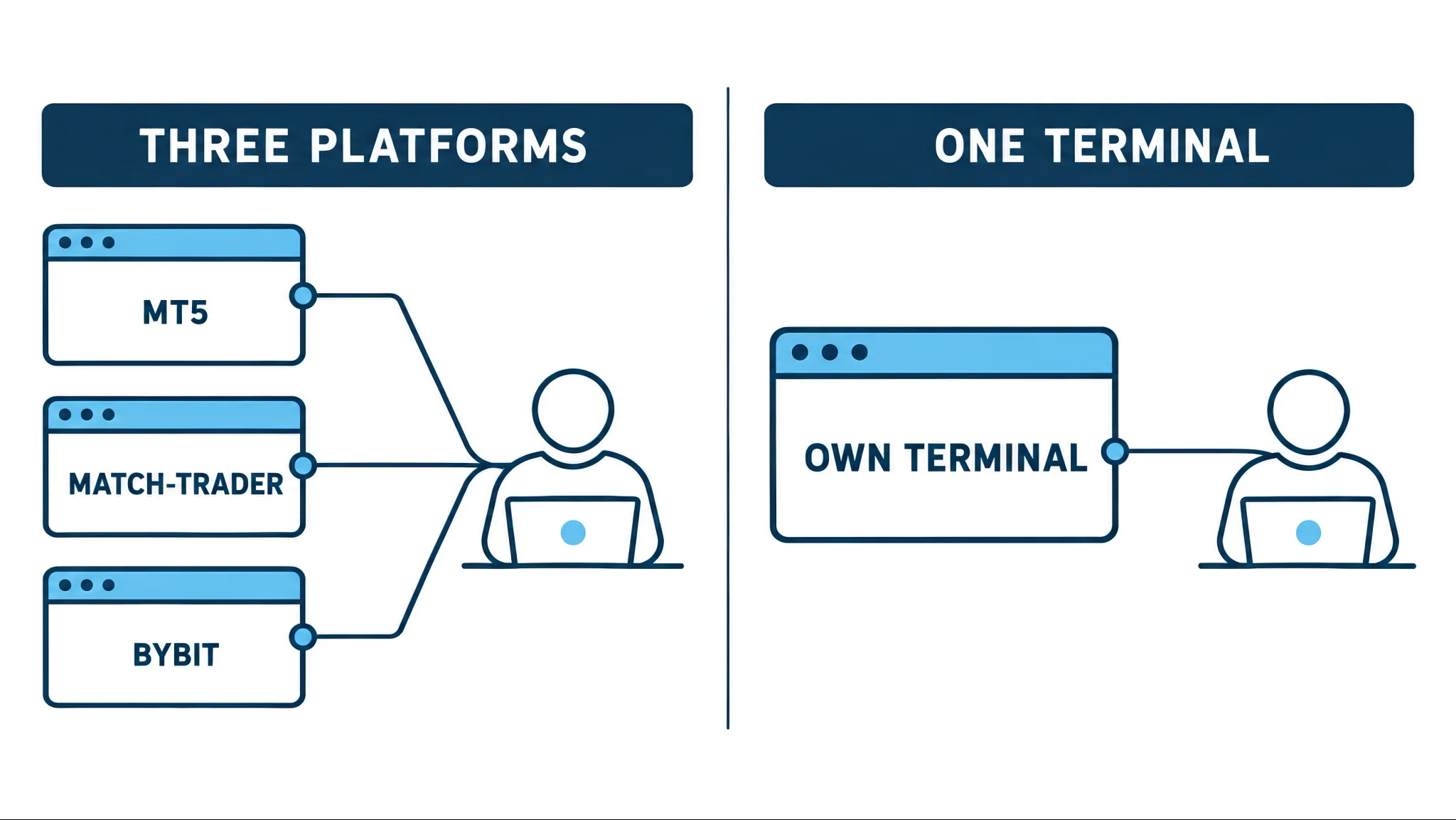
Crypto Fund Trader wins on platform and market breadth, the criterion that separates it from Breakout most. Crypto Fund Trader offers up to 715 crypto pairs on MT5, Match-Trader or Bybit, plus forex, indices and stocks. Breakout offers 63 markets, 60 of them crypto contracts, on its own terminal in the Kraken group. Breakout wins on entry price ($20 against $40) and on payout timing, on demand from $50.
Crypto Fund Trader asks less upfront at $100,000, $199 for its Break account, though a $328 activation fee after passing brings it to $527 against Breakout’s $330 Turbo, and it sells an instant plan that scales to $1.28 million. Both firms run every account on simulated capital in every phase, by their own terms.
Nine differences follow, ordered by weight, then the prices by size, the rules side by side, the payout terms, who can join, the trust evidence and the conditions under which each firm is the right choice.
| attribute | Crypto Fund Trader | Breakout | edge |
|---|---|---|---|
| platforms | MT5, Match-Trader, Bybit venue | Breakout Terminal | Crypto Fund Trader |
| markets | up to 715 crypto pairs (715 on Bybit, 540 on MT5 and Match-Trader); 900+ instruments incl. forex, indices, stocks, commodities | 63 markets: 60 crypto contracts plus indices and commodities | Crypto Fund Trader |
| models | Instant (scales to $1.28M), 1-Phase, 2-Phase, Ascend, Break | 1-Step Classic, Pro, Turbo; Spark | depends |
| entry price ($5,000) | $40 (1-Phase); $58 (2-Phase); $1 trial for $1,000 | $20 (Turbo); $45 (Classic) | Breakout |
| $100,000 | $199 upfront + $328 after passing (Break, $527 in full); $619 (1-Phase); $660 (2-Phase) | $330 (Turbo); $800 (Classic) | Breakout in full |
| daily limit | 5% (2-Phase) / 4% (1-Phase), 00:05 UTC from the balance | 3%, 00:30 UTC from the balance excluding open positions | Crypto Fund Trader on room |
| maximum drawdown | 10% static (2-Phase); 6% trailing (1-Phase) | 6% / 5% / 3% static | depends by model |
| consistency rule | 40% on Break only | none | Breakout |
| payout timing | after 15 traded days or 30 calendar days | on demand from $50 | Breakout |
| payout methods | bank, USDT (ERC-20, TRC-20), BTC, ETH | USDC on Ethereum only | Crypto Fund Trader |
| US access | partial: no MT5 for US residents | not listed as restricted | depends |
| BTC leverage | up to 1:100 (1:5 on smaller MT5 and Match-Trader accounts) | 10x | depends |
Pick Crypto Fund Trader if you… want MT5 or Bybit and altcoin breadth · want a bank payout or a choice of two USDT networks · want the instant scaling path, or the Break account at $199 upfront plus $328 after passing and can live with its 40% consistency rule.Crypto Fund Trader review →Visit Crypto Fund Trader →
Pick Breakout if you… want on-demand payouts from $50 · want the cheapest 1-step entry and static drawdown on every standard plan · trade a small set of major coins and can receive USDC on Ethereum.Breakout review →Visit Breakout →
What is the difference between Crypto Fund Trader and Breakout?
Crypto Fund Trader and Breakout differ in nine ways that change what you pay or how you can fail, and the first is breadth. Crypto Fund Trader is a crypto prop firm run by SWISS RLCRATES AG in Zug, Switzerland, per its terms, whose unique attribute is the widest instrument set in the census on three platforms, all on demo capital by its own FAQ.
Breakout is a crypto prop firm sold by Breakout Trading Group, LLC in Delaware and funded by Payward Oceanic Ltd. in the Kraken group, whose unique attribute is the shortest rulebook in the census.
- Platforms and markets: Crypto Fund Trader trades up to 715 crypto pairs and more than 900 instruments on MT5, Match-Trader or a Bybit sub-account; Breakout trades 63 markets on its own terminal. Both firms’ terms describe every phase as simulated, so the decider is breadth and venue, not real money against demo money.
- Models: Crypto Fund Trader sells Instant, 1-Phase, 2-Phase, Ascend and Break, with the Instant account scaling from $2,500 to $1,280,000 in 10% steps; Breakout sells three 1-step plans and the trailing Spark.
- Entry price: Breakout’s Turbo starts at $20 for $5,000; Crypto Fund Trader’s 1-Phase starts at $40, and its $1 trial buys a $1,000 evaluation.
- Drawdown: Crypto Fund Trader’s 2-Phase allows 5% daily from the balance at 00:05 UTC under a 10% static maximum, and its 1-Phase allows 4% daily under a 6% trailing maximum; Breakout allows 3% daily from the balance excluding open positions at 00:30 UTC under a static 6%, 5% or 3% maximum.
- Payout timing: Crypto Fund Trader pays after 15 traded days or every 30 calendar days, weekly with an add-on; Breakout pays on demand once $50 of net profit accrues.
- Payout methods: Crypto Fund Trader pays by bank in EUR or USD, USDT on Ethereum or Tron, BTC or ETH; Breakout pays USDC on Ethereum only.
- US access: Crypto Fund Trader accepts US residents on Match-Trader and Bybit but not MT5; Breakout does not list the United States as restricted.
- Consistency rule: Crypto Fund Trader caps any single day at 40% of profit on Break accounts only; Breakout has none.
- Leverage: Crypto Fund Trader offers leverage up to 1:100 on crypto on Bybit and its larger MT5 and Match-Trader accounts, and 1:5 on the rest. Breakout’s leverage is 10x on BTC, 5x on ETH and the majors, and 2x to 3x on smaller coins, per its announcement of 12 August 2026.
The full record of Crypto Fund Trader’s values, with the source and date for each, is in its review, the Crypto Fund Trader review; the difference most buyers weigh first is the price, and the next section prices both firms by size.
Which is cheaper, Crypto Fund Trader or Breakout?
Breakout is cheaper than Crypto Fund Trader on its Turbo at every size, $20 against $40 at $5,000 and $330 against the Break’s $527 in full at $100,000. On the static-floor pair the page treats as like-for-like, Crypto Fund Trader’s 2-Phase against Breakout’s Classic, Breakout is cheaper up to $25,000 and Crypto Fund Trader from $50,000 ($389 against $400, then $660 against $800).
Crypto Fund Trader’s 1-Phase at $619 undercuts Classic by $181 at $100,000 but carries a trailing floor, so the answer turns on size and model.
| Plan | $3K | $5K | $10K | $25K | $50K | $100K | $200K |
|---|---|---|---|---|---|---|---|
 Crypto Fund Trader · instant | $125 | $240 | $475 | — | — | — | — |
| Crypto Fund Trader · 1-phase | — | $40 | $80 | $219 | $369 | $619 | $1,199 |
| Crypto Fund Trader · 2-phase | — | $58 | $110 | $240 | $389 | $660 | $1,250 |
| Crypto Fund Trader · ascend | — | $45 | $90 | $225 | $450 | $899 | $1,798 |
| Crypto Fund Trader · break | — | — | — | $70 + $138 after passing | $139 + $198 after passing | $199 + $328 after passing | — |
 Breakout · classic | — | $45 | $85 | $215 | $400 | $800 | — |
| Breakout · pro | — | $33 | $65 | $150 | $280 | $545 | $1,090 |
| Breakout · turbo | — | $20 | $40 | $95 | $180 | $330 | $660 |
| Breakout · spark | — | — | — | — | $139 | — | — |
Values from each firm's own pages, checked by PropRubric
Add-ons and refunds change the total: Crypto Fund Trader sells a weekly-payout add-on and publishes no refund; Breakout sells a 90% split add-on, refunds nothing, and lets the payout balance buy a new evaluation. The Break evaluation costs $199 upfront for $100,000 plus a $328 activation fee after passing, $527 in full, and carries the 40% consistency rule.
The 1-Phase at $619 carries a trailing maximum drawdown that Breakout’s Classic at $800 does not, so the like-for-like row is the 2-Phase’s static 10% against Classic’s static 6%, at $660 against $800.
How do Crypto Fund Trader’s and Breakout’s rules compare?
Crypto Fund Trader’s and Breakout’s rules differ on eleven rows of the table and match on three, and the row that decides the most is the drawdown type by model.
| Rule | Crypto Fund Trader | Breakout |
|---|---|---|
| Daily drawdown ● | 2-phase: 5%; 1-phase: 4%; instant: 4% | classic: 3%; pro: 3%; turbo: 3%; spark: none |
| Daily reset (UTC) ● | 00:05 | 00:30 |
| Maximum drawdown ● | 10% | classic: 6%; pro: 5%; turbo: 3%; spark: $1,500 trailing |
| Drawdown type ● | static (2-phase) | classic/pro/turbo: static from initial balance; spark: trailing $1,500 below the closed-balance high, updated daily at 00:30 UTC; never locks |
| Per-trade loss cap ● | none on the standard models | none |
| Stop-loss required ● | no (general rules) | no |
| Consistency rule ● | 40% single-day profit cap — break accounts only | none |
| Profit target ● | 2-phase: 8% then 5%; 1-phase: 10%; instant: 10% | classic: 10%; pro: 12%; turbo: 9%; spark: $3,000 (6%) |
| Minimum trading days | 0 | 0 |
| Time limit ● | indefinite | unlimited (90 days without a trade suspends a funded account) |
| Weekend trading ● | yes — 'regardless of the account type or instrument'; overnight swap charged on positions open at 00:00 UTC on MT5 and 22:00 UTC on Match-Trader (example: about $3.40 per BTC lot per night); on the Bybit account only Bybit's funding rate applies, no CFT markup | yes |
| Hedging ● | Not published | within one account allowed (Hedge Mode on by default); across accounts or traders prohibited |
| Copy trading ● | Not published | not allowed (third-party signals and cross-user copying prohibited) |
| Leverage ● | up to 1:100: Bybit accounts up to 1:100; on MT5 and Match-Trader, 1:100 on 'Advanced' accounts ($50K–$200K 2-Phase, $100K–$200K 1-Phase) and crypto 1:5 on all other accounts (smaller 2-Phase and 1-Phase, Instant, Ascend, Break) | BTC: 10x; ETH, SOL, XRP, BNB, DOGE and ~20 others: 5x; ENA, HYPE, PEPE and ~8 others: 3x; smaller alts: 2x; XYZ100/S&P500: 10x; spark indices: up to 40x |
| Account limits ● | Not published | $200,000 total across funded accounts |
The drawdown type is the worked example. On a $10,000 Crypto Fund Trader 1-Phase account that rises to $10,400, the trailing drawdown floor moves from $9,400 to $9,776 ($10,400 × 0.94), so a $600 slide to $9,800 survives with $24 of room, and a $625 slide breaches. On a $10,000 Breakout Classic account after the same gain, the static floor stays at $9,400 and the $600 slide leaves $400 of room.
On the Crypto Fund Trader 2-Phase the floor is static at $9,000 and the room is larger still, as the table shows. The three matching rows of the table are the stop-loss, which neither firm requires, the minimum trading days, zero at both, and the time limit, indefinite at one and unlimited at the other.
Breakout’s own values for every row of the table, and the four document conflicts its review found, are in the Breakout review.
Which pays out faster, Crypto Fund Trader or Breakout?
Breakout pays out sooner than Crypto Fund Trader, on demand once $50 of net profit accrues against Crypto Fund Trader’s 15 traded days or 30 calendar days, and Crypto Fund Trader offers the wider set of rails.
| Payout term | Crypto Fund Trader | Breakout |
|---|---|---|
| Payout terms ● | methods: bank EUR/USD · USDT ERC20 · USDT TRC20 · BTC · ETH; frequency: after 15 traded days or every 30 calendar days (weekly with add-on); processing: ~8 hours average, up to 48 business hours | frequency: on demand, 24/7; min usd: 50 (after split); method: USDC on Ethereum (ERC-20) only; speed: approval 12–24h, usually quicker; conditions: no open positions; not breached; KYC done |
| Initial split ● | 50–80% | 80% |
| Maximum split | 90% | 90% |
| Payout proof ● | Not published | public payout leaderboard (lifetime payouts by trader name); not on-chain links |
| Fee refund ● | Not published | none — evaluation fees are non-refundable |
The condition on Crypto Fund Trader’s side is eligibility, unchanged by its September 2026 speed announcement; the condition on Breakout’s side is the rail, USDC on Ethereum with no alternative. Neither firm’s payouts on any rail are listed by an independent tracker in the pages PropRubric read.
Who can join Crypto Fund Trader and Breakout?
Both firms accept US residents in some form and verify identity late in the cycle, with one platform exception on Crypto Fund Trader’s side and none on Breakout’s.
| Access | Crypto Fund Trader | Breakout |
|---|---|---|
| US residents ● | partial — MT5 not available to US residents; Match-Trader and Bybit allowed | not listed as restricted |
| Restricted countries ● | Not published | Afghanistan · Belarus · Myanmar · Cambodia · Central African Republic · Cuba · DR Congo · Ethiopia · Eritrea · Haiti · Iran · Iraq · Lebanon · Libya · Nicaragua · North Korea · Russia · Somalia · South Sudan · Sudan · Syria · Venezuela · Zimbabwe · Ukraine (Crimea, Donetsk, Luhansk) |
| KYC timing ● | mandatory KYC form before any reward (scholarship) is processed (terms §3.1.11); FAQ: before the first reward | none to buy or trade the evaluation; mandatory before the funded account or any payout (SumSub: photo ID + selfie, proof of residence if applicable) |
| Platforms ● | MT5 · Match-Trader · Bybit | Breakout Terminal (proprietary; DXtrade legacy only) |
| Legal entity ● | SWISS RLCRATES AG (CHE-162.567.204), Bahnhofstrasse 21, 6300 Zug, Switzerland; governing law Switzerland, disputes to the courts of Zug (terms §12, §16); offices stated on the homepage: Zug, Pamplona, Dubai | Breakout Trading Group, LLC, a Delaware limited liability company (evaluations); Payward Oceanic Ltd., BVI (funded accounts) |
A US trader at Crypto Fund Trader chooses Match-Trader or Bybit at checkout; a Breakout trader in any of its 24 restricted countries cannot open an account at all.
Is Crypto Fund Trader or Breakout more trustworthy?
Breakout discloses more about itself than Crypto Fund Trader, and both are operating crypto prop firms with published rules and prices. Breakout names its two companies and its exchange-group owner; Crypto Fund Trader names SWISS RLCRATES AG, Zug, in its terms, and no officer is named in its own documents.
| evidence | Crypto Fund Trader | Breakout |
|---|---|---|
| operator | SWISS RLCRATES AG (Zug, Switzerland; CHE-162.567.204), per the firm’s terms; CEO Alan Sanchez per PropFirmMatch | Breakout Trading Group, LLC (Delaware); Payward Oceanic Ltd. (BVI, Kraken group) |
| operating since | November 2022 (per PropFirmMatch and the firm’s Instagram) | 2023; Kraken-owned since 1 Sep 2025 |
| payout proof | none outside the firm; the “proof of reserves” page is a table of users’ simulated performance | leaderboard; no third-party tracker entry |
| capital disclosure | “It’s all demo, no real capital involved” (homepage) | “a demo account funded with simulated capital” (help centre); A- or B-booking at the firm’s discretion |
| contradictions found | “proof of reserves” vs its content; store names vs FAQ model names | leverage annex vs announcement; “no approval delays” vs 12–24 hours; three country lists |
| change log rows | 15 (0 firm changes) | 10 (7 firm changes) |
| shared programme | — | Breakout and Kraken Prop are one programme sold through two storefronts |
No neutral page compared this pair at PropRubric’s last check; the nearest, a four-firm listicle, showed a Breakout price that differed between its page and its search snippet.
Should you choose Crypto Fund Trader or Breakout?
Crypto Fund Trader is the choice for a trader who buys breadth, platform choice and payout rails, and Breakout is the choice for a trader who buys on-demand payouts, the cheapest entry and a static floor on every standard plan. Breakout wins the price, payout-timing and consistency-rule rows; Crypto Fund Trader wins the platform, market and payout-rail rows.
Choose Crypto Fund Trader if you:
- trade altcoins beyond the top 60, or forex, indices and stocks on the same account;
- want MT5, Match-Trader or a Bybit sub-account rather than a proprietary terminal;
- want a bank payout, or USDT on Tron, or BTC or ETH;
- want the Break account for $100,000 at $199 upfront ($527 with the activation fee after passing) and can keep every day under 40% of the profit, or the instant scaling path.
Choose Breakout if you:
- want payouts on demand from $50 rather than after 15 traded days;
- want the cheapest 1-step entry at $20 for $5,000;
- want a static maximum drawdown on every standard plan, with no trailing floor on the cheaper model;
- can receive USDC on Ethereum and accept an approval of up to 24 hours.
The closest alternatives differ on exactly the venue and the payouts, for a trader whom neither firm’s breadth or terminal fits.
What if neither Crypto Fund Trader nor Breakout fits?
Three alternatives differ from the pair on venue and payouts, and each card names the attribute.
- HyroTrader: your own Bybit or BloFin demo account through an API, or its Hyro platform, payouts on demand once the funded account is in profit with on-chain transaction IDs for its Solana payouts, from $59; a UAE and BVI firm with a static floor on every model and no per-trade cap.
- Kraken Prop: the same programme as Breakout, sold inside Kraken Pro at $20 for $5,000 with payouts to a Kraken wallet; the same two limits, no API, and Canada, India and the United Kingdom restricted.
- Klein Funding: your own Bybit account connected by API for tracking, a static maximum on its Bybit One-Step and Two-Step from $52.25, and payouts in 4 to 24 hours; a Delaware-registered firm.
The model that separates the pair most, an account funded from day one without an evaluation, is compared across every firm on the list of instant funding crypto prop firms. The best fit across every need is on the shortlist of the best crypto prop firms. The firms that fix Breakout’s single payout rail are listed among the Breakout Prop alternatives, and every other pair on the site is on the hub where you can compare two crypto prop firms.