Crypto Prop Firm Rules Compared: All 28 Firms (2026)
Crypto prop firm challenges are decided by eight rules; the most common set is a 3% to 5% daily drawdown, a 6% to 10% static maximum drawdown and no stop-loss requirement, but reset times, loss caps and leverage differ firm by firm. The matrix below puts every firm’s rules side by side, the eight rules are then compared one at a time with the range, the most common value and the outliers.
The crypto rules are set against forex rules in five rows, and the most lenient rulebooks are ranked by a published score. The pass and payout rates that the rules produce are stated with their sources, and the last two sections say how to check one firm’s rules before you buy and where each rule is treated in depth.
Once you know the rules, choose a crypto prop firm that fits them best, from the ranked list of the best crypto prop firms.
| Firm | Daily DD | Reset (UTC) | Max DD · type | Per-trade cap / stop-loss | Consistency | Min days | News | Weekend | Leverage |
|---|---|---|---|---|---|---|---|---|---|
 AquaFunded (Crypto) | 3–5% | not published | 5–12% · mixed by plan | Not published | instant-flex: none ("Instant Flex has no consistency… | 3 per step | Not published | allowed; crypto 24/7 incl. weekends | crypto evaluation: 1:2; crypto funded: 1:2 (Old Instant Standard: 1:1) |
 Bitfunded | 3–5% | not published | 3–10% · static | Not published | Not published | 0 | Not published | yes — '24/7 and there's no weekend… | 1x–5x |
 Breakout | 3% | 00:30 UTC | 3–6% · mixed by plan | no per-trade cap; no stop-loss required | none | 0 | Not published | yes | BTC: 10x; ETH, SOL, XRP, BNB, DOGE and ~20 others: 5x; ENA, HYPE… |
 BrightFunded | 3–5% | not published | 6–10% · mixed by plan | no stop-loss required | none — "we do not currently enforce a consistency rule" | 2-step: 5 days | 5-minute restriction around news | crypto may be traded and held over… | crypto: 1:5; forex: 1:100 |
 Cointracts | 4–5% | not published | 6–10% | Not published | funded: 50% Profit Day Ratio: best single day strictly… | 1-step: 0; 2-step: 3 per phase | Not published | yes — overnight and weekend positions… | 1:5 |
 Crypto Fund Trader | 4–5% | 00:05 UTC | 10% · mixed by plan | no per-trade cap; no stop-loss required | 40% single-day profit cap — break accounts only | 0 | Not published | yes — 'regardless of the account type… | up to 1:100: Bybit accounts up to 1:100; on MT5 and Match-Trader… |
 Dolvero | 3–4% | 00:00 (UTC day) | 6% · mixed by plan | cap 2% of starting balance per position (read from closed… | no single day > 15% of the profit that gets you funded… | 5 days, each closing ≥ +0.5% of the… | yes on crypto accounts (per the crypto… | allowed on crypto accounts | up to 50:1 |
 E8 Markets | 2.5–3% | 00:00 server time (zone not stated in the help centre) | 6–8% · dynamic (One) · static (Pro) | no stop-loss required | e8-one: 40% best-day rule at payout (funded only); e8-pro:… | Not published | e8-one: challenge yes; funded no (±5… | yes on E8 One and E8 Pro | perpetual BTC/ETH: 1:15; perpetual other crypto: 1:2… |
 FTMO | 3–5% | 00:00 CE(S)T (22:00/23:00 UTC) | 10% · static (2-Step) · EOD trailing (1-Step) | no stop-loss required | 1-step: Consistency rule: best day may not exceed 50% of… | 2-step: 4 trading days per phase… | Standard funded accounts only: no… | evaluation: trading and holding… | crypto standard: 1:3.33; crypto swing: 1:1 |
 Funded Trader Markets | 4% | 5 PM New York time | 6–10% · trailing (Nitro) · static (2-Step Plus) | cap 2-step-plus & instant-plus: 'Shield Risk Protocol':… | 1-step-nitro: challenge: no day > 50% of the target… | Not published | Not published | yes; crypto enabled at weekends on all… | BTC & ETH: 1:5; other crypto: 1:2 |
 Fundedbit | 3–5% | 00:15 UTC | 6–10% · mixed by plan | cap total open risk on any single pair capped at 2% of… | 1-step funded: best day ≤ 40% of the profit of all… | 1-step: 4 (challenge); 2-step: 4… | yes | yes — 'you can hold positions… | 1:30 on all challenges |
 FundingPips | 2–5% | 21:00 (00:00 platform time, UTC+3) | 5–12% · mixed by plan | cap Responsible Trading Policy (terms, Appendix A): "Your… | zero (instant): 15% consistency score before each reward… | 3 trading days to pass (1 Step and 2… | restricted: no opening/closing within… | evaluation (1 Step Flex, 2 Step… | crypto evaluation: 1:2 (swap-free/swing 1:1); crypto master… |
 Goat Funded Trader | 3–5% | 5 PM New York time | 6–10% · static | no stop-loss required | evaluation models (1-step, 2-step standard/GOAT/PRO… | 3 per evaluation step; funded: 4 days… | unrestricted only on the Swing account | holding allowed; profits from trades… | crypto evaluation: 1:2; crypto funded: 1:2 |
 HyperPNL | 3–5% | 00:00 UTC | 5–9% · static | no per-trade cap; no stop-loss required | none | 1-step: 0; 2-step: 2 profitable days… | yes | yes — overnight and weekend holding… | crypto: up to 20x; fx: up to 50x; indices: up to 50x (+2) |
 HyroTrader | 3–5% | 00:00 UTC | 5–10% · static | no per-trade cap; no stop-loss required | 1-step: evaluation only: one trading day (net of all… | zero-step: 1; 1-step: 5; 2-step: 5 per… | Not published | yes — 'Nothing is closed for you at… | Bybit (own demo account via API): up to 150x on BTC and ETH… |
 Klein Funding | 3% | 00:05 UTC | 3–6% · mixed by plan | no per-trade cap; no stop-loss required | bybit: Stability Score: no single day's profit may equal… | evaluation: 0; instant-pro payout: 3… | Not published | yes — "the cryptocurrency market… | bybit: 'Bybit offers leverage up to 1:100 for most of the tradeable… |
 Kraken Prop (Kraken Pro) | 3% | 00:30 UTC | 3–6% · mixed by plan | no per-trade cap; no stop-loss required | none | 0 | Not published | yes; margin funding 0.033%/day charged… | BTC, ETH: 5x; other crypto: 2x; lite_indices: up to 40x (XYZ100, S&P… |
 Mubite | 3–5% | not published | 8–10% · mixed by plan | cap 3% of the equity at the moment the trade opened, on… | challenge: none ("Mubite does not enforce any consistency… | two-step: 13 days (rules page… | Not published | yes — overnight and through weekends | 1:100 |
 Propr | 3–5% | 00:00 UTC | 3–8% · mixed by plan | no per-trade cap; no stop-loss required | none | 0 | yes | yes | BTC/ETH/SOL perps: 10x; other crypto perps: 2x; equity perps: 4x (+5) |
 PropW | 4–5% | trading day counted in UTC+8 (16:00 UTC) | 6–10% · static | Not published | one-step: Consistency Ratio (max single-day net profit ÷… | 3 profitable days, each above a… | Not published | yes by default (no weekend or… | 5x on all pairs |
 RebelsFunding | 4–5% | not published | 6–10% · fixed | cap RCF (funded) accounts: a 1.5% maximum-risk rule per… | Not published | at least 5 'real trades' in every… | Not published | crypto positions may be held over the… | crypto: 1:2.5 |
 SizeProp | 2–3% | 20:00 UTC | 3–5% · static | no per-trade cap; no stop-loss required | none | 0 | yes | yes — overnight and weekend holding… | BTC, XAUT, SPCX: 5x; all others incl. ETH: 2x |
 The5ers | 3–5% | not published | 6–10% · static | Not published | standard programs: Not published; summer-plan: 50%: 2-step… | Not published | holding through news allowed… | allowed (indices carry high weekend… | 2-step High Stakes: 1:100 account; crypto 1:2; 1-step Growth… |
 Tradeify 247 | 3% | 22:00 UTC | 6% · mixed by plan | no per-trade cap; no stop-loss required | 2-step: none; 1-step: none; instant: 20% consistency score… | 2-step: none in evaluation; 3… | yes — 'allowed on Tradeify 247 with no… | yes — positions may be held through… | BTC/ETH/PAXG + commodities: evaluation: 5x; instant: 2x; altcoins… |
 TradeXProp | 3% | 21:00/22:00 (5 PM New York time) | 6–9% · static | no stop-loss required | 45% consistency score shown on the evaluation offer… | 0 | restricted — no opening positions… | yes | up to 5:1 |
 Upscale | 3–5% | 00:00 UTC | 6–10% · mixed by plan | no per-trade cap; no stop-loss required | 30% single-day cap on Turbo accounts and accounts with the… | basic: 3 profit days (Stage 1), 5… | yes | crypto 24/7; index positions opened in… | crypto: basic/accelerated: 5x; turbo: 2x; forex: basic/accelerated:… |
 Velotrade | 3–5% | 00:30 UTC | 3–10% · static | no per-trade cap; no stop-loss required | none | 5 qualifying days per phase, each… | yes | yes (0.05% daily funding on crypto… | BTC: challenge: 10x; funded: 5x; ETH: challenge: 6x; funded: 5x… |
 WenCrypto | 3–5% | 00:00 UTC | 4–8% · mixed by plan | no stop-loss required | genesis (instant): 20% consistency score before each… | single-pass: 3 winning days… | yes | yes — 'Weekend holdings are permitted… | BTC/ETH: 5x; alts: 2x |
Values from each firm's own pages, checked by PropRubric
n/p = not published by the firm in the documents PropRubric read. The matrix holds every checked value, and the eight sections below read it one rule at a time.
What are the rules of a crypto prop firm challenge?
A crypto prop firm challenge has eight kinds of rules, and every firm in the matrix publishes at least five of them.
- a profit target that ends each phase;
- a daily drawdown, with its reset time;
- a maximum drawdown, static or trailing;
- a stop-loss or per-trade loss rule;
- a consistency rule;
- a minimum number of trading days and a time limit;
- a leverage cap per market;
- restrictions on strategies: news, weekends, hedging, copy trading, bots and multiple accounts.
Each rule below is stated with its range, its most common value and its outliers across the 28 firms, and the first rule is the one every challenge starts with.
What profit target do crypto prop firms set?
Crypto prop firms set profit targets between 5% and 12% per phase; 10% is the most common 1-step target, used by 14 of the 28 firms, and 8% then 5% is the most common 2-step pair.
| model | minimum | most common | maximum |
|---|---|---|---|
| 1-step | 6% (Klein Funding’s Bybit One-Step) | 10% (HyroTrader, Crypto Fund Trader, Breakout Classic, Kraken Prop Starter, Bitfunded, Fundedbit, PropW, Cointracts, HyperPNL, Propr Classic, SizeProp, Velotrade, Dolvero, FTMO) | 12% (Breakout Pro, Kraken Prop Intermediate, Propr Pro, Tradeify 247) |
| 2-step | 5% then 8% (Upscale Basic) · 5% in each of four phases (RebelsFunding Copper) | 8% then 5% (Crypto Fund Trader, Bitfunded, Cointracts, The5ers Classic, BrightFunded, AquaFunded, Funded Trader Markets, FundingPips) or 10% then 5% (HyroTrader, Mubite, Fundedbit, HyperPNL, Velotrade, Dolvero, FTMO, Goat Funded Trader, Tradeify 247) | 10% then 8% (FundingPips Flex) |
| no target | Upscale Turbo (Breakout Spark and Kraken Prop Lite set a dollar target instead: $3,000, 6% of $50,000) | — | — |
A higher target buys a wider floor at the firms that sell three 1-step tiers: Breakout’s Turbo asks 9% for a 3% drawdown, Classic 10% for 6%, Pro 12% for 5%, and Kraken Prop and Propr sell the same ladder. The target is the number a challenge is passed with, and the daily drawdown is the number most challenges are lost on.
How much daily drawdown do crypto prop firms allow?
Crypto prop firms allow daily drawdown between 2% and 5%; 5% is the most common limit on 2-step models, used by 12 crypto-first firms, and 3% the most common on 1-step models, used by 11.
| minimum | most common | maximum | none |
|---|---|---|---|
| 2% (SizeProp Degen); 2.5% (E8 Pro) | 3% on 1-step and turbo models · 5% on 2-step models | 5% | Breakout Spark, Kraken Prop Lite, Upscale Turbo (a trailing maximum drawdown instead) |
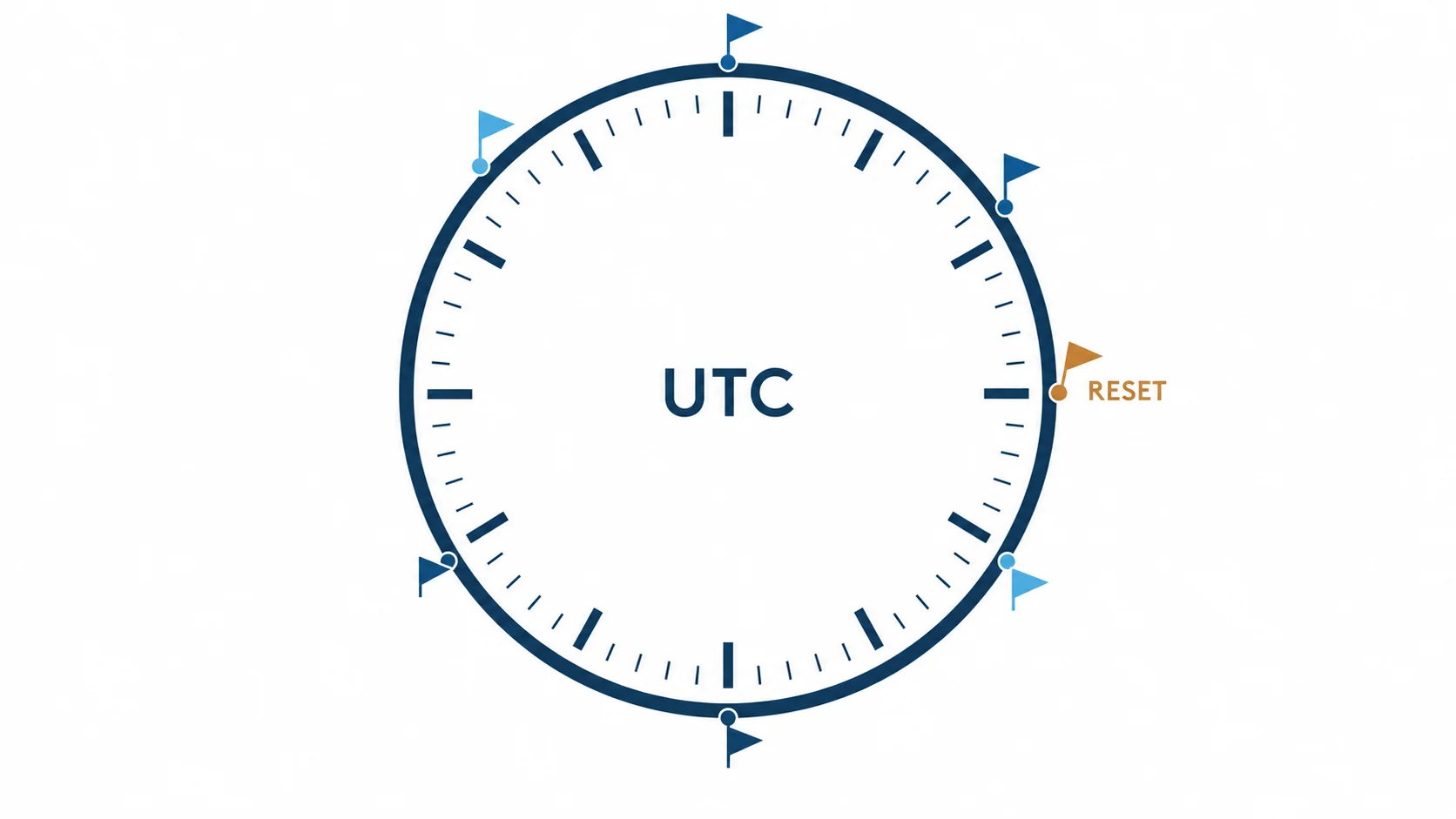
The limit is measured from the balance at the reset (Breakout, Crypto Fund Trader, Kraken Prop, SizeProp) or from the equity (HyperPNL, FTMO, and HyroTrader, which takes the equity at the start of the day on every challenge). The reset itself falls at ten different times across the firms PropRubric tracks. The reset times are 00:00 UTC (HyroTrader, HyperPNL, Propr, Upscale, Dolvero, WenCrypto), 00:05 (Crypto Fund Trader, Klein Funding), 00:15 (Fundedbit) and 00:30 (Breakout, Kraken Prop, Velotrade).
The later reset times are 16:00 (PropW, whose trading day runs on UTC+8), 20:00 (SizeProp), 21:00 (FundingPips, midnight UTC+3), 22:00 (Tradeify 247), 5 PM New York time (TradeXProp, Funded Trader Markets, Goat Funded Trader) and midnight Central European time (FTMO). E8 Markets resets at server midnight and does not name the zone of its reset time.
Three crypto-first firms (Bitfunded, Mubite, Cointracts) and four multi-asset firms have not published a reset time. The reset time, the reference and the trailing daily limit are worked through with examples on the page about daily drawdown in crypto prop challenges.
How much maximum drawdown do crypto prop firms allow?
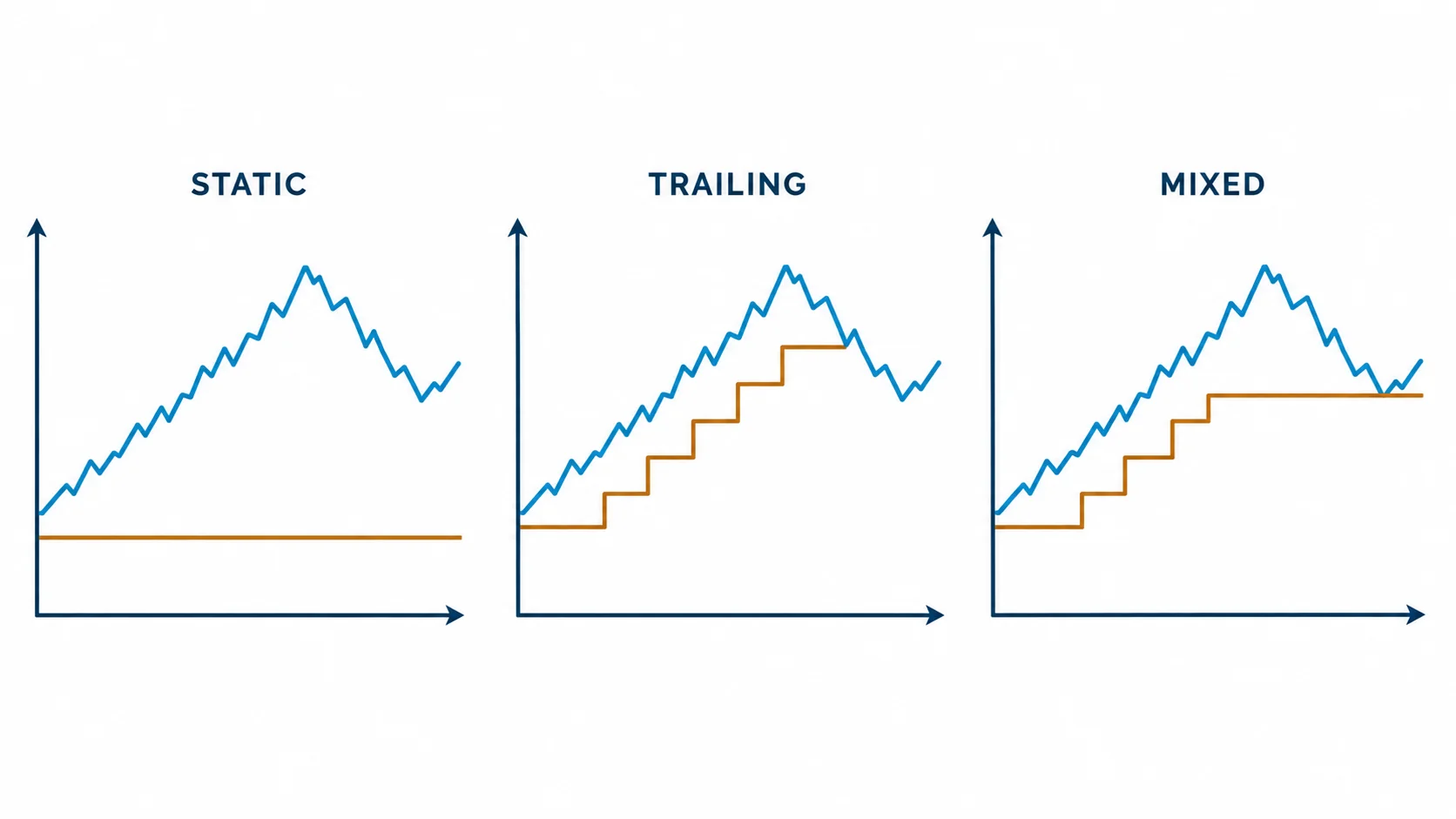
Crypto prop firms allow maximum drawdown between 3% and 10%; 6% is the most common 1-step limit and 10% the most common 2-step limit. The limit is static on at least one model at all 27 firms that publish the type, and the choice of static vs trailing is the one most traders ask about.
| minimum | most common | maximum | type split (firms publishing a type) |
|---|---|---|---|
| 3% (Breakout Turbo, Kraken Prop Advanced, Propr Turbo, Velotrade Pro, SizeProp Degen, Klein Flex, Bitfunded Express) | 6% (1-step) · 10% (2-step) | 10% (Crypto Fund Trader, Mubite, Fundedbit, PropW, Cointracts, Velotrade Classic 2-step, Upscale Basic, FTMO, The5ers, Rebels, Funded Trader Markets Plus, Goat 2-step, HyroTrader Two-Step) | static on every published model: 9 · static and trailing by model: 18 · trailing only: 0 · not published: 1 (Cointracts) |
A static limit is fixed at a set amount below the starting balance and never moves; a trailing limit follows the account’s highest balance or equity, so profit shrinks the room. The firms that mix the two put the trailing floor on the cheaper or faster model (Breakout Spark, Kraken Prop Lite, Propr 2-step, Upscale Turbo, Dolvero 1-step, Tradeify 247 Instant Funding).
The same six days of trades pass under one floor and fail under the other in the worked examples on the page about trailing vs static drawdown, and those examples use the same account sizes as this page.
A maximum limit of either type caps the whole account; the next two rules cap a single trade and a single day’s share of the profit.
Do crypto prop firms require a stop-loss?
No, none of the 21 crypto prop firms that publish a stop-loss rule requires a stop-loss order at PropRubric’s last check, but 6 cap the loss or the risk on a single trade. The other 7 firms in the matrix do not state a stop-loss rule either way. Their silence on the rule is recorded as “not published”, not as “no”.
Fifteen crypto-first firms publish “no stop-loss required”: HyroTrader, Crypto Fund Trader, Breakout, Kraken Prop, Mubite, Klein Funding, WenCrypto, Fundedbit, TradeXProp, HyperPNL, Propr, SizeProp, Upscale, Velotrade and Tradeify 247. Six multi-asset firms publish the same rule: E8 Markets, FTMO, BrightFunded, RebelsFunding, Goat Funded Trader and FundingPips. The per-trade caps that replace a stop-loss order at these firms are six.
Mubite caps the realized loss on one position at 3% of equity, Fundedbit at 2% of balance as the total open risk on one pair, Dolvero at 2% of the starting balance per position. RebelsFunding caps the risk of one trade at 1.5% on funded accounts, and FundingPips’ policy caps the largest losing trade at 1% of the account size. Funded Trader Markets applies its Shield Risk Protocol on its Plus and Instant Plus plans.
HyroTrader is the example of a plan rule that changed: the firm dropped its mandatory stop-loss requirement in 2026 and removed its 3% per-trade cap in its October 2026 relaunch, so its daily and maximum floors are now its only loss limits. A cap on one trade limits how a day is lost; a consistency rule limits how a challenge is won.
Which crypto prop firms have a consistency rule?
19 of the 28 crypto prop firms publish a consistency rule on at least one plan, 7 state that they apply none, and 2 publish nothing either way; the typical rule caps the share of total profit that any single day may hold at 40%.
| rule | firms |
|---|---|
| none, stated | Breakout, Kraken Prop, HyperPNL, Propr, SizeProp, Velotrade, BrightFunded, FTMO 2-step, Goat Funded Trader evaluation models (with a $3,000 daily profit cap instead) |
| 40% | HyroTrader (of the profit target, evaluation phases only; 50% of the target per trade on Zero-Step; the excess stops counting, not a breach), Crypto Fund Trader (Break accounts only), Fundedbit (1-step funded), Mubite Two-Step (Funded Score, funded only; 30% on One-Step, 25% on Instant), E8 One (funded), Tradeify 247 One Step Daily (evaluation; 20% on Instant Funding at payout) |
| other caps | Dolvero 15% (of the profit that funds you; gates promotion only), Klein Funding’s Stability Score (best day under 45% on 2-phase, under 30% on 1-phase), PropW 40% One-Step and 45% Two-Step (Consistency Ratio), TradeXProp 45%, Cointracts 50% Profit Day Ratio (funded, against positive days only), The5ers 50% (Summer Plan), Upscale 30% (Turbo and API option), WenCrypto 20% before each withdrawal (BNPL funded and Genesis), FundingPips 15% (Zero) and 35% (funded), AquaFunded 15% to 20% (Instant Pro), FTMO 50% of positive days’ profit (1-step orders before 12 Oct 2026; 50% of total profit from that date, not a breach) and 30% on the Instant Account, Goat Funded Trader 15% to 20% (Instant models), Funded Trader Markets 50% in the challenge and 45% funded (Nitro) |
| not published | Bitfunded, RebelsFunding |
The phase scope is the part of the rule most often missed. The scope is the evaluation phases only for HyroTrader’s 40%, Break accounts only for Crypto Fund Trader’s, and funded accounts only for E8’s and Fundedbit’s. The same percentage can therefore block a pass at one firm and a payout at another, depending on the phase scope. A consistency rule is measured over the days a challenge phase takes, and how many days that must be is the next rule.
How long do crypto prop challenges last?
Crypto prop firm challenges last as long as the trader needs at the 15 of the 28 firms that publish no time limit, and most require between 0 and 5 trading days before a pass counts.
| rule | minimum | most common | maximum |
|---|---|---|---|
| minimum trading days | 0 (Crypto Fund Trader, Breakout, Bitfunded, TradeXProp, Tradeify 247); none stated (Kraken Prop, Propr, SizeProp) | 3 to 5 (PropW 3 profitable days, WenCrypto 3 winning days, Cointracts 3 per phase, AquaFunded and Goat 3 per step, Fundedbit and FTMO 4, HyroTrader, Velotrade, Dolvero, BrightFunded and RebelsFunding 5) | 10 (Mubite’s pricing table; its rules page says 13 on the Two-Step) |
| time limit | none (HyroTrader, Crypto Fund Trader, Breakout, Kraken Prop, Fundedbit, PropW, Cointracts, TradeXProp, HyperPNL, Propr, SizeProp, Upscale, Velotrade, Tradeify 247, FTMO) | unlimited | 15 days on PropW’s $1,000 two-step |
| inactivity | one trade every 28 days (WenCrypto); 30 days (TradeXProp, Mubite, Velotrade, Tradeify 247) | 90 days without a trade suspends or ends the account (Breakout, Fundedbit, Upscale) | 90 days |
“Unlimited” almost always carries an inactivity clause, and Breakout’s, Fundedbit’s and Upscale’s 90-day clauses are the ones a trader who pauses meets. A pause costs the trader nothing in days or targets, which are the same at 2x and at 100x, and leverage is where the crypto firms differ most from each other.
How much leverage do crypto prop firms give?
Crypto prop firms give between 2x and 150x on BTC; 5x is the most common BTC leverage, used by 13 firms, and altcoins get 2x at most firms.
| pair group | minimum | most common | maximum |
|---|---|---|---|
| BTC | 2x (AquaFunded, Goat Funded Trader, FundingPips, The5ers) | 5x (Kraken Prop, Klein Funding Cleo, WenCrypto, PropW, Cointracts, TradeXProp, SizeProp, Upscale, Bitfunded, BrightFunded, Funded Trader Markets, Velotrade funded, Tradeify 247 evaluation) | 150x (HyroTrader on BloFin); 100x (Crypto Fund Trader, Mubite, HyroTrader on Bybit’s limits, Klein Funding on Bybit) |
| ETH | 2x (SizeProp, Kraken Prop and WenCrypto give 5x) | 5x | 150x (HyroTrader on BloFin); 100x (the same four firms) |
| majors (SOL, XRP, BNB, DOGE) | 2x | 5x at Breakout; 2x elsewhere | 100x; 10x on SOL at Propr |
| altcoins | 2x (Breakout’s smaller coins, Propr, WenCrypto, Funded Trader Markets, Tradeify 247) | 2x | 100x |
Perpetual-futures accounts carry the higher figures (HyroTrader’s up to 150x on BTC and ETH on BloFin, Crypto Fund Trader’s up to 1:100, HyperPNL’s 20x, Propr’s 10x) and crypto-CFD accounts at the multi-asset firms the lower figures (FTMO 3.33x, AquaFunded 2x).
The perpetual-futures figure at Breakout rose from 5x to 10x on BTC on 12 August 2026, in the firm’s words after “a full review of realized volatility and order book depth, market by market”. A leverage figure is a cap on size; the last kind of rule is a cap on what you may do.
Which strategies do crypto prop firms restrict?
Crypto prop firms restrict six strategies, and the matrix below counts, for each one, the firms that allow it, the firms that ban it and the firms that say nothing.
| Firm | News | Weekend | Hedging | Copy trading | Bots / API | Account limits |
|---|---|---|---|---|---|---|
| HyroTrader | Not published | yes — 'Nothing is closed for you at the end of… | Not published | Not published | Not published | Not published |
| Crypto Fund Trader | Not published | yes — 'regardless of the account type or… | Not published | Not published | Not published | Not published |
| Breakout | Not published | yes | within one account allowed (Hedge Mode on by… | not allowed (third-party signals and cross-user… | Not published | $200,000 total across funded accounts |
| Bitfunded | Not published | yes — '24/7 and there's no weekend restriction'… | Not published | Not published | Not published | Not published |
| Mubite | Not published | yes — overnight and through weekends | Not published | Not published | yes — "Automated trading bots and EAs are allowed" | Not published |
| Kraken Prop (Kraken Pro) | Not published | yes; margin funding 0.033%/day charged every 4… | not allowed across accounts | not allowed (checked at payout review) | no — no API access; all orders placed manually | $200,000 combined across all active evaluation… |
| Klein Funding | Not published | yes — "the cryptocurrency market operates 24/7" | Not published | Not published | no — EAs, bots and automated copy-trading… | $300,000 funded per trader; only one evaluation… |
| WenCrypto | yes | yes — 'Weekend holdings are permitted for all… | reverse/group hedging across accounts prohibited | not allowed | no — EAs, HFT and tick scalping prohibited | $100,000 combined per account type; $300,000… |
| Fundedbit | yes | yes — 'you can hold positions overnight and… | not allowed between accounts | Not published | no — EAs not allowed; HFT prohibited | unlimited accounts; $300,000 total funded |
| PropW | Not published | yes by default (no weekend or overnight ban… | Not published | Not published | Not published | Not published |
| Cointracts | Not published | yes — overnight and weekend positions allowed | not permitted within the same account, across… | allowed (FAQ, 2026-09-30) | yes — "EA, algorithmic, and copy trading are… | one profile; multiple challenges; one funded… |
| TradeXProp | restricted — no opening positions within 3… | yes | allowed within a single account ("not a… | prohibited, incl. EAs or third-party strategies… | Not published | Not published |
| HyperPNL | yes | yes — overnight and weekend holding allowed… | not allowed across accounts; one account per… | not allowed | Not published | one evaluation account at a time; one account… |
| Propr | yes | yes | not allowed across Propr accounts or against… | CONFLICT: rulebook §14 says copy trading is… | developer API published (propr.xyz/developers)… | multiple accounts allowed up to an aggregate… |
| SizeProp | yes | yes — overnight and weekend holding allowed | within one account only | not allowed | no — 'off-the-shelf strategies, scripts, or bots… | one paid account at a time (an evaluation or a… |
| Upscale | yes | crypto 24/7; index positions opened in the… | within one account only; not across accounts | Not published | yes, with the paid API Trading option (adds the… | combined $400K notional for Basic + Accelerated… |
| Velotrade | yes | yes (0.05% daily funding on crypto positions… | within one account allowed; across accounts or… | only between the trader's own accounts, or from… | yes — EAs and full DXtrade REST/WebSocket API on… | one profile per person; multiple challenges… |
| Dolvero | yes on crypto accounts (per the crypto rulebook) | allowed on crypto accounts | offsetting positions on the same or correlated… | not allowed (external signals end the account) | EAs allowed after compliance review (CFD rules)… | one account per customer |
| E8 Markets | e8-one: challenge yes; funded no (±5 min around… | yes on E8 One and E8 Pro | Not published | allowed between the trader's own accounts | EAs allowed on E8 One and E8 Pro | Not published |
| FTMO | Standard funded accounts only: no… | evaluation: trading and holding allowed on all… | Not published | Not published | Not published | Not published |
| The5ers | holding through news allowed; executing orders… | allowed (indices carry high weekend swaps) | Not published | Not published | Not published | Not published |
| BrightFunded | 5-minute restriction around news | crypto may be traded and held over weekends | Not published | Not published | Not published | up to $400,000 initially, with a scaling plan |
| AquaFunded (Crypto) | Not published | allowed; crypto 24/7 incl. weekends | Not published | Not published | Not published | Not published |
| RebelsFunding | Not published | crypto positions may be held over the weekend… | Not published | Not published | Not published | Not published |
| Funded Trader Markets | Not published | yes; crypto enabled at weekends on all platforms | Not published | Not published | Not published | Not published |
| Goat Funded Trader | unrestricted only on the Swing account | holding allowed; profits from trades opened in… | Not published | Not published | Not published | Not published |
| FundingPips | restricted: no opening/closing within 5 min of… | evaluation (1 Step Flex, 2 Step… | Not published | Not published | Not published | Not published |
| Tradeify 247 | yes — 'allowed on Tradeify 247 with no… | yes — positions may be held through weekends… | not allowed (same instrument, across own… | allowed (except to/from the 3-Step Promotional… | yes if the trader owns the bot; shared bots and… | unlimited evaluations; funded accounts capped at… |
The “not published” column is the honest count, and it is large because the crypto-first firms publish drawdown rules in full and strategy rules in FAQs that PropRubric reads but that do not always exist. The rules above are crypto rules; a trader arriving from a forex firm meets five of them in a different form.
How are crypto prop firm rules different from forex prop firm rules?
Crypto prop firm rules differ from forex prop firm rules in five places, and each one comes from the market’s hours or its instrument.
| difference | crypto prop firms | forex prop firms |
|---|---|---|
| market hours | 24/7, so the daily limit needs an invented anchor | closed Friday to Sunday, so the day ends with the market |
| reset time | a fixed UTC time per firm, nine across the firms PropRubric tracks | server midnight or 5 PM New York, moving with daylight saving |
| leverage | 2x to 10x on BTC at most firms, 100x to 150x on perpetual accounts | around 1:100 on major pairs |
| overnight cost | funding payments on perpetuals at fixed intervals | swaps charged per night |
| weekend | positions held at all 28 firms, with a funding charge or a forced-close account type at 11 | no weekend positions; gap risk at the open |
Each row is one sentence here because the full comparison, with the values from the firms that publish both rulebooks, has its own page in the cards at the end. The same page also explains why a forex-first firm’s crypto account carries a forex clock and a lower leverage cap. Read together with the eight crypto rules, the rows give a rulebook a score, and the score ranks the firms.
Which crypto prop firms have the most lenient rules?
The crypto prop firm with the most lenient rules is Velotrade on its Classic 2-step, followed by HyperPNL, BrightFunded, AquaFunded and HyroTrader. The leniency score behind those rules adds the daily and maximum drawdown percentages to points for a static limit, no consistency rule and no per-trade cap, and never uses price.
| Firm | Leniency score | Daily DD | Max DD · type | Consistency rule | Per-trade cap |
|---|---|---|---|---|---|
| Velotrade | 20 | 3–5% | 3–10% · static | none | no per-trade cap; no stop-loss required |
| HyperPNL | 19 | 3–5% | 5–9% · static | none | no per-trade cap; no stop-loss required |
| BrightFunded | 19 | 3–5% | 6–10% · mixed by plan | none — "we do not currently enforce a… | no stop-loss required |
| AquaFunded (Crypto) | 19 | 3–5% | 5–12% · mixed by plan | instant-flex: none ("Instant Flex has no… | Not published |
| HyroTrader | 18 | 3–5% | 5–10% · static | 1-step: evaluation only: one trading day (net of… | no per-trade cap; no stop-loss required |
Leniency = daily % + max % + 2 (static) + 2 (no consistency rule published) + 1 (no per-trade cap published), on the most lenient model with a published type
The score is published in the page on how PropRubric verifies crypto prop firm rules and is identical wherever it appears. The score rewards room to lose, not cheapness, so a lenient rulebook is not a cheap one, and a firm whose consistency rule or drawdown type is not published cannot score the points for them.
The firms at the top of this table are 2-step models, because a second phase buys a wider floor, and the 1-step and turbo plans that most buyers choose sit lower. How many buyers pass under any of these rulebooks is the last number the rules produce.
Which rules fail the most prop traders?
The rules fail most crypto prop firm traders before any payout: 14% of 300,000 challenge accounts passed and 7% received a payout in FPFX Technologies’ dataset, reported by Finance Magnates in September 2024, and no firm or dataset publishes which rule ended each account.
| passed the evaluation | received a payout | pass rate reported by one crypto firm |
|---|---|---|
| 14% of 300,000+ accounts (FPFX, 2024) | 7% of all accounts; half of those who passed | 16.3% (4,092 of 25,132 paid evaluations), reported by Propr’s own dashboard, 29 Sep 2026 |
Angelo Ciaramello, CEO and founder of The Funded Trader, told Finance Magnates on 18 March 2025 that 5–10% of his firm’s traders pass and 1–2% of all buyers receive a payout, lower than the FPFX figures. Propr’s transparency dashboard, a firm’s own live figure and not an audit, showed a 16.3% pass rate on 29 September 2026, the only crypto-specific pass rate PropRubric has found published by a firm.
The breach-by-rule breakdown is not public at any firm, so this page keeps to pass and payout rates and to what the rules’ design implies. The daily limit is the tightest of those rules in every rulebook. Marcel Hambálek of For Traders, in the firm’s guide to prop trading rules, describes why the daily limit ends accounts. The limit is “typically 4-6% of starting balance” and “in most rule sets it’s measured on floating equity, not closed balance”, so “an open position deep underwater can trip the breach the instant it hits the threshold”.
Murthy Thevar, writing for JournalX on 19 July 2026, adds the test a buyer should apply to any rulebook: “When you don’t know the model, you can’t judge whether the rules exist to manage real risk or to manufacture failure.” The matrix shows every firm at once; the rule pages and tools go one rule deeper.
How do you check one firm’s rules before you buy?
You check one crypto prop firm’s rules in five steps, and each step catches a rule the matrix cannot show.
- Read the terms, not the homepage. A homepage shows the friendliest model; the terms bind every model, and PropRubric records the terms when the two disagree.
- Find the reset time and its time zone. A UTC time never moves; a New York or Central European time moves twice a year.
- Check whether the maximum drawdown is static or trailing on the exact model you are buying. The same firm can sell both.
- Look for a per-trade cap and a consistency rule, and read their phase scope. A cap that applies in the evaluation only is a different rule from one that applies at payout.
- Check the firm’s change history. A rule that changed last month can change next month, and every change PropRubric has verified is dated in the log.
Where can you go deeper on each rule?
Each rule on this page has a page or a tool that goes one level deeper, and the seven cards below say what each one adds.
- Stop-loss and per-trade loss rules at crypto prop firms: which firms cap the loss on one trade and how the cap is measured.
- Weekend holding at crypto prop firms: which firms allow positions over the weekend, which charge a daily funding rate on them, and what two weekend days cost.
- Consistency rules at crypto prop firms: every cap with its phase scope and a worked example of a blocked payout.
- Highest-leverage crypto prop firms: the 28 firms ranked by leverage on Bitcoin and altcoins, with the per-trade caps that limit it.
- Drawdown calculator with firm presets: your own account size and limits under static and trailing rules.
- How to pass a crypto prop firm challenge: the rules in the order a challenge meets them.
- Crypto prop firms vs forex prop firms: the eight differences with the values from firms that publish both.
- Rule changes: every verified change with its old value, new value, source and date is in the log of crypto prop firm rule changes.
Three reviews carry the firm’s whole rulebook with every rule beside its source: the HyroTrader review, the Crypto Fund Trader review and the Breakout review.