Crypto vs Forex Prop Firms: 8 Rule Differences That Matter
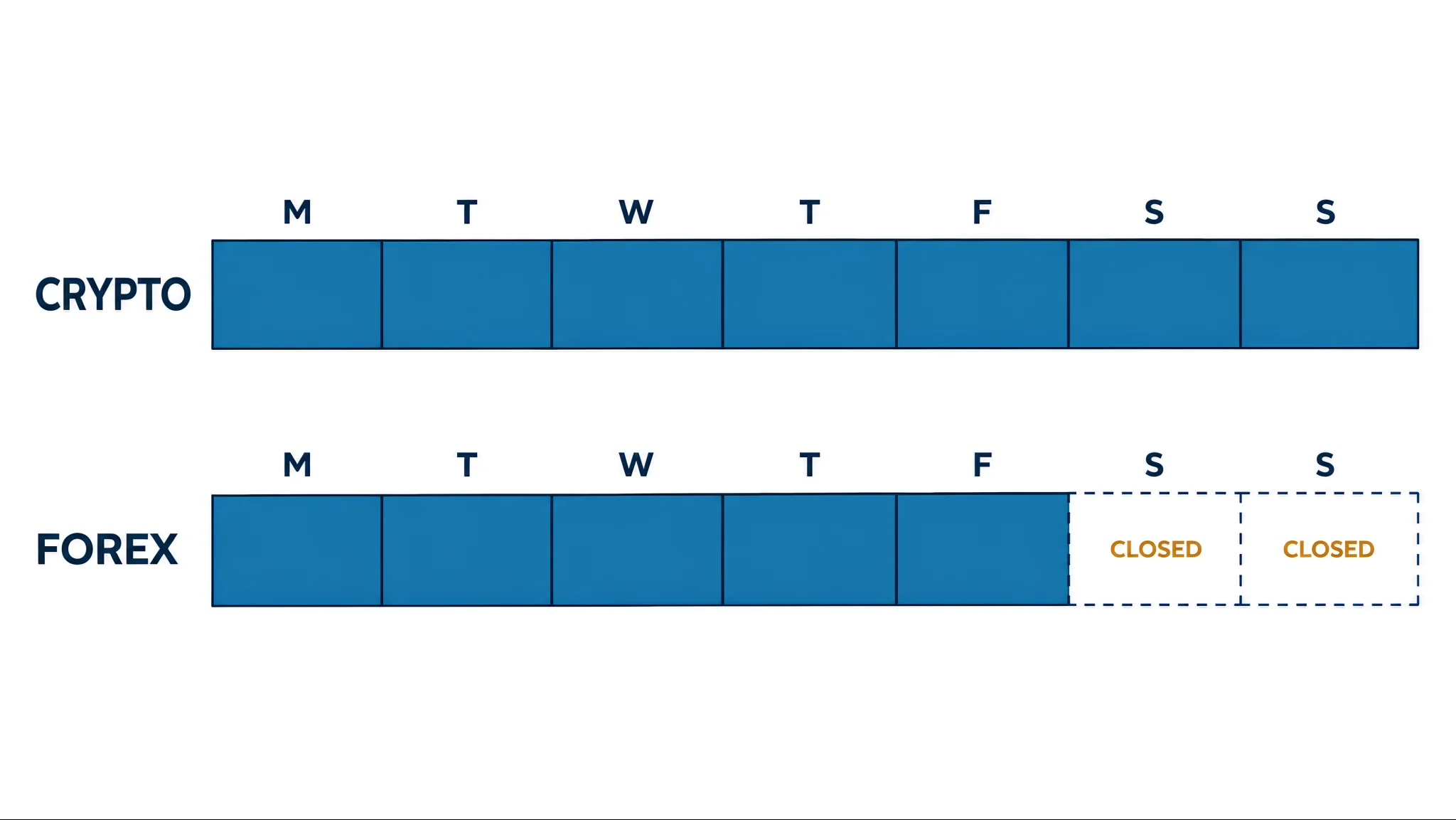
Crypto prop firms differ from forex prop firms in eight ways: a 24/7 market, a UTC daily reset, perpetual futures instead of currency pairs, lower leverage at most firms, funding fees, weekend exposure, exchange-connected accounts and stablecoin payouts. The eight differences come from the same rulebooks the two classes share, and this page shows each one with the crypto value from PropRubric’s checks and the forex value from the multi-asset firms that publish both.
The firms’ market hours drive the reset rule, the instruments drive the leverage and the costs, the payout rails differ, the risks differ in kind rather than size, and the last section says which class fits which trader.
For either class, nine prop firms that offer crypto trading alongside forex among the firms PropRubric tracks let you choose one that covers both.
| difference | crypto prop firms | forex prop firms (typical, from firms that publish both) |
|---|---|---|
| market hours | open 24 hours a day, 7 days a week at every crypto-first firm | Sunday 22:00 to Friday 22:00 UTC, closed at weekends |
| daily loss reset | a fixed UTC time per firm: 00:00, 00:05, 00:15, 00:30, 20:00 or 22:00 UTC, or 17:00 New York | server midnight or 17:00 New York, anchored to the trading day |
| instruments | perpetual futures (HyroTrader, Breakout, HyperPNL, Propr) or crypto CFDs (FTMO’s 30, BrightFunded’s 48+) | currency pairs as CFDs |
| leverage on the main market | BTC at 2x to 10x at most crypto-first terminals (Breakout 10x, Bitfunded 5x, FTMO 3.33x, AquaFunded 2x); 100x to 150x on exchange-connected accounts (HyroTrader, Mubite, Crypto Fund Trader, Klein Funding) | EUR/USD commonly 1:100 (BrightFunded: 1:100 forex against 1:5 crypto) |
| trading costs | a percentage per side (Crypto Fund Trader 0.0325%, Breakout 0.04%) and funding payments on perpetuals | a per-lot commission (Crypto Fund Trader $5 per lot) and overnight swaps |
| weekend exposure | positions held through weekend moves at Breakout, BrightFunded, AquaFunded, Goat Funded Trader and Funded Trader Markets | no positions can move; gap risk at the Sunday open; FundingPips closes crypto too |
| account connection | exchange-connected: HyroTrader on Bybit and BloFin, Crypto Fund Trader on Bybit, HyperPNL and Propr on Hyperliquid, all still simulated by their terms | a broker price feed on a simulated CFD account |
| payouts | USDT or USDC on request, on chain at four firms | bank transfer or Rise, on a 14-day cycle at FTMO and The5ers, with crypto as an option capped at $1,500 per transaction at The5ers |
How are crypto prop firms different from forex prop firms?
Crypto prop firms differ from forex prop firms in eight rules and conditions, and each difference below names the crypto value and the forex value.
- Crypto prop firms run 24/7, while forex prop firms follow a market that closes on Friday. Every crypto-first firm among the firms PropRubric tracks lets you trade on Saturday and Sunday; a forex account has nothing to trade from Friday 22:00 to Sunday 22:00 UTC.
- Crypto prop firms reset the daily loss limit at a fixed UTC time, while forex prop firms anchor it to the trading day. HyperPNL, Propr, Upscale and Dolvero reset at 00:00 UTC, Breakout, Kraken Prop and Velotrade at 00:30 UTC, SizeProp at 20:00 UTC, and TradeXProp at 17:00 New York time.
- Crypto prop firms trade perpetual futures or crypto CFDs, while forex prop firms trade currency-pair CFDs. HyroTrader’s accounts trade USDT perpetual futures, Breakout’s trade 60 perpetual-style contracts, and FTMO’s crypto offer is 30 CFDs on a broker feed.
- Crypto prop firms cap BTC leverage at 2x to 10x on most crypto-first terminals, while exchange-connected accounts reach 100x to 150x and forex prop firms give around 1:100 on major pairs. Breakout raised BTC to 10x on 12 August 2026, Bitfunded caps at 1:5, and AquaFunded, Goat Funded Trader and FundingPips cap crypto at 1:2, while HyroTrader allows up to 150x on BTC and ETH through BloFin and Mubite, Crypto Fund Trader and Klein Funding pass on Bybit’s 1:100.
- Crypto prop firms charge a percentage per side plus funding payments, while forex prop firms charge per lot plus swaps. Crypto Fund Trader charges 0.0325% per side on crypto and $5 per lot on forex, on the same account.
- Crypto prop firms let you hold positions over the weekend, while forex prop firms have no weekend market. Breakout, BrightFunded, AquaFunded, Goat Funded Trader and Funded Trader Markets allow weekend crypto holding; FundingPips requires crypto closed before the weekend as well.
- Crypto prop firms can connect the account to an exchange, while forex prop firms simulate against a broker feed. HyroTrader connects your own Bybit or BloFin demo account through an API, and HyperPNL fills orders against Hyperliquid’s live order book; both firms’ terms still describe the accounts as simulated.
- Crypto prop firms pay in stablecoins on request, while forex prop firms pay by bank transfer on a cycle. HyroTrader, Breakout and Propr pay USDT or USDC on demand; FTMO pays from day 14 by bank wire, card or crypto.
The first difference causes the second, because a market that never closes gives a daily limit nothing to reset against, and that is the rule most traders meet first.
Why does a 24/7 market change prop firm rules?
A 24/7 market changes prop firm rules because a daily loss limit needs a moment to recalculate and a weekend needs a policy, and crypto has neither built in. Forex hands the firm both: the market closes on Friday, and each trading day ends at the broker’s server midnight or at 17:00 New York time.
| market | open | closed | the firm’s daily anchor |
|---|---|---|---|
| forex | Sunday 22:00 UTC to Friday 22:00 UTC | Friday 22:00 UTC to Sunday 22:00 UTC | server midnight or 17:00 New York (FTMO: 00:00 Central European time) |
| crypto | always | never | a UTC time the firm chooses: ten different times across the firms PropRubric tracks |
The ten reset times PropRubric tracks (00:00, 00:05, 00:15, 00:30, 16:00, 20:00, 21:00 and 22:00 UTC, 17:00 New York, and FTMO’s 00:00 Central European time for its crypto CFDs) exist because each firm had to invent an anchor. The anchor decides whether a position held through the reset gets a fresh allowance or carries yesterday’s loss. Breakout recalculates from the balance excluding open positions at 00:30 UTC, so a gain held open does not raise the next day’s room, and a gain banked before 00:30 does.
Weekend gaps are a forex problem and weekend moves are a crypto problem. A forex account cannot lose money on Saturday, and a crypto account can lose its whole daily allowance on a Sunday move while the trader sleeps. That is why the weekend-holding rule and the reset time are read together, market by market, in the table of crypto prop firm rules compared across the firms PropRubric tracks. The market that never closes also trades a different instrument from the one forex traders know.
What do you actually trade at a crypto prop firm vs a forex prop firm?
At a crypto prop firm you trade perpetual futures or crypto CFDs, never spot, and at a forex prop firm you trade currency pairs as CFDs; the instrument decides the cost structure and the leverage.
Crypto prop firm. A perpetual future is a derivative contract on a coin’s price with no expiry date, kept close to the spot price by a funding payment exchanged between long and short holders at fixed intervals. The funding interval is every eight hours on Bybit at 00:00, 08:00 and 16:00 UTC per its help centre and every hour on Hyperliquid per its docs. HyroTrader’s accounts trade USDT perpetual futures on Bybit, BloFin and its own Hyro platform, Breakout’s trade 60 perpetual-style contracts on its own terminal, and HyperPNL, Propr and E8 Markets price perpetuals off Hyperliquid. A crypto CFD is a contract with the firm’s price provider that mirrors the coin’s price without a funding payment, and it is what the multi-asset firms sell: FTMO lists 30 crypto CFDs, BrightFunded 48 or more, RebelsFunding 17 against USDT.
Forex prop firm. A currency pair on a prop firm account is a CFD on the exchange rate, priced from the firm’s liquidity feed, charged a swap for holding overnight, and closed to trading at the weekend. The same firm often runs both: Crypto Fund Trader’s leverage table gives crypto 1:5 and forex 1:30 on the same smaller one-step account, and 1:100 to both on its Advanced accounts.
Of the 19 crypto-first firms PropRubric tracks, 2 fill orders against a live order book, HyperPNL and Propr on Hyperliquid, and the rest fill orders on their own systems or on exchange demo accounts at exchange prices. Crypto Fund Trader’s Bybit venue is a Bybit demo account by its own terms, and HyroTrader’s is a Bybit or BloFin demo account.
Crypto futures at futures prop firms, such as CME micro bitcoin contracts, are a third route with its own rules and are outside this page. The instrument also explains why the leverage figures on the two classes differ by an order of magnitude, because a perpetual contract already carries leverage that a currency CFD does not.
Why is leverage lower at crypto prop firms?
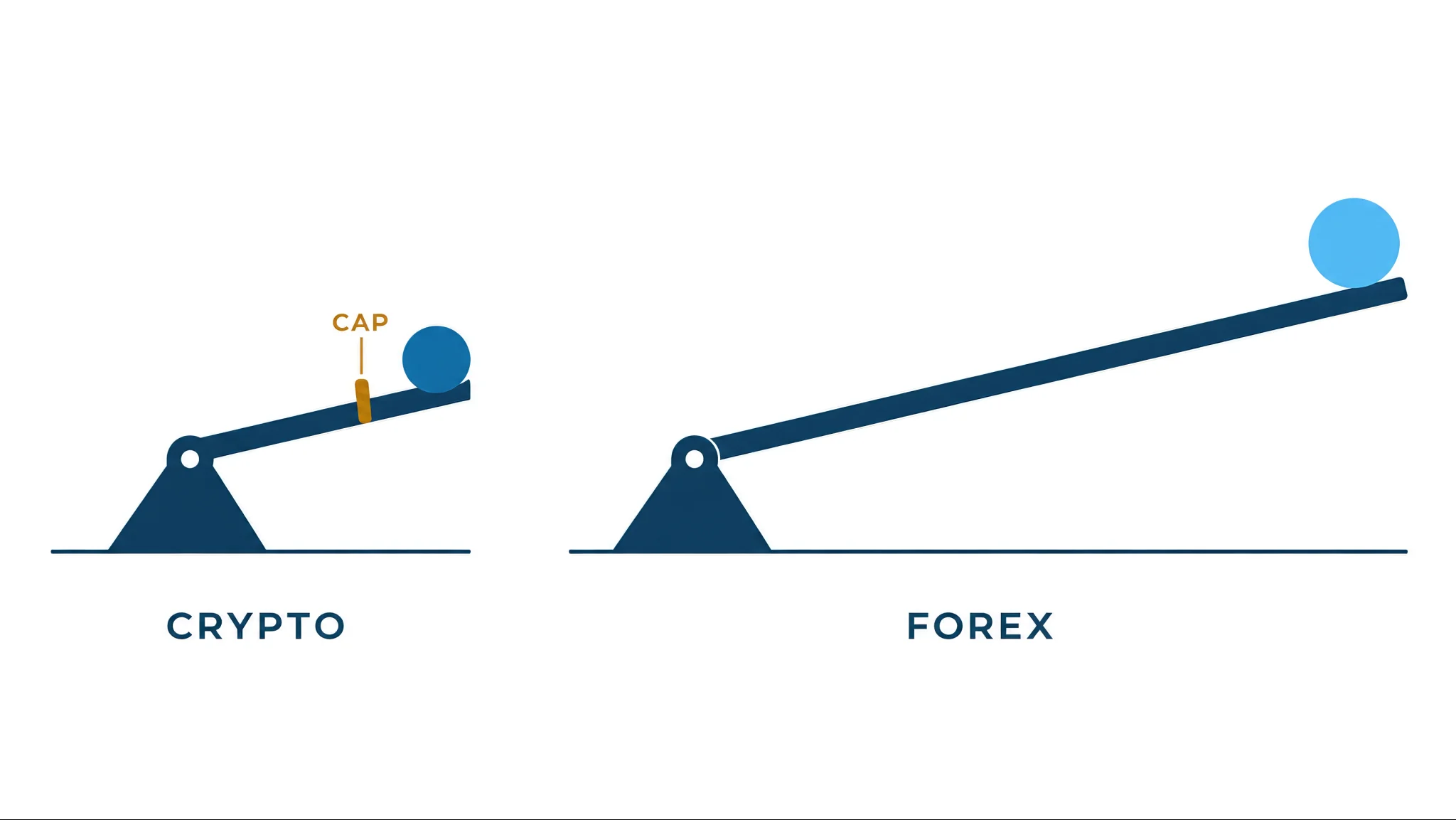
Leverage is lower at most crypto prop firms because the crypto-first terminals set it per market against the coin’s volatility, and BTC at 2x to 10x is their norm where forex majors get 1:100. Exchange-connected accounts are the exception: HyroTrader passes on BloFin’s 150x on BTC and ETH, and Mubite, Crypto Fund Trader and Klein Funding pass on Bybit’s 1:100.
| Firm | Leverage |
|---|---|
 HyroTrader | Bybit (own demo account via API): up to 150x on BTC and ETH, 50x–100x on most pairs; BloFin (own demo account via API): up to 150x on BTC and ETH; Hyro platform: up to 100x+, depending on the pair |
 Crypto Fund Trader | up to 1:100: Bybit accounts up to 1:100; on MT5 and Match-Trader, 1:100 on 'Advanced' accounts ($50K–$200K 2-Phase, $100K–$200K 1-Phase) and crypto 1:5 on all other accounts (smaller 2-Phase and 1-Phase, Instant, Ascend, Break) |
 Breakout | BTC: 10x; ETH, SOL, XRP, BNB, DOGE and ~20 others: 5x; ENA, HYPE, PEPE and ~8 others: 3x; smaller alts: 2x; XYZ100/S&P500: 10x; spark indices: up to 40x |
 Bitfunded | 1x–5x |
 Mubite | 1:100 |
 Kraken Prop (Kraken Pro) | BTC, ETH: 5x; other crypto: 2x; lite indices: up to 40x (XYZ100, S&P 500) |
 Klein Funding | bybit: 'Bybit offers leverage up to 1:100 for most of the tradeable coins'; cleo: 1:5 BTC/ETH, 1:2 all other assets |
 WenCrypto | BTC/ETH: 5x; alts: 2x |
 Fundedbit | 1:30 on all challenges |
 PropW | 5x on all pairs |
 Cointracts | 1:5 |
 TradeXProp | up to 5:1 |
 HyperPNL | crypto: up to 20x; fx: up to 50x; indices: up to 50x; stocks: up to 20x; commodities: up to 50x |
 Propr | BTC/ETH/SOL perps: 10x; other crypto perps: 2x; equity perps: 4x; SP500/XYZ100: 10x; other indices: 5x; gold/silver/oil: 8x; other commodities: 5x; FX perps: 25x |
 SizeProp | BTC, XAUT, SPCX: 5x; all others incl. ETH: 2x |
 Upscale | crypto: basic/accelerated: 5x; turbo: 2x; forex: basic/accelerated: 100x; turbo: 30x; US indices: basic/accelerated: 15x; turbo: 5x |
 Velotrade | BTC: challenge: 10x; funded: 5x; ETH: challenge: 6x; funded: 5x; SOL: challenge: 6x; funded: 5x; most alts: challenge: 2x; funded: 2x |
 Dolvero | up to 50:1 |
 E8 Markets | perpetual BTC/ETH: 1:15; perpetual other crypto: 1:2; classic-markets crypto: 1:1 |
 FTMO | crypto standard: 1:3.33; crypto swing: 1:1 |
 The5ers | 2-step High Stakes: 1:100 account; crypto 1:2; 1-step Growth (Hyper/Pro): 1:30 account; crypto 1:0.60; 3-step Bootcamp: 1:30 account; crypto 1:0.60; asset spec page: crypto margin rate 50 |
 BrightFunded | crypto: 1:5; forex: 1:100 |
 AquaFunded (Crypto) | crypto evaluation: 1:2; crypto funded: 1:2 (Old Instant Standard: 1:1) |
 RebelsFunding | crypto: 1:2.5 |
 Funded Trader Markets | BTC & ETH: 1:5; other crypto: 1:2 |
 Goat Funded Trader | crypto evaluation: 1:2; crypto funded: 1:2 |
 FundingPips | crypto evaluation: 1:2 (swap-free/swing 1:1); crypto master (funded): 1:1 on all accounts ('Crypto leverage changes from 1:2 to 1:1') |
 Tradeify 247 | BTC/ETH/PAXG + commodities: evaluation: 5x; instant: 2x; altcoins, indices, tokenized stocks: evaluation: 2x; instant: 2x |
Values from each firm's own pages, checked by PropRubric
Breakout’s announcement of its rise to 10x on 12 August 2026 gives the firm’s own reason for the change in its own words. The change “took a full review of realized volatility and order book depth, market by market”, and leverage “is auto-applied per market” with no setting for the trader to change.
A 5% move in BTC on that 10x setting is half the account, and the firms that publish both tables price that difference into the crypto column. The lower multiplier changes what a trade costs, which is the next difference.
How do trading costs differ between crypto and forex prop firms?
Crypto prop firm trading costs are a percentage of the position per side plus funding payments, and forex prop firm costs are a fixed commission per lot plus a swap per night, so the two differ in their unit.
| Firm | Trading fees |
|---|---|
| Breakout | commission: 0.04% per side; swap: 0.033% per day; spark_indices_commodities: 0.04 bps per side |
| Kraken Prop (Kraken Pro) | commission: 0.04% per side; margin_funding: 0.033% per day, charged every 4 hours; lite_index_commission:… |
| Klein Funding | bybit_taker: 0.055%; bybit_maker: 0.02% |
| HyperPNL | crypto_maker: 0.015%; crypto_taker: 0.045% |
| Propr | Hyperliquid maker/taker fees passed through at cost; funding rates apply |
| SizeProp | per_side: 0.055%; holding: 0.0167% every 8 hours |
| Upscale | crypto_basic_accelerated: 0.008% per open/close; crypto_turbo: 0.06% per open/close |
| E8 Markets | perpetual crypto: 0.045% taker / 0.015% maker (Hyperliquid fee schedule); perpetual other: 0.009% taker /… |
| FTMO | crypto commission: 0.065% of volume (PERCENT/VOLUME); crypto swap: -30% p.a. long and short (percentage… |
| The5ers | crypto commission: percentage-based: (rate/100) × entry price × contract size × lots × 2; the rate is not… |
| AquaFunded (Crypto) | crypto commission: $0 |
| RebelsFunding | crypto commission: $10 per lot ($5 in, $5 out); crypto rollover: -7% (BTC, ETH), -10% (LTC), -12% (SOL, ADA… |
| Funded Trader Markets | crypto commission: $0 |
| Goat Funded Trader | crypto commission: $0 |
| FundingPips | crypto commission: 0.04% (lot × crypto price × 0.04%), standard and swing/swap-free; crypto swaps: charged… |
| Tradeify 247 | 0.04% of notional per side on crypto and tokenized stocks |
A percentage fee scales with the position and a per-lot fee scales with the lot count, so the same $100,000 position costs $40 per side at Breakout and $5 per lot on a forex account. The overnight cost runs in opposite directions: funding can be paid to you when the market is short-heavy, while a swap is almost always a charge. Costs come out of the simulated balance and the payout comes out of the profit, and the payout rails are the next difference.
How do payouts differ between crypto and forex prop firms?
Crypto prop firm payouts are stablecoins paid on request, and forex prop firm payouts are bank transfers or Rise on a cycle with crypto as a capped option, so the two differ in currency, rail and rhythm.
| payout term | crypto prop firms | forex prop firms |
|---|---|---|
| currency | USDT or USDC (HyroTrader, Breakout, Velotrade, Upscale); BTC and ETH as options at Crypto Fund Trader and Klein Funding | bank transfer, card, Rise; crypto as an option |
| network | Ethereum, Tron, Solana, Arbitrum, TON, Base, BSC | — |
| rhythm | on demand at HyroTrader, Breakout, Propr and SizeProp; 14-day periods at Upscale and PropW | from day 14 after the first funded trade at FTMO; bi-weekly at The5ers and Goat Funded Trader |
| caps | none at Breakout; per-period caps at Upscale (from 50% of a $5,000 account down to 15% of a $200,000 account) | The5ers caps crypto at $1,500 per transaction; AquaFunded routes amounts under $5,000 to crypto |
| proof outside the firm | on-chain transaction IDs at HyroTrader, Velotrade, HyperPNL and Propr | none published by the multi-asset firms PropRubric tracks |
The stablecoin rail is why on-chain payout proof exists only on the crypto side: a USDC transfer on Solana leaves a public transaction ID, and a bank wire leaves none. The rail also carries a risk that forex traders never meet: a transfer sent to the wrong network is lost. Risk is the last difference between the two classes.
Are crypto prop firms riskier than forex prop firms?
Crypto prop firms are riskier per position and forex prop firms were riskier as businesses in 2024, so the answer depends on what you measure. Crypto prop firms carry more market risk per position and a shorter track record, forex prop firms carried the platform and closure risk of 2024, and both classes are unregulated as prop firms.
- Platform risk hit forex firms first. MetaQuotes began revoking MT4 and MT5 access from prop firms on 2 February 2024, starting with True Forex Funds, citing exposure to US clients, as reported by Finance Magnates; crypto-first firms mostly run their own terminals or exchange connections, so the same cutoff could not reach them.
- Regulation is absent for both. Christopher Lewis of DailyForex describes crypto prop firms as “legitimate businesses duly registered in their jurisdiction but remain unregulated”, and DailyForex’s regulation guide, updated in September 2026, says the same of the whole retail prop sector. The CFTC’s case against Traders Global Group, the company behind My Forex Funds, was dismissed with prejudice on 13 May 2025 by Judge Edward S. Kiel, with sanctions against the CFTC, so the one large regulatory test ended without a ruling on the model.
- Closures came in a wave for both. Finance Magnates Intelligence estimated that 80 to 100 prop firms shut down in 2024, most of them forex firms; PropRubric’s census holds 28 active crypto prop firms, 3 closed or unreachable and 1 excluded after a check, and each closure is listed with its date on the page about whether crypto prop firms are legit.
- Simulated capital is the norm for both. Every crypto prop firm PropRubric has checked runs simulated funded accounts, and FTMO, FundingPips and RebelsFunding say the same of theirs.
Crypto adds one risk of its own kind: a 24/7 market on a trailing or intraday daily limit can breach an account during a weekend move, and no forex account can. The eight differences decide which class fits you, and some firms offer both classes in one account.
Should you choose a crypto or a forex prop firm?
Choose a crypto prop firm when your strategy needs the coin market’s hours and instruments, and a forex prop firm when it needs the leverage and the closed weekend. The conditions below are the ones the eight differences produce for each strategy.
Choose a crypto prop firm if:
- you trade coins and want perpetual futures or an exchange-connected account rather than a CFD on a broker feed;
- you trade at weekends or overnight in Asian hours, when the forex market is closed or thin;
- you want payouts in USDT or USDC on request, with an on-chain record;
- you can size positions to a daily limit that resets at a fixed UTC time, and to leverage of 2x to 10x.
Choose a forex prop firm if:
- your strategy is built on currency pairs and 1:100 leverage on majors;
- you want the market closed at weekends, with no exposure between Friday and Sunday;
- you prefer a bank transfer on a schedule to a stablecoin wallet;
- you accept a per-lot commission and nightly swaps as the cost structure.
One prop firm can cover both when you want crypto and forex in one account: nine multi-asset firms among the firms PropRubric tracks sell accounts that trade crypto beside currency pairs, with the crypto side on lower leverage (FTMO 3.33x, BrightFunded 5x, FundingPips 2x). At FTMO, weekend holding is allowed in the evaluation but not on a funded Standard account. FTMO publishes its crypto rules, symbols and leverage apart from its forex ones.
The daily-limit rule that separates the crypto and forex classes most, when the daily loss limit resets, has its own worked examples. Whichever class you choose, the definition of the product behind those examples is the same.
The crypto-first firms that pass PropRubric’s checks are the best of the class, and they are ranked on the list of the best crypto prop firms.