Trailing vs Static Drawdown in Crypto Prop Challenges
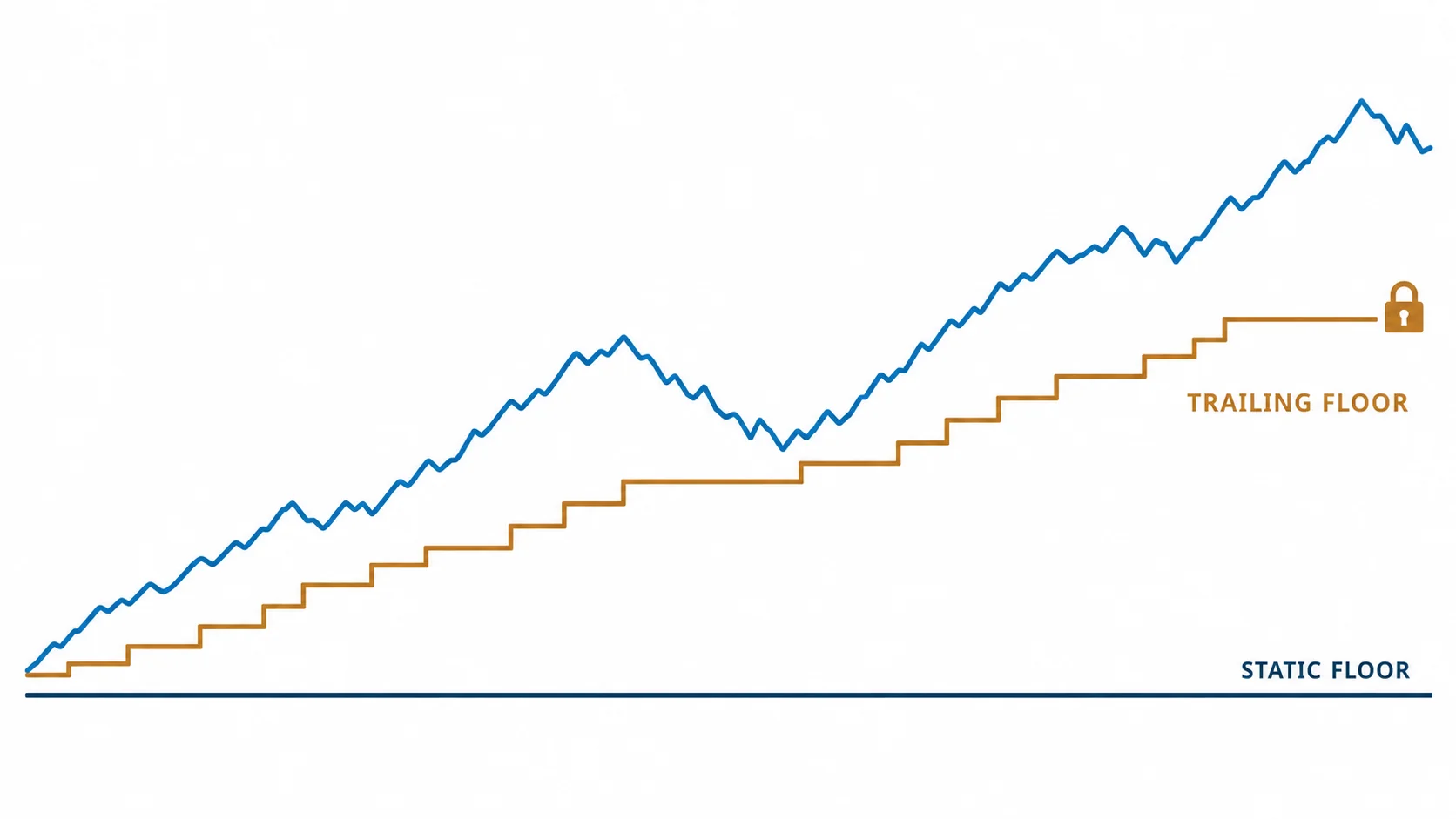
A static drawdown sets your loss floor once, at the starting balance, while a trailing drawdown raises the floor as your balance or equity reaches new highs, so profits shrink your room to lose. The two rules are defined and compared below, then run on the same six days of crypto trades on a crypto prop firm account, where the trailing account breaches on day four and the static account survives.
Intraday and end-of-day trailing differ by whether open profit moves the floor, some trailing floors lock at the starting balance and some never do. Crypto volatility hits a trailing floor harder, eighteen crypto prop firms mix the two types by model, and static is easier to pass for most traders.
The simulator below runs the same numbers on the presets of any firm PropRubric tracks, and the same fields sort the table of crypto prop firm rules compared across every crypto prop firm PropRubric tracks.
Calculator
Pick an account size and a limit, or a firm’s plan, and the simulator draws the static and the trailing floor over the six-day example below.
What is the difference between trailing and static drawdown?
The difference between trailing and static drawdown at a crypto prop firm is the reference point: a static drawdown measures your maximum loss from the starting balance, and a trailing drawdown measures it from the highest balance or equity the account has reached. The two questions below answer this in order: What is a static drawdown; and What is a trailing drawdown.
| feature | static drawdown | trailing drawdown |
|---|---|---|
| reference point | the starting balance | the account’s highest balance (or equity) so far |
| moves with profit? | no; the floor never changes | yes; the floor rises with every new high |
| locks? | not needed | at some firms, once the floor reaches the starting balance; at others, never |
| what counts | balance or equity, per the firm | balance (end-of-day) or equity including open trades (intraday) |
| difficulty | easier: profit adds room | harder: profit removes room |
| common at | Breakout, Kraken Prop, Velotrade, HyperPNL, SizeProp, TradeXProp, Mubite | Breakout Spark, Kraken Prop Lite, Propr 2-step, Fundedbit 1-step, Upscale Turbo, Dolvero 1-step |
Marcel Hambálek, a senior trader at For Traders, describes the same split as four drawdown types in the firm’s guide to prop trading rules: static, trailing intraday, trailing end-of-day and locked trailing, and the four collapse into the two reference points in the table. The reference point is the whole difference, and each type deserves its own definition.
What is a static drawdown?
What is a trailing drawdown?
How do trailing and static drawdown work on the same trades?
Trailing and static drawdown work differently on the same trades from the first winning day, and the six-day sequence below shows the moment two crypto prop firm accounts separate. Both accounts start at $10,000 with a 6% limit, the static floor at $9,400 and the trailing floor following the closed balance.
| day | trade result | balance | static floor | room under static | trailing floor | room under trailing |
|---|---|---|---|---|---|---|
| 1 | +$250 | $10,250 | $9,400 | $850 | $9,650 | $600 |
| 2 | +$150 | $10,400 | $9,400 | $1,000 | $9,800 | $600 |
| 3 | −$100 | $10,300 | $9,400 | $900 | $9,800 | $500 |
| 4 | −$550 | $9,750 | $9,400 | $350 | $9,800 | breached by $50 |
| 5 | +$200 | $9,950 | $9,400 | $550 | closed | — |
| 6 | −$300 | $9,650 | $9,400 | $250 | closed | — |
Day four is the key moment: a $550 loss is 5.3% of the day-three balance and an ordinary bad day on a crypto account. The loss ends the trailing account because two winning days had lifted the floor to $9,800, while the static account keeps $350 of room and is still trading on day six. The trailing account’s room never exceeded $600, the size of its limit, because every gain moved the floor by the same amount; the static account’s room grew to $1,000 on day two because its gains were added to the cushion.
Which one is harder to pass is answered by the table: the same six trades pass under static and fail under trailing. The same numbers, with your own account size and limit, run in the simulator at the top of the page and, with any firm’s preset, on the prop firm drawdown calculator.
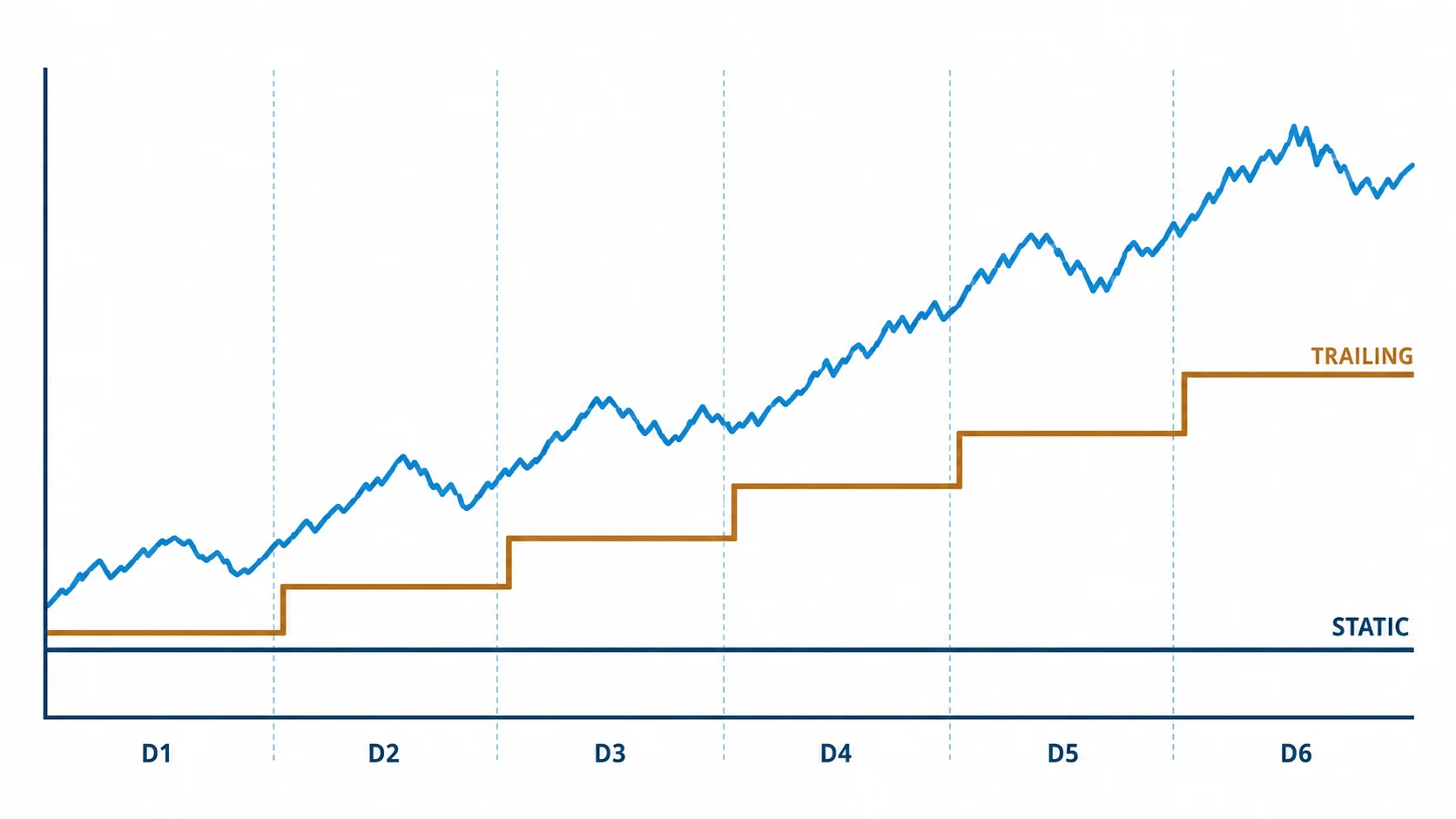
The trailing column above followed the closed balance, and on a 24/7 market the choice between the closed balance and live equity is a rule of its own.
What is the difference between intraday and end-of-day trailing drawdown?
The difference between intraday and end-of-day trailing drawdown at a crypto prop firm is what moves the floor: an intraday trailing drawdown follows the equity peak, open profit included, and an end-of-day trailing drawdown updates once a day from the closed balance.
Intraday trailing. The floor tracks the highest equity the account reaches at any moment, so a position that is up $500 and then closed at +$100 has already lifted the floor by $500. Propr’s 2-step plan trails “from the equity high-water mark (floating P&L included)”, and Fundedbit’s 1-step trails “from highest equity”, per their rules.
End-of-day trailing. The floor updates once a day from the closed balance, so the same position, up $500 intraday and closed at +$100, lifts the floor by $100 at the next update. Breakout’s Spark plan trails $1,500 below the closed-balance high, updated daily at 00:30 UTC, and Kraken Prop’s Lite plan runs the same rule; FTMO’s 1-step is a 10% end-of-day trailing limit, and WenCrypto’s Genesis plan a 4% end-of-day trailing limit from the highest equity.
The example is one BTC long: it rises $500 while open and is closed at +$100. On Propr’s 2-step, that $500 peak lifts the floor by $500 the moment it prints; on Breakout Spark, the closed $100 lifts it by $100 after 00:30 UTC. A wick that reverses ratchets an intraday floor and leaves an end-of-day floor alone, which is why the end-of-day rule is the friendlier of the two trailing types on a market that never closes. Whether the floor keeps rising forever is the next rule to read.
Does a trailing drawdown ever stop trailing?
Yes, some trailing drawdowns stop trailing once the floor reaches the starting balance, and others never lock; the firm’s own rule decides which. A locked trailing drawdown becomes a static one at breakeven, so the account can never lose more than the profit it has made. Three lock rules appear among the crypto prop firms PropRubric tracks.
- Locks at the starting balance: Propr’s 2-step “stops at the starting balance” and resets after each payout; E8 Markets’ E8 One trails closed profits and “locks at initial balance”; BrightFunded’s 1-step 6% trailing locks once equity is 6% above the initial balance; Funded Trader Markets’ 1-Step Nitro is fixed once the account is up 6%; Klein Funding’s Bybit Instant Pro trails until +3% profit, then locks 3% below the starting balance.
- Never locks: Breakout’s Spark plan and Kraken Prop’s Lite plan trail $1,500 below the highest closed balance and state that the floor never locks, so the floor can rise above the starting balance and keep rising.
- Resets or moves on payouts: Upscale’s Turbo plan recalculates its 6% trailing floor after each payout, and WenCrypto’s BNPL funded plan reduces its drawdown by withdrawals, a rule the firm calls a “withdraw lock”.
Can the trailing floor go above your starting balance? Yes, the trailing floor rises above the starting balance at Breakout Spark and Kraken Prop Lite, and no, it stops at breakeven at Propr, E8 Markets and BrightFunded, where the lock holds it. A floor that keeps rising on a market that moves at weekends is where crypto volatility does its damage.
How does crypto volatility affect a trailing drawdown?
Crypto volatility affects a trailing drawdown at a crypto prop firm by moving the floor on spikes that reverse, by opening gaps at no market close, and by charging funding on open perpetuals, and all three reduce the room a trailing account keeps.
Breakout gave its own account of the volatility review behind its leverage change on 12 August 2026. Raising BTC to 10x “took a full review of realized volatility and order book depth, market by market”, and the firm warned that “size that was out of reach yesterday can spend a full day’s allowance on a small move today”. Three crypto-specific mechanics work on the floor beyond that one-day move.
Firstly, a 24/7 market has no close, so an intraday trailing floor can be ratcheted on a Sunday wick while the trader is away. Secondly, a perpetual position held through that wick pays or receives funding at fixed intervals, and a funding debit, settled every eight hours on Bybit per its help centre and every hour on Hyperliquid, lowers equity without a price move. Finally, a funding debit is small next to BTC’s daily moves.
BTC’s daily close moved more than 5% from the prior day on 16 days in the twelve months to 29 September 2026 and more than 3% on 55, by PropRubric’s count of the Coinbase series FRED publishes as CBBTCUSD.
So a trailing account that has just made new highs is one ordinary day from its floor. The firms that use trailing limits on crypto, and the models they use them on, are the next table.
Which crypto prop firms use static or trailing drawdown?
Seven of the 19 crypto-first prop firms among the firms PropRubric tracks use static drawdown on every model captured, eleven mix static and trailing by model, none uses trailing only, and one has not published the type.
| Firm | Max DD | Type |
|---|---|---|
 HyroTrader | 5–10% | static |
 Crypto Fund Trader | 10% | mixed by plan |
 Breakout | 3–6% | mixed by plan |
 Bitfunded | 3–10% | static |
 Mubite | 8–10% | mixed by plan |
 Kraken Prop (Kraken Pro) | 3–6% | mixed by plan |
 Klein Funding | 3–6% | mixed by plan |
 WenCrypto | 4–8% | mixed by plan |
 Fundedbit | 6–10% | mixed by plan |
 PropW | 6–10% | static |
 Cointracts | 6–10% | not published |
 TradeXProp | 6–9% | static |
 HyperPNL | 5–9% | static |
 Propr | 3–8% | mixed by plan |
 SizeProp | 3–5% | static |
 Upscale | 6–10% | mixed by plan |
 Velotrade | 3–10% | static |
 Dolvero | 6% | mixed by plan |
 E8 Markets | 6–8% | mixed by plan |
 FTMO | 10% | mixed by plan |
 The5ers | 6–10% | static |
 BrightFunded | 6–10% | mixed by plan |
 AquaFunded (Crypto) | 5–12% | mixed by plan |
 RebelsFunding | 6–10% | static |
 Funded Trader Markets | 6–10% | mixed by plan |
 Goat Funded Trader | 6–10% | mixed by plan |
 FundingPips | 5–12% | mixed by plan |
 Tradeify 247 | 6% | mixed by plan |
Values from each firm's own pages, checked by PropRubric
The pattern across the mixed firms is that the cheaper or faster model carries the trailing floor: Breakout Spark, Kraken Prop Lite, Propr’s 2-step, Upscale’s Turbo and Dolvero’s 1-step are each the firm’s alternative to a static plan at the same size.
Every value in the table is the firm’s own published rule with its source, and the same fields sort the rules table across the firms PropRubric tracks. The same table fields, filtered to static floors, give the eleven firms whose every published model is static. Which type to choose follows from the six-day table and this one.
Is static drawdown better than trailing drawdown?
Yes, static drawdown is better for most crypto prop firm traders, because profits add to your room instead of shrinking it. Trailing drawdown usually comes with a lower price or a larger account, and it suits a trader who withdraws often.
Static drawdown suits you if:
- your strategy has drawdowns after winning streaks, because a static floor keeps the room you earned;
- you hold positions through weekends and news, because no spike can move the floor;
- you want the same rule in the evaluation and on the funded account, as Breakout, Velotrade and HyperPNL apply it.
Trailing drawdown can suit you if:
- you take profits out at each payout, because a floor that locks at breakeven (Propr, E8 Markets, BrightFunded) caps your loss at the profit made;
- you want the cheaper model at a firm that prices its trailing plan below its static plan, such as Propr’s 2-step against its 1-step, and you should compare the two prices at the same account size before choosing;
- your strategy closes every position daily, so an end-of-day floor (Breakout Spark and Kraken Prop Lite, both sold out at PropRubric’s last check) never sees an open-profit peak.
You should read the daily limit next to the maximum limit before choosing, because the two rules interact. A static maximum drawdown with a daily limit measured from the start-of-day equity, as HyroTrader runs both on every challenge, can breach on a day the maximum limit would have survived. Maximum drawdown is only one of two loss limits; the other resets every day.
Is a trailing drawdown the same as a daily drawdown?
No, a trailing drawdown is not the same as a daily drawdown: a trailing drawdown limits your total loss from the peak, and a daily drawdown limits your loss within one day. A trailing drawdown is one type of maximum drawdown; a daily drawdown is a separate rule that resets at a fixed time, whatever type the maximum limit is.
The two limits can share a mechanism, a daily limit that trails the day’s high so the daily allowance shrinks as the day’s profit grows, but no crypto prop firm PropRubric tracks publishes one at its last check. HyroTrader, which ran it on its Standard plan, now measures every daily limit from the equity at the start of the day and no longer sells the Swing upgrade.
How the daily limit resets on a 24/7 market, firm by firm, is explained on the page about daily drawdown in crypto prop challenges. Both limits sit side by side for every crypto prop firm in the rules table at the top of the rules section.