Stop-Loss and Per-Trade Loss Rules at Crypto Prop Firms
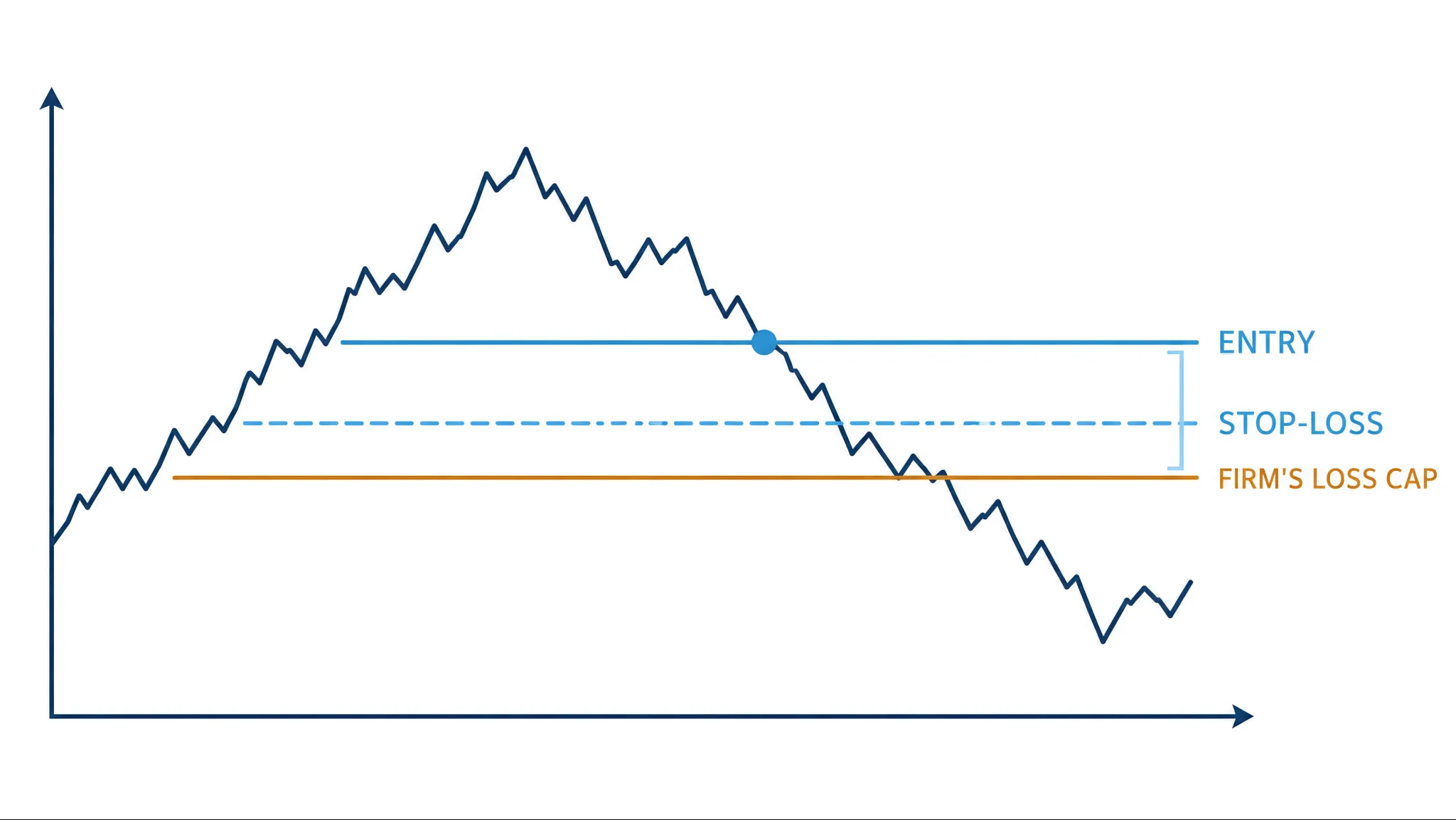
A per-trade loss cap at a crypto prop firm is the most one position may lose, as a percentage of the balance or the equity, and no crypto prop firm among the 20 with a recorded value requires a stop-loss order any more. Six firms cap the loss or the risk on one trade instead. The cap is defined against its conditional synonyms, calculated on a $10,000 and a $100,000 account, tested against the three ways a 24/7 market pushes a loss past a stop.
The cap is then sorted into five kinds of rule, listed firm by firm from the firms’ own documents, and turned into six habits that keep a position under the line. The firms with no cap at all close the page, because the absence of a cap is one column of the rules table that compares crypto prop firm rules across every firm PropRubric tracks.
HyroTrader, the one firm that once required a stop-loss, dropped the order and, in its October 2026 relaunch, its 3% per-trade cap as well.
| firm | stop-loss required | per-trade loss cap | basis | consequence |
|---|---|---|---|---|
| HyroTrader | no (dropped in 2026) | none since the October 2026 relaunch (3% before it) | funded exposure caps instead: margin ≤ 25% of the initial balance, notional ≤ 2× | one warning, then the funded stage fails |
| Crypto Fund Trader | no | none on standard models; Break $100K: losses ≤ 3% of the highest balance | realized and open losses, Break only | breach |
| Breakout | no | none (“no … risk per trade rule”); position-size caps per market | — | leverage or size breach |
| Kraken Prop | no | none stated; per-market position limits | — | breach |
| Bitfunded | not published | not published | — | — |
| Mubite | no (“highly recommended”) | 3% of the equity when the trade opened | realized loss, per partial close and cumulative per trade | violation, checked daily at 23:59 GMT+1 |
| Klein Funding | no | none stated; Bybit trades open ≥ 50 seconds | — | — |
| WenCrypto | no | not published | — | — |
| Fundedbit | no | 2% of the balance per pair | open risk on one pair | breach |
| PropW | not published | not published | — | — |
| Cointracts | not published | none per trade; 70% total margin cap | open margin | payout penalties |
| TradeXProp | no | not published | — | — |
| HyperPNL | no | none | — | — |
| Propr | no | none | — | — |
| SizeProp | no | none stated | — | — |
| Upscale | no | none | — | — |
| Velotrade | no | none | — | — |
| Dolvero | not published | 2% of the starting balance per position | realized, read from closed trades | first breach ends the account |
| E8 Markets | no | not published | — | — |
| FTMO | no | not published | — | — |
| The5ers | not published | not published | — | — |
| BrightFunded | no | not published | — | — |
| AquaFunded | not published | not published | — | — |
| RebelsFunding | no (“recommended but not mandatory”) | 1.5% maximum risk per trade on funded (RCF) accounts | per trade | breach |
| Funded Trader Markets | not published | 1% floating loss, Shield Risk Protocol (2-Step Plus, Instant Plus) | open loss at any moment | positions closed, split cut per breach |
| Goat Funded Trader | no (“we do not make them mandatory”) | not published | — | — |
| FundingPips | no hard rule | 1% of the account size for the largest losing trade (Responsible Trading Policy) | realized, per trade | warning, restrictions, denied fees or termination after review |
What is a per-trade loss cap at a crypto prop firm?
The per-trade cap is the parameter that sits inside the daily limit: a 3% cap under a 4% daily limit means one full-size loss leaves $100 of the day’s room on a $10,000 account. Marcel Hambálek, a senior trader at For Traders, describes loss rules of this kind in the firm’s guide to prop trading rules. The guide calls them “risk parameters written into a firm’s terms and conditions, applied to a simulated trading account, not regulations imposed by a financial authority”.
The stop-loss rule that PropFirmMatch’s glossary, written for forex firms, still defines as “You must have an active Stop Loss in place at all times when entering a trade” is a forex and futures rule. No crypto prop firm among the 20 with a recorded value applies that rule at PropRubric’s last check.
HyroTrader’s stop rule required a stop within five minutes of opening until 2026, and its October 2026 relaunch removed the 3% per-trade cap that had replaced the requirement. The cap, not the order, is the rule a crypto trader has to calculate at the six firms that still cap one trade.
How is a per-trade loss cap calculated?
A per-trade loss cap at a crypto prop firm is calculated as the account figure the firm names, the initial balance, the equity at entry or the current balance, multiplied by the cap percentage. The result is the most the position may lose before the firm counts a violation.
Formula
maximum loss on one trade = reference figure × cap % position size that fits the cap = maximum loss ÷ stop distance (as a fraction of the entry price) example: $100,000 × 3% = $3,000 of allowed loss; at a 2% stop distance the position can be $150,000 of notional, which needs $1,500 of margin at 100x leverage or $15,000 at 10x
The reference figure decides how the cap moves. Dolvero’s 2% is taken on the starting balance per position, so a $10,000 account keeps a $200 cap however the balance changes. Mubite’s 3% is taken on the equity at the moment the trade opens, so a $15,000 equity gives a $450 cap and an $8,000 equity gives $240, locked for the life of that trade, per its FAQ.
FundingPips’ 1% is taken on the account size, so those three percentages rest on two different bases. The stop distance in the formula is the trader’s choice, and the position size that a crypto challenge allows at each distance follows from that choice and the cap.
Is the cap measured on the realized loss or the open loss?
Four firms measure the realized loss when the trade closes and two measure the open loss while the position runs, and the difference between the two decides whether a wick can breach the cap.
Realized-loss caps. Mubite counts “only realized losses — floating drawdown on an open position is not evaluated until it’s closed”. Dolvero reads the cap from closed trades, FundingPips names “your largest losing trade”, and RebelsFunding applies its 1.5% maximum-risk rule per trade. A trade that falls 5% and recovers to close at a 1% loss passes all four.
Open-loss caps. Fundedbit caps “total open risk on any single pair” at 2% of the balance, and Funded Trader Markets’ Shield Risk Protocol closes every position the moment the floating loss on 2-Step Plus and Instant Plus accounts reaches 1% of the balance. A position that falls 5% breaches both, whatever it closes at.
Mubite adds a third layer that no other firm publishes: its 3% applies to each partial close and to the trade’s cumulative net result. Three partial stops of $80, $120 and $150 on a $10,000 account pass one by one and fail together at $350, while a trade that loses $200, gains $150 and loses $180 passes because its deepest net point is $230. Whether the loss is read at the close or during the trade, a crypto market adds three ways to push it past the stop.
How does a per-trade loss cap work on a 24/7 crypto market?
A per-trade loss cap on a 24/7 crypto market can be breached after the stop-loss order fires, and three mechanics cause it: a weekend gap, a funding debit on an open perpetual, and slippage on a thin pair.
| moment | what happens to the position | example on a $10,000 account, 3% cap ($300) |
|---|---|---|
| Friday 22:00 UTC, long BTC, stop 2.5% below entry | the stop is in place; the planned loss is $250 | room under the cap: $50 |
| Saturday 03:00 UTC, BTC drops 4% in one candle | the stop fills 1.2% below its price | realized loss $370: the cap is breached |
| any 8-hour mark, position still open | Bybit settles funding at 00:00, 08:00 and 16:00 UTC | a 0.05% debit on $100,000 of notional costs $50 without a price move |
| a low-cap altcoin, stop at 2% | the order book is thin; the fill lands 1.5% lower | realized loss $350, above the cap |
Firstly, a weekend move counts, because every crypto-first firm trades through Saturday and Sunday and the 16 days in the year to 29 September 2026 on which bitcoin moved 5% or more, per the FRED Coinbase daily series, include weekend days. Secondly, a perpetual position pays or receives funding at fixed intervals, every eight hours on Bybit per its help centre and every hour on Hyperliquid per its docs, and a debit lowers the realized result of a trade that is closed after it.
Finally, a stop-loss order on that trade is an instruction, not a guaranteed price, as RebelsFunding’s FAQ puts it. The fill of that order on a thin pair can land past the cap, which is why HyroTrader limits low-cap coins to 5% of the initial balance, leverage included, even though it no longer caps one trade. The three mechanics are the reason the firms that cap one trade chose different kinds of rule to do it.
What are the types of per-trade loss rules at crypto prop firms?
Crypto prop firms use five kinds of per-trade loss rule, counting the absence of one, and the firms PropRubric tracks fall into them as follows.
- Mandatory stop-loss orders: none recorded. No crypto prop firm among the 20 with a recorded value requires the order at PropRubric’s last check; FTMO, E8 Markets, Goat Funded Trader, Mubite, BrightFunded and RebelsFunding each state in their own FAQ or help centre that a stop-loss is not mandatory, and HyroTrader dropped its requirement in 2026.
- Realized-loss caps per position: Mubite at 3% of the entry equity, Dolvero at 2% of the starting balance, FundingPips at 1% of the account size under its Responsible Trading Policy, and RebelsFunding at 1.5% on funded accounts.
- Open-risk caps: Fundedbit at 2% of the balance per pair, and Funded Trader Markets’ 1% floating-loss Shield on 2-Step Plus and Instant Plus accounts, which closes positions and cuts the split per breach rather than ending the account.
- Exposure caps instead of a loss cap: HyroTrader’s funded accounts may hold at most 25% of the initial balance as margin and 2× the initial balance as notional, Cointracts caps open margin at 70% of the balance, and Breakout and Kraken Prop cap the position size per market.
- No per-trade rule: HyroTrader since its October 2026 relaunch, Breakout, Crypto Fund Trader on its standard models, Propr, HyperPNL, Velotrade, Upscale, SizeProp, Klein Funding and Kraken Prop state none, and the daily and maximum drawdown limits are the only loss rules on one trade.
The kind of rule decides what a trader has to size for, and the firm-by-firm table above records the kind beside the value. What the table does not show is how a cap combines with a trailing floor, which the pair of drawdown rules on the page about trailing vs static drawdown works through.
Which crypto prop firms require a stop-loss or cap the loss on one trade?
No crypto prop firm among the 20 with a recorded value requires a stop-loss, and six crypto prop firms cap the loss or the risk on one trade, per the firms’ own documents.
| rule | firms |
|---|---|
| stop-loss not required, stated by the firm | HyroTrader (dropped in 2026) · Crypto Fund Trader · Breakout · Kraken Prop · Mubite · Klein Funding · WenCrypto · Fundedbit · TradeXProp · HyperPNL · Propr · SizeProp · Upscale · Velotrade · E8 Markets · FTMO · BrightFunded · RebelsFunding · Goat Funded Trader · FundingPips (no hard rule) |
| a cap on the loss or risk of one trade | Mubite 3% · Dolvero 2% · Fundedbit 2% per pair · RebelsFunding 1.5% (funded) · FundingPips 1% (policy) · Funded Trader Markets 1% floating (two plans) |
| a plan or exposure rule instead of a per-trade cap | Crypto Fund Trader 3% of the highest balance (Break $100K only) · Cointracts 70% margin cap · HyroTrader 25% margin and 2× notional (funded) |
| stop-loss rule not published in the pages read | Bitfunded · PropW · Cointracts · The5ers · AquaFunded · Dolvero · Funded Trader Markets |
Three of the six caps sit at crypto-first firms and three at multi-asset firms, and the multi-asset caps are the softer ones. FundingPips’ 1% is a Responsible Trading Policy that the firm reviews rather than an automated breach, and Funded Trader Markets’ Shield cuts the split instead of the account. The crypto-first caps are the ones that end accounts, and the firm whose rulebook changed most on this point is HyroTrader, which dropped its stop-loss requirement and then its 3% cap, as the review of HyroTrader’s rules and fees records.
How do you stay under a per-trade loss cap?
You stay under a per-trade loss cap with six habits, and each habit follows from a mechanic on this page.
- Size the position from the cap, not from the daily limit. Divide the cap by the stop distance: a $300 cap and a 2% stop give a $15,000 position on a $10,000 account, whatever leverage the venue offers.
- Leave a gap between the stop and the cap. A stop at 2.5% under a 3% cap leaves $50 of slippage room on a $10,000 account, and a weekend candle can use all of it.
- Check the basis before the first trade. A cap on the initial balance stays fixed; a cap on the entry equity shrinks after a loss and grows after a gain, as Mubite’s does.
- Count funding into the trade’s result. A perpetual held across a funding mark loses part of the cap’s room without a price move, so close before the mark or size for it.
- Keep partial closes inside the cap too. Mubite evaluates each partial and the trade’s cumulative result, so three small stops can fail together.
- Read the consequence, not only the number. Mubite counts a violation at its daily 23:59 GMT+1 check; Dolvero ends the account on the first breach; Funded Trader Markets cuts the split.
The six habits keep one trade inside its line, and the firms whose rulebooks have no such line are a different kind of risk.
Which crypto prop firms have no per-trade loss cap?
Ten crypto prop firms publish no per-trade loss cap of any kind: HyroTrader, Breakout, Kraken Prop, Crypto Fund Trader on its standard models, Propr, HyperPNL, Velotrade, Upscale, SizeProp and Klein Funding. At each of the ten firms, the daily drawdown and the maximum drawdown are the only limits on what one trade can lose.
A firm with no per-trade cap lets one position use the whole daily allowance, which is the freedom scalpers and single-trade strategies buy. The price of that freedom is that one trade can end the account under the daily limit alone; Breakout states its position in its help centre as “no … risk per trade rule” and its two equity limits do the rest. The cap on one trade and the cap on one day are two of the eight rule kinds that the hub of crypto prop firm rules compared records for every firm. The rule that caps one day’s share of the profit, rather than one trade’s loss, is explained on the page on which crypto prop firms use a consistency rule and how it is calculated.