Breakout Prop Review 2026: Rules, Fees, Payouts and Legitimacy

Breakout ranks #2 of 18 crypto-first and on-chain firms on PropRubric's list of the best crypto prop firms. It also appears on the lists of crypto prop firms with no consistency rule, crypto prop firms in India and crypto prop firms for UK traders. The firms that drop its strictest rules are on the Breakout alternatives page, and it is set side by side with other firms in Bitfunded vs Breakout, Crypto Fund Trader vs Breakout and HyroTrader vs Breakout.
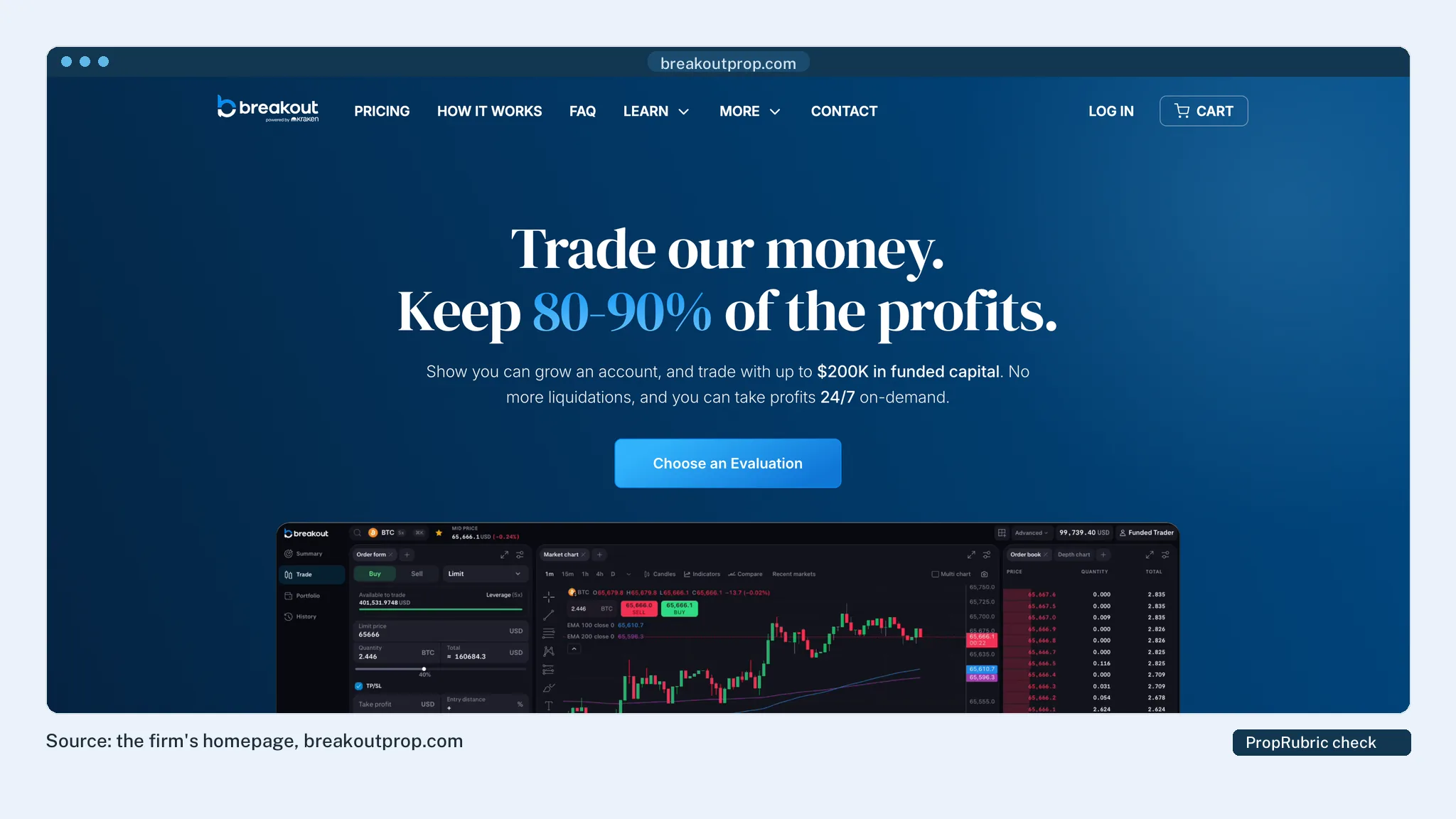 Breakout is a crypto prop firm owned by Kraken that runs the same funded-account programme as Kraken Prop through its own terminal, with two equity limits and almost no other rules.
Yes, Breakout is a legitimate, operating crypto prop firm: a Delaware company sells the evaluation, and a Kraken group company in the British Virgin Islands provides the funded accounts. The firm publishes the shortest rulebook in the census, in documents that disagree with each other in places. The firm sells three 1-step plans from $20, and Kraken’s ownership decides its payout rail and its KYC.
The plans cost $20 to $1,090, and the two limits are a 3% daily loss and a static 3% to 6% maximum. The firm pays 80% to 90% in USDC on Ethereum on demand from $50 on every plan, does not list the United States as restricted, and its change log holds 10 rows, 7 of them changes the firm made. Compare it with all crypto prop firms PropRubric tracks before you choose.
At a glance
| status | category | venue | entry fee from | daily DD + reset | max DD + type | per-trade cap / stop-loss | split | payout | US access |
|---|---|---|---|---|---|---|---|---|---|
| active | crypto-first, now multi-asset (60 crypto + 4 index and commodity contracts) | simulated on the Breakout Terminal; funded trade ideas may be A-booked or B-booked | $20 (Turbo $5K) | 3%, from the balance excluding open positions at 00:30 UTC | 6% / 5% / 3% static (Classic / Pro / Turbo); Spark $1,500 trailing | none; no stop-loss required | 80% → 90% (add-on) | USDC on Ethereum, on demand from $50, approval 12–24 hours | not listed as restricted |
Total-cost calculator
total-cost (fee + one reset + add-ons per size; formula stated in §3.1)
Pick a model and a size to see the fee, the cost with resets and the price per $10,000 (needs JavaScript; the price table below has every value).
Visit Breakout →What is Breakout?
Breakout is a crypto prop firm that sells 1-Step Classic, Pro and Turbo challenges on 60 crypto perpetual-style contracts and four index and commodity contracts, and pays 80% to 90% of simulated profits in USDC.
Breakout Trading Group, LLC, a Delaware limited liability company, runs the evaluations, and Payward Oceanic Ltd., a British Virgin Islands company in the Kraken group, provides the funded accounts.
The firm launched in 2023, raised $4.5 million led by RockawayX before its sale, and was acquired by Kraken with effect from 1 September 2025, announced on 4 September 2025.
| operator | legal entities | founded | status | category |
|---|---|---|---|---|
| Breakout (brand), Kraken-owned | Breakout Trading Group, LLC (Delaware); Payward Oceanic Ltd. (BVI) | 2023 (acquired 2025) | active | crypto-first, now multi-asset |
Breakout and Kraken Prop are one programme: Breakout LLC runs the evaluations and Payward Oceanic Ltd provides the funded accounts, and Kraken Prop sells the same plans inside Kraken Pro with its own prices, interface and payout rail. The Kraken Prop review covers the same programme sold inside Kraken Pro.
How does Breakout work?
Breakout’s cycle has four steps, and the firm’s help centre describes each of them.
- Buy a Classic, Pro or Turbo evaluation from $5,000 to $200,000 of simulated capital, priced from $20, with no KYC needed to buy or trade it.
- Pass the target of 10% on Classic, 12% on Pro or 9% on Turbo inside a 3% daily limit and a static 6%, 5% or 3% maximum, with no minimum days, no time limit and no consistency rule; 90 days without a trade suspends a funded account.
- Verify your identity through SumSub with a photo ID and a selfie before the funded account is issued, and trade it under the same two limits, with the firm free to A-book or B-book your trade ideas at its discretion.
- Request a payout at any time once $50 of net profit has accrued after the split, with no open positions, and receive USDC on Ethereum after an approval of 12 to 24 hours.
The step that Kraken’s ownership shaped most is the third, and the next section reads what the acquisition changed.
Is Breakout owned by Kraken?
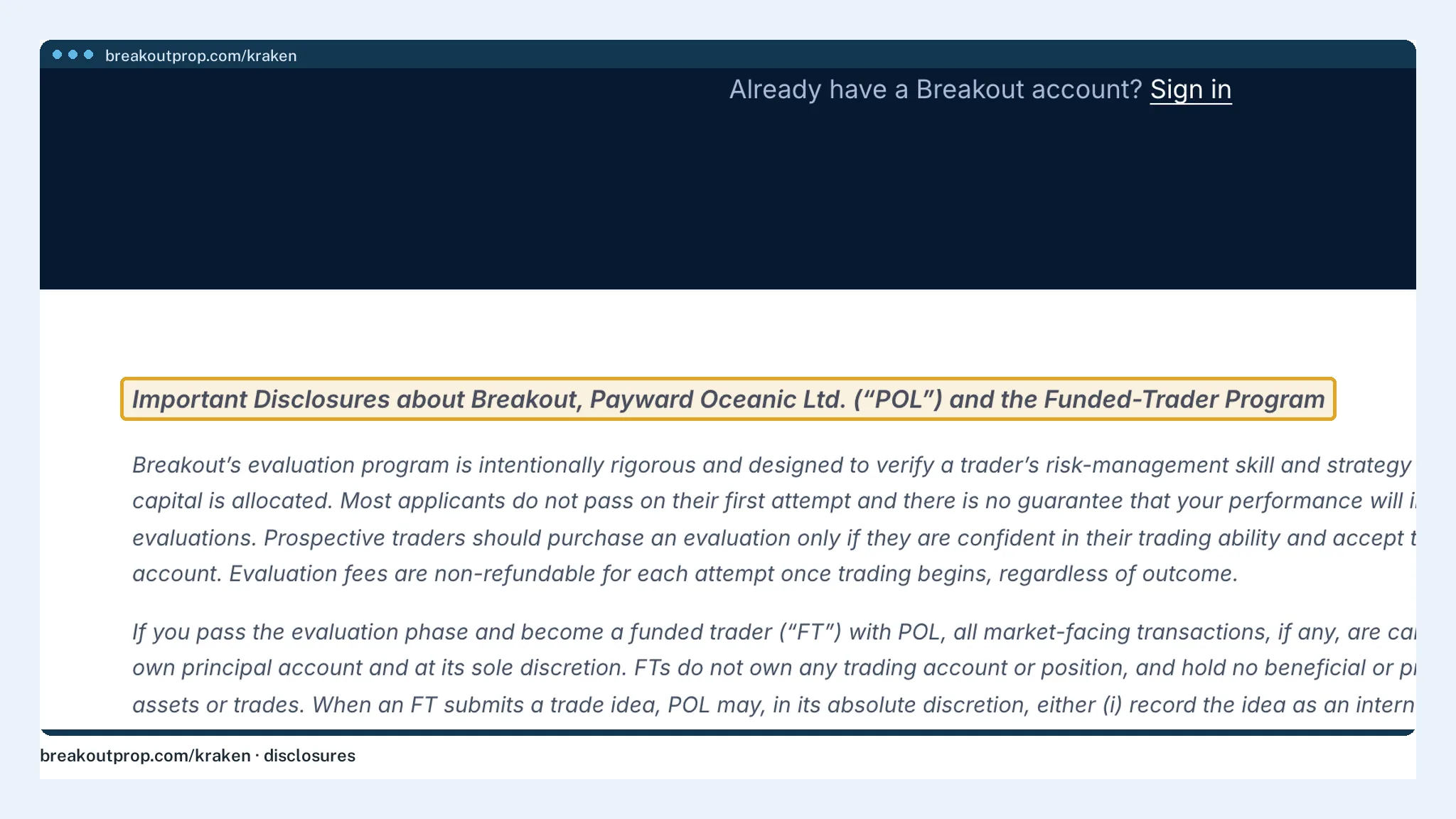
Yes, Breakout is owned by Kraken, which announced the acquisition on 4 September 2025. Breakout’s funded accounts are provided by Payward Oceanic Ltd, a Kraken group company. The ownership changes three things for a trader: payouts arrive only in USDC on Ethereum, identity is verified through SumSub before the funded account, and the funded contract states that trade ideas “may be A-booked or B-booked” at Payward Oceanic’s discretion.
Evidence
| quote | source |
|---|---|
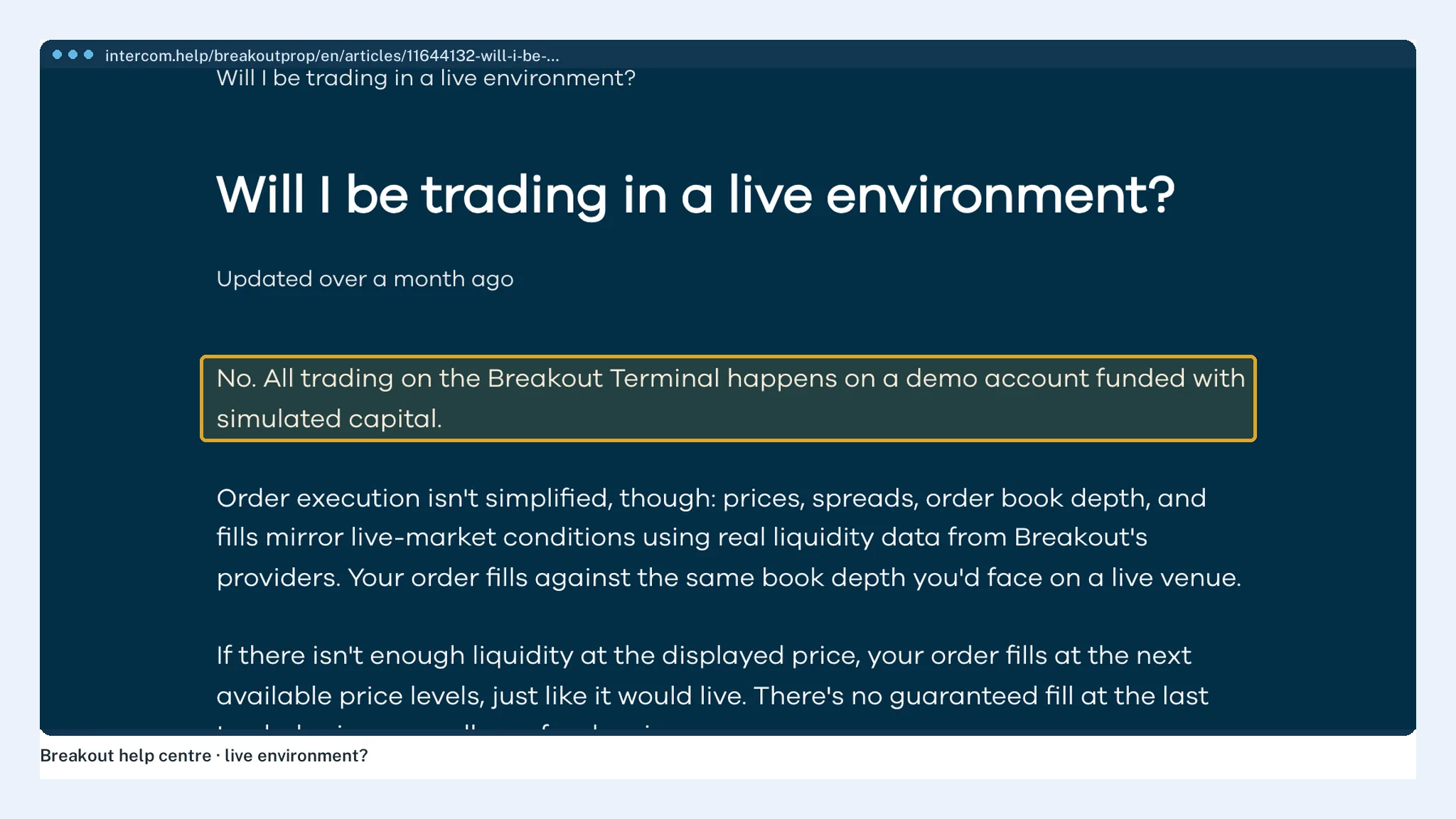
| the funded account is “a demo account funded with simulated capital” | Breakout help centre |
| Breakout’s evaluation program is “designed to verify a trader’s risk-management skill and strategy discipline before any proprietary capital is allocated by Payward Oceanic Ltd.” | breakoutprop.com (page disclosure) |
Kraken co-CEO Arjun Sethi said in the 4 September 2025 press release that “Breakout gives us a way to allocate capital based on proof of skill rather than access to capital itself”. Breakout co-founder and CEO Alex Miningham said that “Breakout gives traders a performance-based starting point. Kraken delivers the scale and tools to grow”, statements Blockhead paraphrased on 5 September 2025.
Payward Oceanic Ltd. appears by name in Kraken’s own global terms of service, per the Prop Firm Briefing review of 16 September 2026, which also notes that both the evaluation agreement and the funded agreement state the firm is unregulated.
Breakout does not use Bybit: it runs its own Breakout Terminal, with DXtrade retired, and the Kraken connection is corporate, not an exchange account. The $20 Turbo entry, which the Kraken ownership did not change, puts the firm among the cheapest crypto prop firms at the $5,000 size.
How much does a Breakout challenge cost?
Breakout challenges cost $20 to $1,090, from the $5,000 Turbo to the $200,000 Pro, with no refunds and a 90% split sold as an add-on at checkout.
| Account size | classic | pro | turbo | spark |
|---|---|---|---|---|
| $5,000 | $45 | $33 | $20 | — |
| $10,000 | $85 | $65 | $40 | — |
| $25,000 | $215 | $150 | $95 | — |
| $50,000 | $400 | $280 | $180 | $139 |
| $100,000 | $800 | $545 | $330 | — |
| $200,000 | — | $1,090 | $660 | — |
Values from each firm's own pages, checked by PropRubric
Three notes apply to the table. The first note on the table is the 90% profit split, an add-on to the table’s prices bought at checkout and permanent for that account. The add-on costs 20% of the evaluation fee, $8 on the $10,000 Turbo, $13 on the Pro and $17 on the Classic per the pricing page. The Spark plan, a $50,000 account with a $1,500 trailing drawdown, was priced at $139 and sold out on 29 September 2026; breach insurance, named in the search family, appears nowhere on the pricing page, so it is not sold there.
Evaluation fees for the plans sold there are non-refundable once trading begins, the payout balance can buy a new evaluation, and the checkout accepts cards and “select” cryptocurrencies through third-party processors.
Prop Firm Briefing’s review notes “Evaluations from $20” on pages where it found the cheapest product at $40; PropRubric’s ladder, read at the pricing page, records the Turbo $5,000 at $20.
What does Breakout cost per $10,000 of funding?
Breakout costs $66.00 per $10,000 of funding on the $200,000 Turbo and $80.00 on the $5,000 Turbo, computed as the fee plus one reset at the same price, divided by the account size in $10,000 units. The Classic plan, with double the Turbo’s floor, costs $160.00 per $10,000 at $100,000.
| account size | Turbo | Pro | Classic |
|---|---|---|---|
| $5,000 | $80.00 | $132.00 | $180.00 |
| $10,000 | $80.00 | $130.00 | $170.00 |
| $50,000 | $72.00 | $112.00 | $160.00 |
| $100,000 | $66.00 | $109.00 | $160.00 |
| $200,000 | $66.00 | $109.00 | — |
The price buys the floor: Turbo’s 3% maximum drawdown is half the room of Classic’s 6% for less than half the price, and the rules decide which one a strategy survives.
What are Breakout’s trading rules?
Breakout’s trading rules are two equity limits, a 3% daily loss and a static 3% to 6% maximum drawdown, and a list of prohibited trading practices, with no consistency rule, minimum days, time limit, stop-loss requirement or news restriction. The three sections below cover those rules: the drawdown limits, the restrictions and the instruments.
| Rule | Value | Source |
|---|---|---|
| Daily drawdown | classic: 3%; pro: 3%; turbo: 3%; spark: none Spark has no daily loss limit. Legacy 2-step: 4%. | intercom.help |
| Daily reset (UTC) | 00:30 | intercom.help |
| Maximum drawdown | classic: 6%; pro: 5%; turbo: 3%; spark: $1,500 trailing | intercom.help |
| Drawdown type | classic/pro/turbo: static from initial balance; spark: trailing $1,500 below the closed-balance high, updated daily at 00:30 UTC; never locks | breakoutprop.com |
| Per-trade loss cap | none The rulebook states no per-trade risk rule; exposure is limited by the daily and maximum drawdown only. | breakoutprop.com |
| Stop-loss required | no | breakoutprop.com |
| Consistency rule | none | breakoutprop.com |
| Profit target | classic: 10%; pro: 12%; turbo: 9%; spark: $3,000 (6%) | breakoutprop.com |
| Minimum trading days | 0 'No min trading days. Pass in one trade.' | breakoutprop.com |
| Time limit | unlimited (90 days without a trade suspends a funded account) | breakoutprop.com |
| Weekend trading | yes | intercom.help |
| Hedging | within one account allowed (Hedge Mode on by default); across accounts or traders prohibited | intercom.help |
| Copy trading | not allowed (third-party signals and cross-user copying prohibited) | intercom.help |
| Leverage | BTC: 10x; ETH, SOL, XRP, BNB, DOGE and ~20 others: 5x; ENA, HYPE, PEPE and ~8 others: 3x; smaller alts: 2x; XYZ100/S&P500: 10x; spark indices: up to 40x Conflict resolved 2026-09-30: the firm's announcement '10x Leverage Is Now Live on Breakout' (2026-08-12) raised BTC, XYZ100 and S&P500 from 5x to 10x, SOL 2x→5x, HYPE 2x→3x. The Funded Trader Agreement / Evaluation Agreement Annex A ('Program Rules updated as of August 27, 2026') still lists the older 5x for the indices; propfirmbriefing.com (2026-09-16) documents the same drift. The live symbol list is the firm's stated source of truth. | intercom.help |
| Account limits | $200,000 total across funded accounts | intercom.help |
What are Breakout’s drawdown limits?
Breakout allows a 3% daily drawdown and a maximum drawdown of 6% on Classic, 5% on Pro and 3% on Turbo, measured on equity, with the daily floor recalculated from the balance excluding open positions at 00:30 UTC and the maximum floor static from the initial balance.
Both limits are measured on equity, so an open position can breach either floor, and the firm gives its reason in its help centre: balance limits would let a trader “incur any amount of losses without breaching as long as they didn’t close the trade”.
A withdrawal moves the daily floor down by the amount withdrawn, and the static maximum never trails, so withdrawing every dollar of profit returns the account to its original room.
The Spark plan replaces both with one $1,500 trailing floor below the highest closed balance, updated daily at 00:30 UTC, that never locks.
Which trading restrictions does Breakout have?
PropRubric checks twelve restriction rules at Breakout, and the firm publishes ten of them.
- Stop-loss required: ✗ no.
- Per-trade loss cap: none.
- Consistency rule: none.
- Minimum trading days: none.
- Time limit: none; 90 days without a trade suspends a funded account.
- News trading: not published.
- Weekend holding: ✓ allowed; the market is 24/7.
- Hedging: ✓ within one account (Hedge Mode on by default); ✗ across accounts or traders, including correlated positions.
- Copy trading: ✗ third-party signals and cross-user copying prohibited.
- Bots and API: a rule is not published; strategies “marketed to pass evaluation requirements” are prohibited.
- Multiple accounts: ✓ up to $200,000 across funded accounts; trading from the same household, device or IP address is prohibited.
- Inactivity: 90 days.
The prohibited-trading list is long and discretionary, per the evaluation agreement, and Prop Firm Briefing’s review found that the agreement answers whether a breach finding can be arbitrated both ways in two sections. How the absence of a stop-loss rule compares across firms belongs on the page about which crypto prop firms cap the loss on one trade.
What can you trade at Breakout, and with how much leverage?
You can trade 60 crypto perpetual-style contracts and four index and commodity contracts at Breakout, 63 markets in all, at leverage the firm applies per market with no setting for the trader.
| market | leverage | note |
|---|---|---|
| BTC | 10x | raised from 5x on 12 August 2026, per the firm’s announcement |
| ETH, SOL, XRP, BNB, DOGE and about 20 others | 5x | SOL raised from 2x |
| ENA, HYPE, PEPE and about 8 others | 3x | HYPE raised from 2x |
| smaller altcoins | 2x | eight new assets added 16 September 2026 |
| XYZ100 (Nasdaq 100) and S&P 500 | 10x | Breakout Terminal only; priced from Hyperliquid |
| crude oil and silver | 5x per the symbols page | — |
The firm’s evaluation agreement annex, dated 27 August 2026, still lists the two indices at 5x and the commodities at 2x. The firm’s announcement of 12 August 2026, its symbols page and its help centre give 10x and 5x, so PropRubric records the announced values and notes the annex as stale. Commissions on the announced markets are 0.04% per side on crypto, with a 0.033% daily financing charge taken every four hours on the Breakout Terminal.
How do Breakout payouts work?
Breakout pays 80% of profits, or 90% with the add-on, in USDC on Ethereum on demand, with the first payout available as soon as $50 of net profit has accrued after the split.
Payout terms
| split | first payout | frequency | minimum | currency + network | speed | proof |
|---|---|---|---|---|---|---|
| 80% → 90% (add-on bought at checkout) | once ≥ $50 of net profit accrues | on demand, 24/7 | $50 after the split | USDC on Ethereum (ERC-20) only | approval 12–24 hours, “usually much quicker” | public leaderboard of lifetime payouts by trader name; no on-chain links |
Three conditions apply to a request: no open positions at the time of the request, no breach, and KYC completed. The request then waits for an approval: the pricing page advertises “no approval delays” while the help centre states an approval process of 12 to 24 hours, and PropRubric records the help centre’s figure for the approval. After the approval, the payout travels on one rail, USDC on Ethereum and nothing else, uninsured by any institution in the firm’s own words, and a wrong-network transfer is lost.
The leaderboard is the firm’s own statement of totals, not a proof of transfer, and Breakout appears in no third-party payout tracker in the pages PropRubric read. How payouts work across the whole class is explained in how crypto prop firm payouts work.
Who can trade with Breakout?
Not listed as restricted: Breakout does not name the United States on its restricted-country list, and its terms carry a 24-country list that excludes, among others, Russia, Iran, Cuba, Venezuela and the occupied regions of Ukraine. The country count differs between the firm’s documents, per Prop Firm Briefing: 21 countries on the public rules page, 22 in the agreements, 23 in the help centre.
Who can join
| US status | restricted countries | KYC timing | platform exceptions |
|---|---|---|---|
| not listed as restricted (the earlier “yes, with regional restrictions” came from a Kraken comparison page) | 24 entries in the terms PropRubric read | none to buy or trade the evaluation; mandatory before the funded account or any payout (SumSub) | Breakout Terminal only; index and commodity contracts not on the retired DXtrade |
“Not listed as restricted” is the firm’s silence about the United States, not a statement that it accepts US residents, and the two are recorded differently by PropRubric.
Is Breakout legit?
Yes, Breakout is a legitimate, operating crypto prop firm. The evidence for that firm is that an exchange group owns it, its two contracting companies are named, one has a public SEC filing, and its rules are published in full. The rulebook exists in more versions than it should, and the evidence list below says where.
- Status: active.
- Operator and jurisdiction: Breakout Trading Group, LLC (Delaware, SEC Form D on file per Prop Firm Briefing) for evaluations; Payward Oceanic Ltd. (BVI, Kraken group) for funded accounts.
- Operating since: 2023; Kraken’s ownership since 1 September 2025.
- Payout evidence: a firm leaderboard only; no on-chain record and no third-party tracker entry; the firm’s “$60M+ paid to traders” and “20,000 funded accounts” are unaudited claims.
- Complaint signal: Trustpilot 4.7 from 1,211 reviews, read directly, with 470 in the last twelve months and a Trustpilot “may be associated with high-risk investments” notice but no guideline-breach warning, matching Prop Firm Briefing’s 4.7 from 1,100 on 16 September 2026; complaints cluster on commissions, spreads and platform quality, not on non-payment.
- Contradictions found: the evaluation agreement annex vs the leverage announcement; “no approval delays” vs a 12–24-hour approval; three restricted-country lists; a KYC refund right granted in three documents and denied in one help article, per the same review.
- Named people: Alex Miningham, co-founder and CEO; Dylan Loomer, co-founder; Arjun Sethi, Kraken co-CEO; Michael Cogswell of Prop Firm Briefing, whose review of 16 September 2026 scored the firm 8.2 out of 10.
A firm’s rules and status change over time, so the last question is what has changed at Breakout recently.
What has changed at Breakout?
The change log for Breakout holds 10 rows, 7 of them changes the firm made, and the other rows are PropRubric’s 0 corrections and 3 additions to its own record.
| Date | Firm | What changed | Source |
|---|---|---|---|
| 5 Oct 2026PropRubric addition |  Breakout | Founded Not published → 2023 (firm-reported on Kraken's prop page: "Over 35,000 wallets funded since 2023"); acquired by Kraken with effect from 1 September 2025 not a rule change) | kraken.com |
| 30 Sep 2026PropRubric addition | Breakout | Daily drawdown basis Not published → balance excluding open positions at 00:30 UTC, recalculated daily (a floor for the next 24 h); breach is measured on equity, so open positions count toward hitting the floor help-centre example: balance $105,000 at 00:30 UTC → floor $101,850. | intercom.help |
| 30 Sep 2026PropRubric addition | Breakout | Leverage note The Funded Trader Agreement annex (linked from Kraken support) still says 'BTC and ETH 5x, all others 2x'; the help centre and symbols page are newer. Help centre recorded. → Conflict resolved 2026-09-30: the firm's announcement '10x Leverage Is Now Live on Breakout' (2026-08-12) raised BTC, XYZ100 and S&P500 from 5x to 10x, SOL 2x→5x, HYPE 2x→3x. The Funded Trader Agreement / Evaluation Agreement Annex A ('Program Rules updated as of August 27, 2026') still lists the older 5x for the indices; propfirmbriefing.com (2026-09-16) documents the same drift. The live symbol list is the firm's stated source of truth. 5x-vs-10x conflict resolved: agreement annex is stale. | breakoutprop.com |
| 29 Sep 2026Firm change | Breakout | US residents yes, with regional restrictions → not listed as restricted firm-side date unknown. | intercom.help |
| 29 Sep 2026Firm change | Breakout | Daily drawdown 3 (Classic) / 4 (Pro, 2-step) → classic: 3; pro: 3; turbo: 3; spark: Not published firm-side date unknown. | intercom.help |
10 logged changes at Breakout, the 5 newest above; every row is in the log of crypto prop firm rule changes
Every change at every firm, with the same columns, is in the log of crypto prop firm rule changes.
What are the alternatives to Breakout?
Three firms differ from Breakout on its weakest attributes, the USDC-on-Ethereum-only payout rail and the absence of a refund, and each card names the difference; how PropRubric scores firms sets out the five criteria behind every score on this site.
- HyroTrader: USDT or USDC with Solana transaction IDs in a public feed, and the One-Step and Two-Step fee refunded with the first payout, from $59; a UAE and BVI firm whose account trades your own Bybit or BloFin demo account, or its Hyro platform. The two are compared side by side in HyroTrader vs Breakout.
- Propr: USDC on chain on demand from $20 with every trade labelled A-book or B-book, from $25; a British Virgin Islands firm on Hyperliquid perpetuals.
- Crypto Fund Trader: bank transfer, USDT on two networks, BTC or ETH, from $40; a Swiss-run firm with up to 715 pairs across three platforms. The two are compared side by side in Crypto Fund Trader vs Breakout.
Firms that fix the payout rail and the refund are listed among the Breakout Prop alternatives.