How PropRubric Verifies Prop Firm Rules, Prices and Payouts
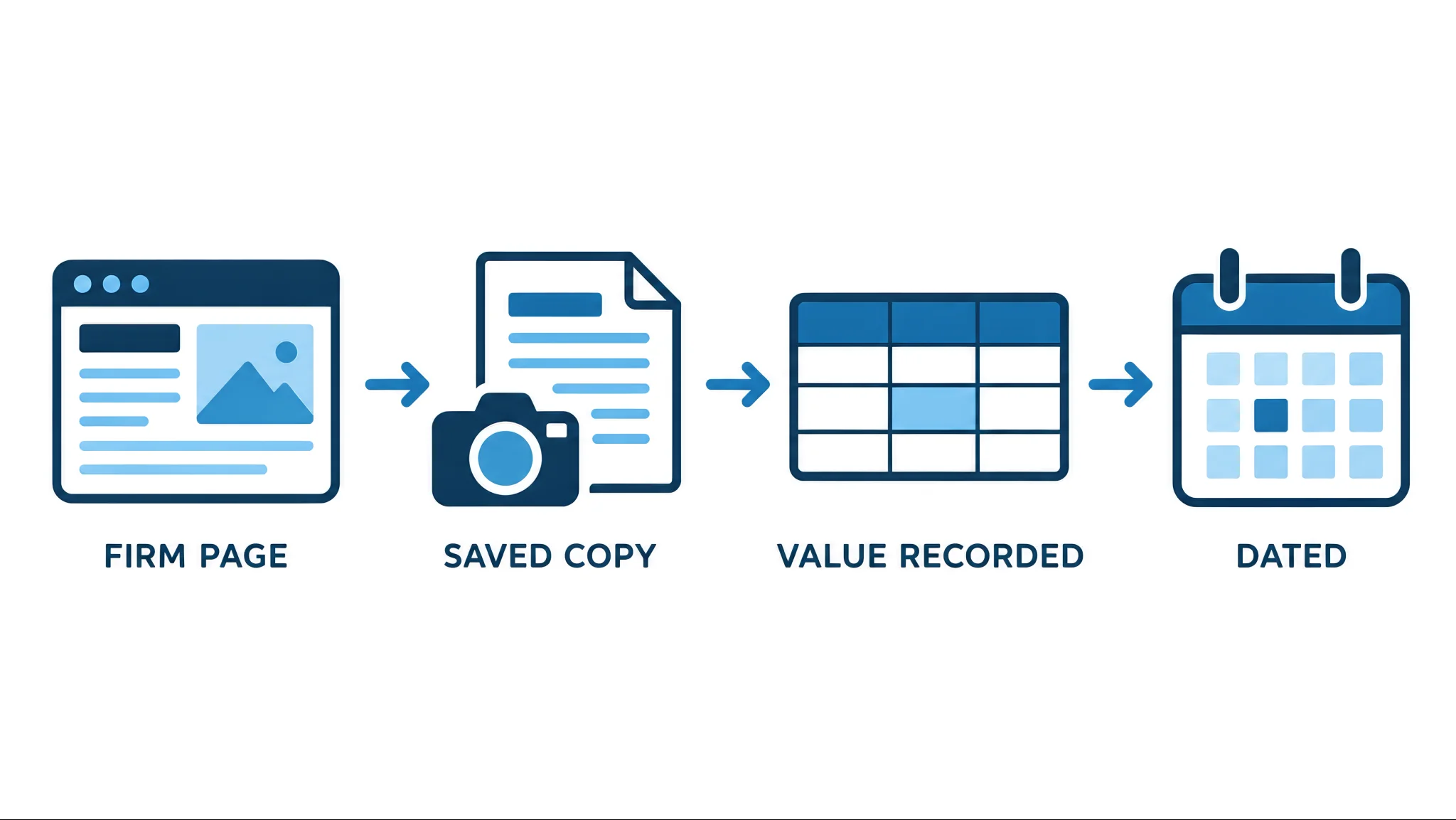
PropRubric records a crypto prop firm value only when the firm’s own page states it, and stores the page, the date and a saved copy with every value. The value then appears on every page that uses it, with the same wording, and each one carries a tooltip naming its source and check date. This page describes that procedure step by step, from the evidence rule to the limits of what a reader of firm documents can know, so you can judge the list of all crypto prop firms before you rely on it.
What is PropRubric’s evidence rule?
The saved copy matters as much as the URL. Firm pages change without notice, so the copy is the evidence that the value was true on the day it was read. One stop-loss rule in these records was already out of date on the day it was read, because the FAQ answer it came from was removed the same week.
Which values does PropRubric check?
PropRubric checks twenty fields for every firm, and the same twenty fields feed every table on the site. The table below names each field in plain words, says where the value is read from and how often it is re-read.
| field | what it means | where PropRubric finds it | re-check |
|---|---|---|---|
| status | active, paused, closed or unreachable | the firm’s site, a status page, a dated announcement | monthly, and on signal |
| challenge fee | the one-time price per account size and model | the firm’s pricing page or checkout | weekly (W1 firms) |
| profit target | the gain needed to pass each phase | the rules table and the terms | monthly |
| daily loss limit | how much the account can lose in one day, and from which reference (balance or equity) | the rules table, the FAQ and the terms | monthly |
| daily reset time | the UTC time the daily limit is recalculated | the FAQ or the help centre | monthly |
| maximum drawdown and its type | the overall loss floor: static, trailing intraday, trailing end-of-day, or locked | the terms and the FAQ | monthly |
| per-trade loss cap | a limit on the loss of one position | the rules page | monthly |
| stop-loss requirement | whether every order needs a stop | the rules page and the FAQ | monthly |
| consistency rule | a cap on how much of the profit one day may hold | the rules page, with its phase scope | monthly |
| minimum trading days and time limit | days required and days allowed | the rules table | monthly |
| leverage | the maximum per market or per model | the symbols page, the FAQ, the terms | monthly |
| instruments and pair count | what the account can trade | the symbols page | monthly |
| platform and execution venue | the terminal, and whether orders are simulated, exchange-connected or on-chain | the terms, first; the platform page second | monthly |
| profit split and scaling | the initial and maximum share of profit | the pricing page and the terms | monthly |
| payout terms | frequency, minimum, currency and network | the payout page, the FAQ and the terms | weekly (W1 firms) |
| payout proof | whether payouts can be checked outside the firm’s own claims | the firm’s payout feed; on-chain transaction IDs | monthly |
| KYC timing | when identity checks happen | the FAQ and the terms | monthly |
| restricted countries | who cannot join | the terms and the FAQ | monthly |
| refund policy | whether and when a fee comes back | the terms and the FAQ | monthly |
| legal entity | the company behind the brand | the terms and the footer | monthly |
Each field has one place it is read from first, listed in the “where” column, and the firm’s terms are always read alongside it. A rules table is the fastest to read and the first to go stale.
What happens when a firm contradicts itself?
A firm contradicts itself when its marketing page and its contract state a rule differently, and PropRubric records the contract. The terms bind the trader, the marketing page does not, so PropRubric follows the terms and the page shows both statements with their dates.
HyroTrader’s homepage used to advertise trading on your own Bybit account, while its terms stated that all trading under the service is simulated, and PropRubric recorded the account as simulated with the homepage claim noted beside it. HyroTrader has since removed that homepage claim, so its pages and its terms now both say simulated.
The difference between those two statements is explained on the page about simulated vs live accounts at crypto prop firms. A second pair of statements shows how a dated document closes a contradiction.
Breakout’s evaluation agreement annex listed two indices at 5x leverage while its help centre said 10x, and the two values stayed side by side in PropRubric’s records until the firm’s own announcement of the change, dated 12 August 2026, settled it. The announcement carries a date and the annex does not, so the dated document wins and the annex is noted as stale.
How often are values re-checked?
Re-checks run on four cadences, and the cadence depends on how fast the field moves and how many readers depend on it.
| cadence | scope |
|---|---|
| before launch | every firm PropRubric tracks fully verified, with the reviewed firms at 100% field coverage |
| weekly | the firms with a full review page |
| monthly | every firm, including a status re-check (active, paused, closed, unreachable) |
| on signal | a firm announcement, a Discord or X post, or a spike of complaints on Reddit or a review site triggers a same-day re-check of that firm |
A re-check that finds a changed value writes the old value, the new value, the source and the date to the log of crypto prop firm rule changes, and the page updates from the record on the next build.
How do firms enter and leave the list?
Firms enter the list through a census, and they leave it only with a dated reason. The census has one inclusion rule and four exit states.
- Inclusion: a firm enters when it sells a funded-account evaluation and lets the account trade cryptocurrency, either as a crypto-first firm or as a multi-asset firm with a crypto offer.
- Active: the firm’s site is live and its checkout sells at least one challenge.
- Closed: the firm’s own announcement, a regulator notice or a dated news report confirms it stopped operating.
- Unreachable: the firm’s site fails to load on two checks at least a day apart, but no closure source exists; the page says so instead of calling the firm closed.
- Excluded: the firm was checked and found not to meet the inclusion rule, for example a firm that an aggregator lists as crypto but whose own FAQ says no crypto is offered; the exclusion and its reason are listed on the directory.
A watch list holds firms named by other sources that PropRubric has not yet checked, and each one is checked at the next monthly pass.
How are firms ranked?
Firms are ranked on five criteria with equal weight, rule leniency, total cost, payout terms, transparency and who can join, and every criterion is computed from checked values that come from the firms’ own terms. Affiliate status is never one of those fields, so a firm that pays PropRubric a commission is scored by the same rule as a firm that pays nothing.
| criterion | weight | checked values it uses |
|---|---|---|
| rule leniency | 20% | daily loss limit, maximum drawdown and its type, per-trade cap, stop-loss requirement, consistency rule, minimum days, time limit |
| total cost | 20% | challenge fee per size, reset and activation fees, refund policy |
| payout terms | 20% | profit split, first-payout wait, frequency, minimum, currency, payout proof |
| transparency | 20% | published terms, contradictions between documents, legal entity named |
| who can join | 20% | restricted countries, KYC timing, platform limits by region |
The rules hub uses the rule-leniency criterion on its own as a leniency score. The score is the daily loss percentage plus the maximum drawdown percentage, plus 2 points for a static maximum drawdown, 2 points for no consistency rule and 1 point for no per-trade loss cap. The score is computed on the firm’s most lenient model with a published drawdown type. In the overall ranking, the score sits on a fixed scale from 6 to 22 points.
Six points, a 3% daily and 3% maximum limit with no bonus, count as 0, and 22 points, a 5% daily and 12% maximum limit with every bonus, count as 10. A fixed scale of points means one firm’s values never move another firm’s score.
A firm’s place in the rules table and its place in the overall ranking can therefore differ. Both rankings are recomputed from the checked values whenever a value changes, and a change to one value moves a firm without anyone editing a page.
What can’t PropRubric verify?
PropRubric can verify what a firm publishes, and nothing beyond it. Four things stay outside what PropRubric can verify.
- A firm’s back-end data. Pass rates, funded-account counts and total payouts are the firm’s own claims unless a third party has checked them, and the page says which is the case.
- Every trader’s payout. A payout feed with on-chain transaction IDs proves those transactions happened; it does not prove that every eligible trader was paid.
- Live versus simulated execution beyond the documents. The terms say whether an account is simulated, and PropRubric reports what the terms say; it cannot see the firm’s order routing.
- Firm-stated speeds. “Payouts in 12 hours” is recorded as the firm’s statement with its date, not as a measurement.
Anything PropRubric got wrong within those limits is fixed under the corrections policy, with the old value, the new value and the date shown on the page. Who does the checking is on the page About PropRubric, and every affiliate agreement PropRubric holds, with the rule that none of them touches a score, is listed on the page about how PropRubric makes money.