Crypto Fund Trader: simulated, stated on the homepage. The homepage says “It’s all demo, no real capital involved.” Payouts are still real money, sent by bank transfer in EUR or USD, or in USDT, BTC or ETH, in about 8 hours on average by the firm’s own account.
Do Prop Firms Use Real Money? Simulated vs Live Accounts
Affiliate link: PropRubric may earn a commission if you buy, at no extra cost to you. It never changes a score or a ranking.
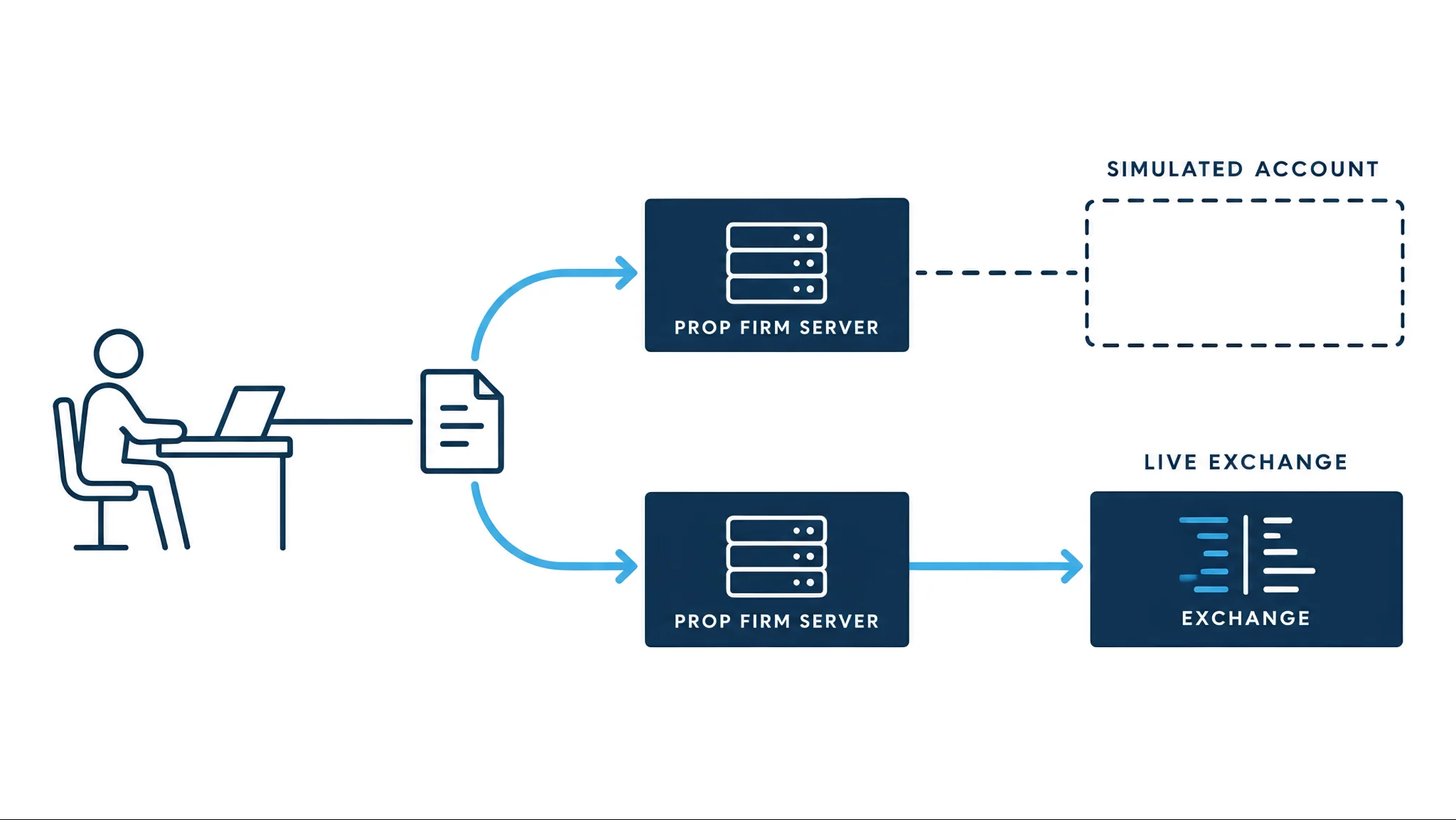
Prop firms mostly do not use real money for funded accounts: traders trade simulated capital, and the firm pays real-money profit splits from its revenue. A simulated account mirrors the market without sending orders to it. A live account routes orders to a real market with the firm’s capital behind them.
In the simulated account model, payout money comes mainly from challenge fees. All five crypto prop firms compared on this page run simulated funded accounts, and that includes the one that connects your own Bybit demo account.
The two account types differ in routing, fills, funding payments and withdrawals, and the evidence that separates them is written, not visual. A disclosed simulated account is not a scam. Check how a firm funds each account, so you know what you are buying before you compare all crypto prop firms side by side.
| Firm | What the firm says | Capital model | Rules and price |
|---|---|---|---|
| Crypto Fund Trader | “It’s all demo, no real capital involved” | Simulated (homepage) | Check |
| Bitfunded | “Bitfunded is fully simulated environment” | Simulated (homepage) | Check |
| Mubite | “a simulated funded account” after verification | Simulated (rules page), priced from Bybit | Check |
| Breakout | “a demo account funded with simulated capital” | Simulated (help center) | Check |
| HyroTrader | “All trading activity conducted under the Service is simulated” | Simulated (terms and FAQ) | Check |
The quote behind each row, and where it was found, is in the section on which crypto prop firms trade on a real exchange.
Do prop firms use real money?
No, most prop firms do not trade funded accounts with real money: traders trade simulated capital, and the firm pays real-money profit splits from its own revenue. The three questions below answer this in order: Is a prop firm a demo account; What is a simulated funded account; and What is a live funded account.
The real money sits in the payouts, not in the funded balance. The balance is a number on the firm’s system. The payout is a real transfer from that system to your bank account or crypto wallet.
Murthy Thevar, writing for JournalX in July 2026, put it bluntly: “The uncomfortable truth of the modern prop industry is that the majority of ‘funded accounts’ are simulated.”
Spotware, the company behind the cTrader platform, describes three funding models that prop firms run:
- Simulated account with real payouts. You trade a simulated balance, and the firm pays a share of the simulated profit in real money.
- Hybrid or trade-mirroring model. You stay on a simulated account, but the firm copies some of your positions to a real market with its own money.
- Direct real-money account. Your orders go to a real market with firm capital, usually only after you have proven yourself.
Spotware sums up the order of events in one line: “Real money comes later. Prop firms do deploy live funds, but only after traders prove consistency.” That line comes from an October 2025 guide written for firm owners, not traders, which makes it unusually candid.
Why run simulated accounts at all, if the payouts are real? Spotware’s phrase for the simulated evaluation stage answers it: “revenue first, risk later.”
A simulated balance lets a firm test thousands of traders without risking capital on any of them. The challenge fees fund the payouts, and real capital is kept for the few who prove consistency. Keeping capital simulated is a cost decision by the firm, not a verdict on your skill.
That makes payouts depend on fee revenue. Angelo Ciaramello, CEO and founder of The Funded Trader, told Finance Magnates in March 2025 that the margin from his firm’s pass and payout numbers “allows us to clear our debts.”
So a prop firm’s own labels prove little about the money behind an account. Andrej Gjorgievski of CryptoSlate lists “‘live’ or funded labels and real-time charts” as weak evidence, a point the section on checking a firm comes back to.
Behind the answer sit two account types, the simulated funded account and the live funded account, and both start with a demo-style challenge.
Is a prop firm a demo account?
Yes, a prop firm challenge is a demo account in all but name, and most prop firm funded accounts stay demo accounts after the trader passes. Every crypto firm PropRubric checked says so in its own words.
Crypto Fund Trader calls its accounts “all demo.” Breakout’s help center says all trading happens “on a demo account funded with simulated capital.” You trade simulated money from the first challenge day, and real money only shows up when a payout arrives.
What separates a prop firm account from an ordinary demo is rules and payouts. An exchange demo has no loss limits and pays nothing. A prop firm demo enforces a daily and maximum drawdown and pays a share of eligible profit in real money.
Free trials sit in between: real market prices, but no real money. HyroTrader’s free trial runs “in a simulated environment powered by real market data,” and the firm says that “performance during the trial is not eligible for withdrawals or profit payouts.” Only the paid challenge opens the path to a payout.
What is a simulated funded account?
The contract is what turns simulated profit into real money. It defines eligible profit, the split and the payout schedule, and the firm pays from its own funds once you meet the terms.
Identity checks usually happen here too: HyroTrader requires KYC before it activates a funded account, and Crypto Fund Trader requires it before the first reward.
The challenge’s loss limits carry over, so breaking a daily or maximum drawdown still closes the account. Those limits protect the prop firm’s payout budget, not real capital, because there is no real capital behind the balance. You cannot withdraw the balance itself, only your share of eligible profit.
What is a live funded account?
Among retail prop firms it is the exception, which is exactly Thevar’s point about most funded accounts being simulated. Spotware places real-money accounts after a trader has proven consistency.
No crypto firm compared on this page offers a live account after a trader proves consistency: HyroTrader, whose FAQ once tied real capital to a minimum 15% profit, now states “There is no real-capital stage at any point.”
Four things change when a trader moves to live capital:
- fills and slippage come from the real order book, partial fills included;
- exchange fees and funding payments are charged by the market, not by the firm’s rulebook;
- risk controls often tighten, since Spotware describes live accounts as reserved for top traders under strict parameters;
- payouts can come from real market profit instead of the firm’s revenue.
Even a live funded account is not your own account. In that account, the capital, the withdrawal rights and the rules all stay with the firm, and your loss is still capped at the challenge fee.
A personal live account works the other way round: you own the capital, keep all of the profit and carry all of the loss.
Moving to live capital is a selection, not a default. Among the five crypto firms compared on this page, none describes a route to real capital at all, since HyroTrader removed the route it used to describe.
Where does the money for prop firm payouts come from?
Prop firm payouts come from the firm’s revenue, which in the simulated model is mainly challenge fees, according to Spotware; only firms running mirrored or live accounts can also pay from market profits.
Fees can cover payouts because far more people buy a challenge than ever get paid. FPFX Technologies data on more than 300,000 prop trading accounts, reported by Finance Magnates in September 2024, puts average challenge spending at about $800 per account.
In the same data, 14% of traders passed a challenge and about 45% of those reached a payout, so roughly 7% of all traders were ever paid. As a rough illustration: 100 traders spending about $800 each bring in about $80,000 in fees, and only about 7 of them are ever paid.
- $800average challenge spending per account
- 14%traders who passed a challenge
- 7%traders who were ever paid
Ciaramello’s firm-level figures on who gets paid point the same way: he told Finance Magnates that his pass rate ran from 5% to 10%, and that only 1% to 2% of clients received a payout.
The rulebook keeps that balance stable. Spotware lists the rulebook controls that keep the simulated model sustainable: position sizing limits, drawdown caps, daily loss limits and the ability to force-close positions in bulk.
Each control caps how much a single trader can earn before a rule ends the account, which keeps payouts inside the fee budget. Ciaramello’s remark about clearing debts shows the same revenue funding the whole business, not only the payouts.
Mirrored trading adds a possible second source. In mirrored trading, a firm copies a consistent trader’s positions to a real exchange with its own capital, and the profit on those copies may cover part of that trader’s payout.
Few prop firms publish whether they do this, so you cannot confirm it from the outside. Assume every payout comes from revenue unless a firm publishes live routing in its terms.
Which crypto prop firms trade on a real exchange?
None do by their own terms: all five crypto prop firms compared on this page run funded accounts on simulated capital, including HyroTrader, which connects the trader’s own Bybit or BloFin demo account.
Here is what each of the five firms says, and where it says it:
Bitfunded: simulated, stated on the homepage. A banner on the homepage reads “Bitfunded is fully simulated environment.” Bitfunded pays profits in USDT within 24 hours of a request, by its own account.
Mubite: simulated, stated on the rules page. After verification, the rules page says traders move to “a simulated funded account,” while prices and market depth come directly from Bybit.
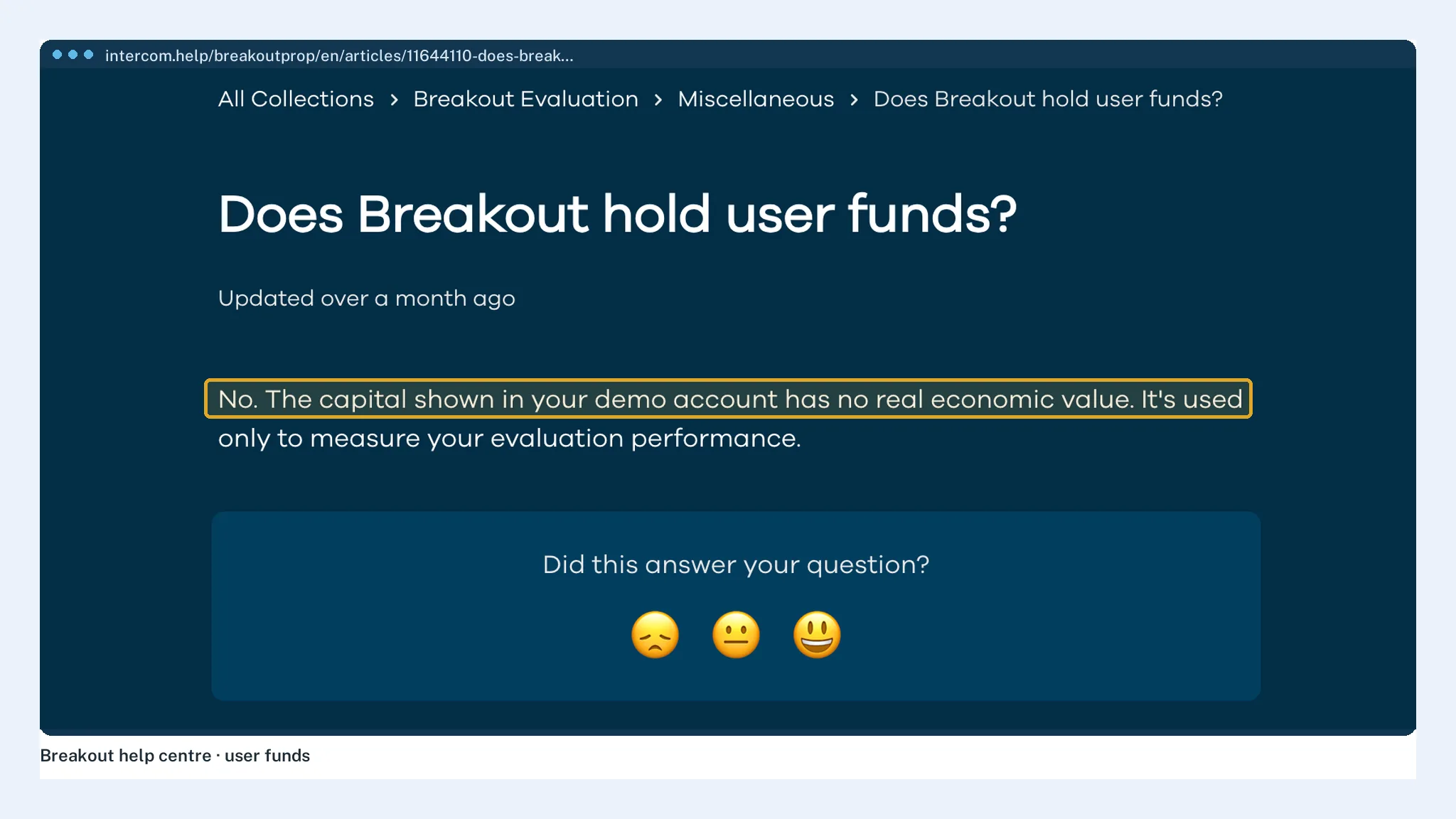
Breakout: simulated, stated in its help center. Asked whether traders trade in a live environment, Breakout answers “No” and says all trading happens “on a demo account funded with simulated capital.” CryptoSlate’s review of Breakout says the same. Breakout, which Kraken announced it had acquired on 4 September 2025, pays out in USDC.
HyroTrader: simulated, stated in its terms. The HyroTrader terms, last updated 29 September 2026, say “All trading activity conducted under the Service is simulated,” across the challenge, verification and funded phases, and “no order you place through the Platform is executed against a live market venue.” The HyroTrader FAQ says the same: “The payouts are real; the trading is simulated.” The homepage line that advertised “real market execution” has been removed, so HyroTrader’s pages and terms now agree. HyroTrader pays out in USDT or USDC within 24 hours.
A Bybit connection is not a Bybit account with firm capital in it. Mubite prices its simulated balances from Bybit. HyroTrader connects the trader’s own Bybit or BloFin demo account, and its contract calls the funded phase simulated.
Whatever the connection does technically, the terms are what the firm pays out under, so PropRubric files both firms as simulated. The firms that connect to Bybit in either way are compared in crypto prop firms that use Bybit.
PropRubric re-checks this wording weekly for the reviewed firms and monthly for the rest, and dates every change, so a firm that adds a live stage moves rows here.
Do crypto prop firms pay real money?
Yes, crypto prop firms pay real money: the challenge fee, any fee refund and every payout are real transfers, even when the trading balance is simulated. The table shows where real money changes hands at the five crypto prop firms compared on this page:
| Firm | Real money you pay | Real money back as a refund | Real money out as payouts | The balance |
|---|---|---|---|---|
| Crypto Fund Trader | $40–$1,199 for a one-phase challenge ($5,000–$200,000) | Not published on the pages checked | Bank transfer (EUR/USD), USDT, BTC or ETH | Simulated |
| Bitfunded | $79–$799 for a two-step challenge ($5,000–$100,000) | Two-step fee returned with the third successful payout | USDT, within 24 hours | Simulated |
| Mubite | $65–$1,099 for a two-step challenge ($5,000–$200,000) | Two-step fee refunded in full with the first profit split | On demand once funded and in profit, then every 14 days | Simulated |
| Breakout | From $20 (a $5,000 one-step Turbo account) | None: evaluation fees are non-refundable | USDC (ERC-20), on demand | Simulated |
| HyroTrader | $59–$969 for a two-step challenge, $69–$1,299 for a one-step ($5,000–$200,000), $89–$949 for a zero-step ($5,000–$100,000) | Two-step and one-step fee returned with the first payout; zero-step fee non-refundable once activated | USDT or USDC, within 24 hours | Simulated |
Real money moves in a loop: you pay a fee in, the firm may refund it, and the firm pays profit splits out. The balance on your screen is the only part of that loop that is not real money, at all five firms.
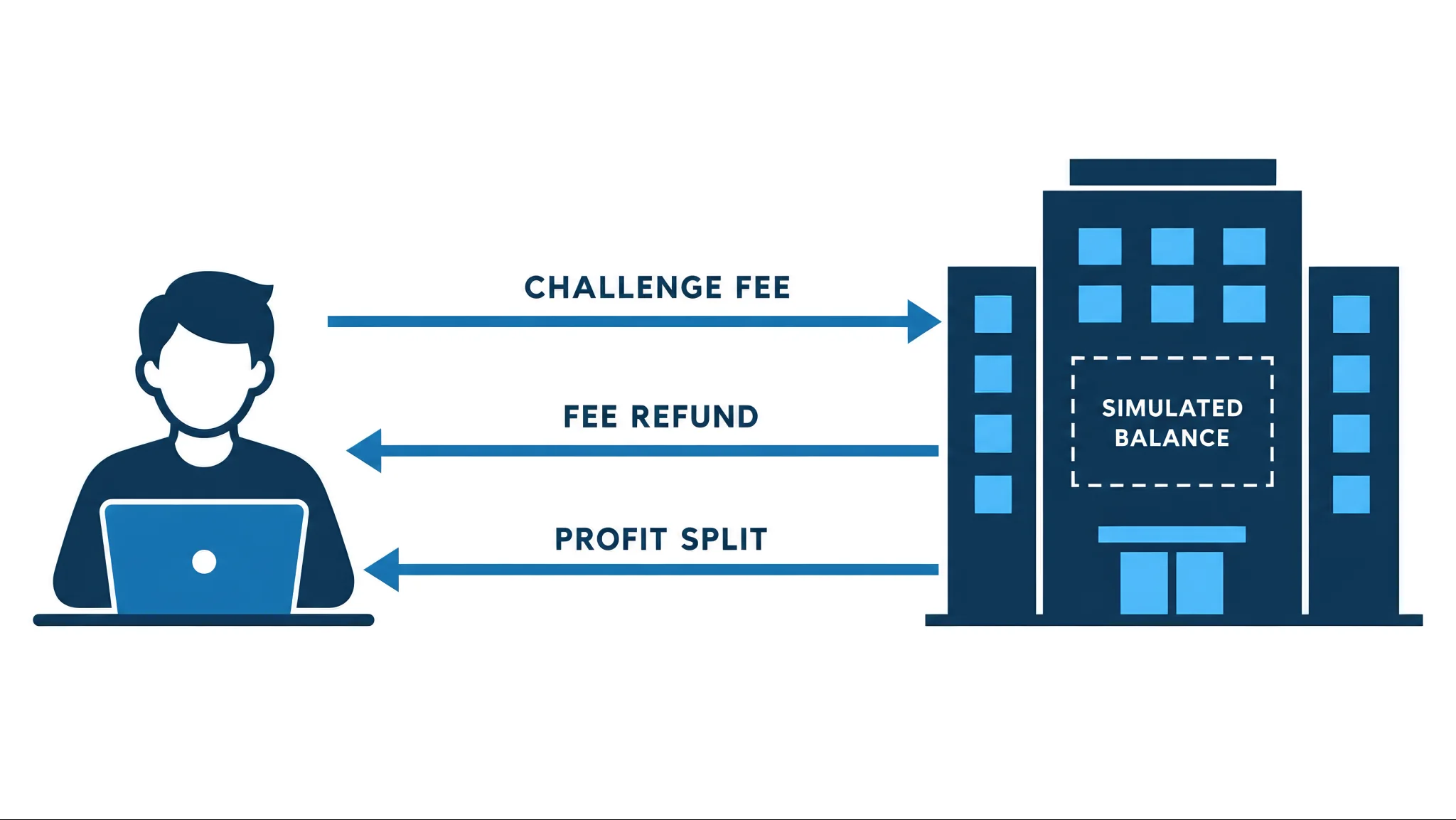
So judge a crypto prop firm on the loop (fee, refund policy, payout speed, payout record), not on the size of the balance.
Is real exchange execution the same as real capital?
No, real exchange execution is not the same as real capital: execution is where orders are priced and filled, and capital is whose money is at risk.
Execution on a real order book means real fills and real slippage. Real capital means the firm’s own money sits behind the orders and absorbs the losses.
Execution and capital can come apart: a prop firm can connect to an exchange and still keep the capital simulated under its contract. Gjorgievski’s CryptoSlate guide draws the same line between how a firm routes orders and where the profit or loss actually exists.
HyroTrader shows how execution and capital can come apart. HyroTrader accounts connect to Bybit or BloFin, or run on its own Hyro platform priced from live Bybit data, yet its FAQ says “no order reaches the live order book” on a challenge or a funded account. The HyroTrader homepage once led with “real market execution,” and that marketing line has been removed.
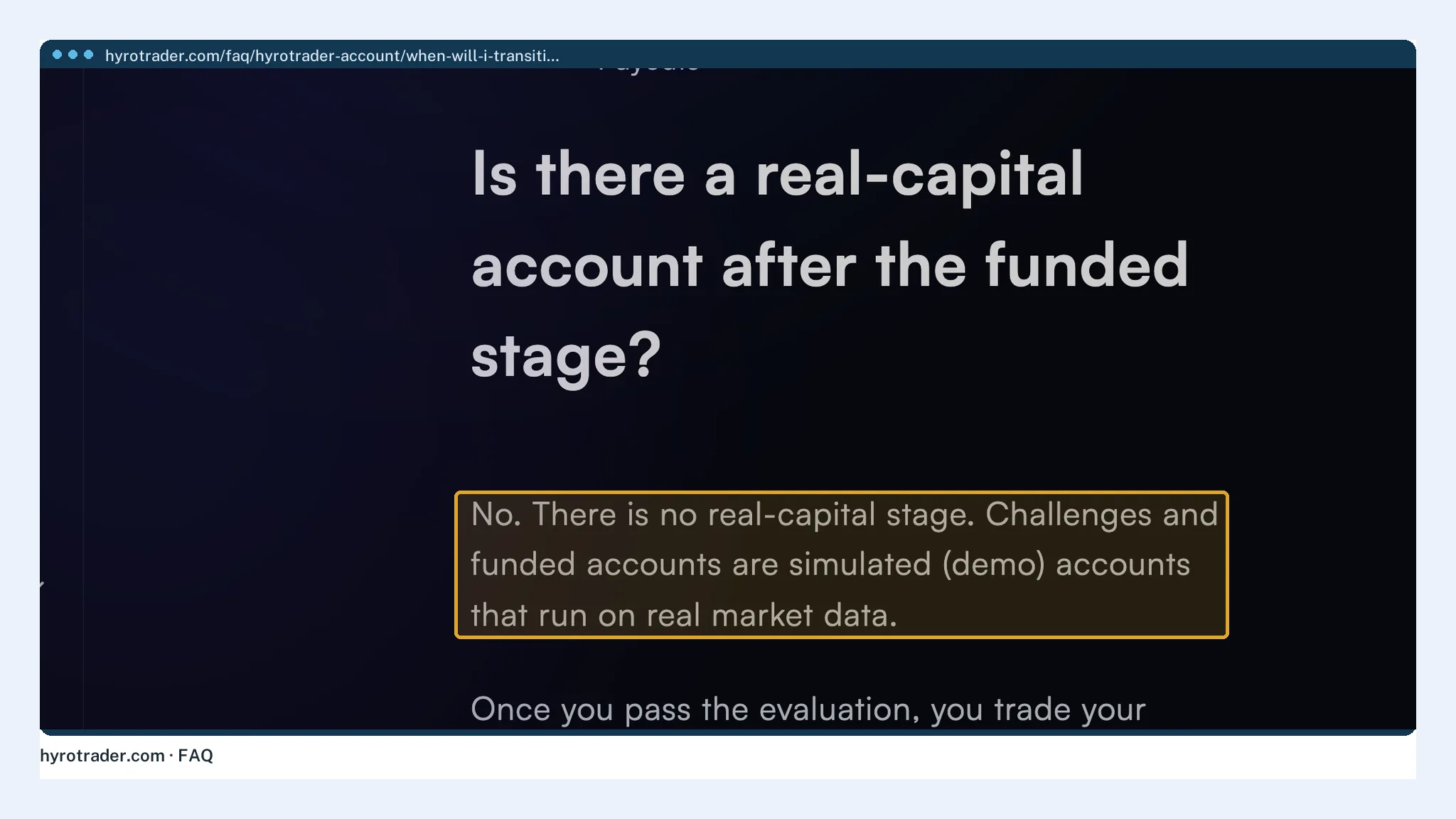
The FAQ that once named a minimum 15% profit for a real-capital step now answers “No. There is no real-capital stage.” The terms add that any separate agreement is one no participant has “any right or expectation” of being offered.
A CryptoPotato piece telling traders that funded accounts are “mirrored into a live ByBit sub-account” is labelled sponsored, so it counts as the firm’s own marketing.
For a HyroTrader trader, this settles what the funded account is: simulated, with contractual payouts, like the other four. No later step moves that trader to real capital.
Trust the terms over the marketing when the two disagree, because the firm’s payouts follow the terms. Ask any firm that claims a live stage, in writing, what would qualify you for it and what that agreement’s terms would say.
How are simulated and live funded accounts different?
Simulated and live funded accounts differ in where orders go, how fills happen, who holds the profit or loss, and what the trader can withdraw. The six differences below cover what changes for a trader:
| Item | Simulated funded account | Live funded account |
|---|---|---|
| Where orders go | The prop firm’s internal system | A real exchange or broker |
| Fills and slippage | Simulated from market prices | Real, including partial fills |
| Funding payments on perpetuals | Applied by the firm’s rules, if at all | Charged by the exchange |
| Who holds the profit or loss | Nobody; the result is a number on the firm’s system | The firm’s capital |
| What the trader withdraws | A contractual share of simulated profit | A share of real market profit |
| Rules | The challenge’s loss limits | The same loss limits, often with extra risk controls |
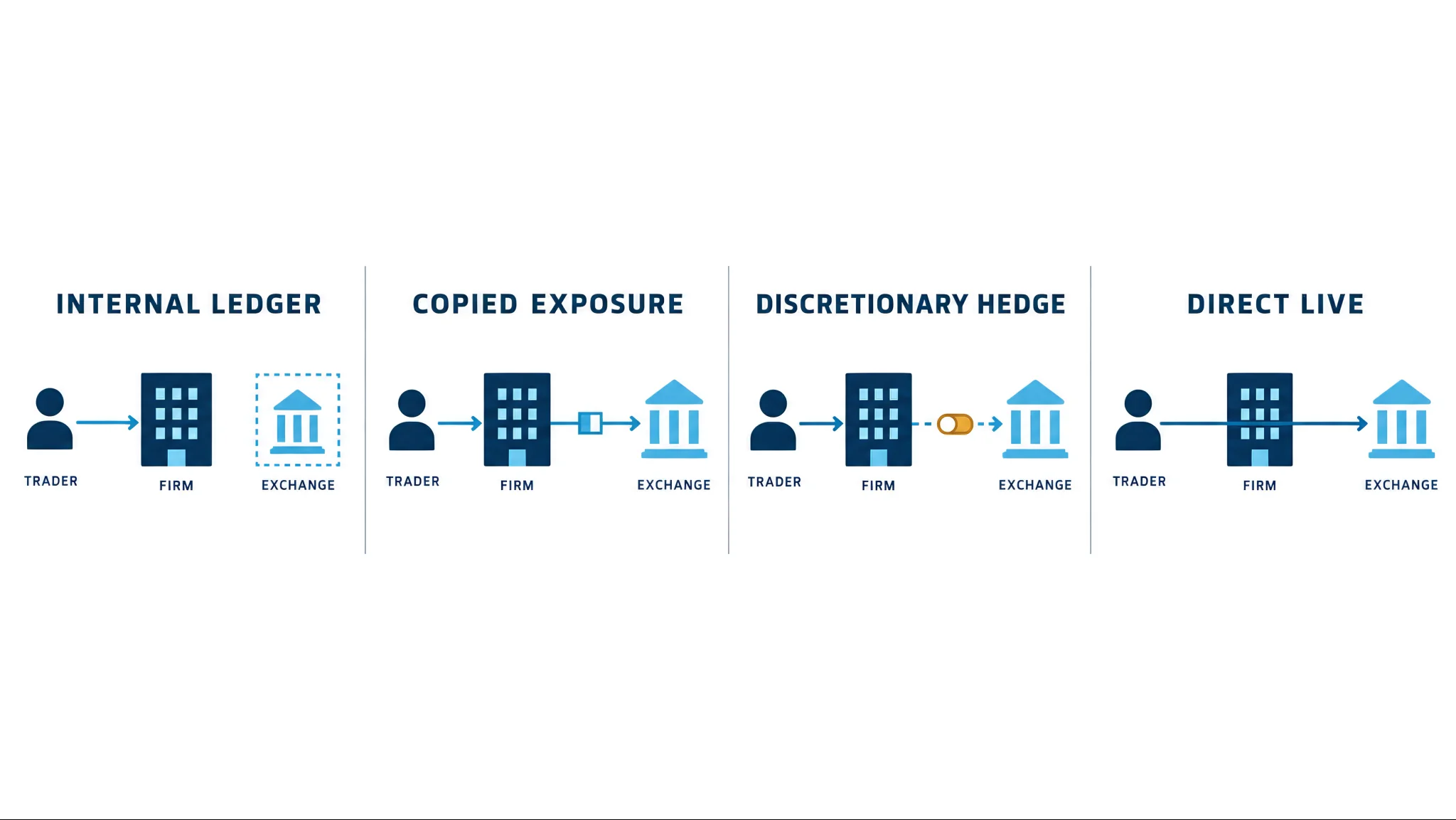
Gjorgievski’s CryptoSlate guide on live and simulated funded accounts describes four ways a prop firm can handle a funded trader’s orders:
- Internal ledger: the orders never leave the firm’s system.
- Copied exposure: the firm copies some positions to a real market.
- Discretionary hedge: the firm hedges its overall exposure as it chooses.
- Direct live routing: every order goes to a real market with firm capital.
Crypto adds two differences forex accounts rarely face. On a live exchange, crypto perpetual futures charge funding payments between longs and shorts, and positions can be liquidated at the exchange’s mark price.
On a simulated account, both depend on how closely the firm’s system copies the exchange. Read the firm’s rules on funding payments first if you hold perpetuals. HyroTrader’s terms, for instance, say the platform applies estimated spreads, commissions, funding charges and slippage to simulated positions.
Live routing also leaves records a simulated account cannot produce. Spotware names those records: trade receipts, Level 2 order-book data and execution-quality reports.
A prop firm running live accounts can hand you those reports. A simulated account can only show you the firm’s own dashboard.
What happens to the same trade under each model?
The same trade produces the same number on the dashboard under every model, and only the money behind the number changes. Take one illustrative trade on a $10,000 funded account that closes $500 in profit:
- Internal ledger: the $500 exists only on the firm’s system. At an 80% split, the firm pays you $400 of real money from its revenue.
- Copied exposure: the firm may have copied the position to an exchange. Your $400 is the same, but part of it may now be covered by real profit on the copy.
- Direct live routing: the $500 is real market profit on the firm’s capital, and your $400 comes out of it.
A losing trade runs the same pattern in reverse. A $500 losing trade is only a number on an internal ledger, partly real under copied exposure, and a real loss of firm capital under live routing. In every model your own loss is capped at the challenge fee, and the account closes at the same drawdown limits.
How can you check if a prop firm uses real money?
You can check whether a prop firm uses real money in five steps, and the strongest evidence is written, not visual:
- Read the terms for each stage and search them for “simulated,” “demo” or “virtual.” All five crypto firms compared on this page use one of those words somewhere. At HyroTrader, those words sit in its terms, its FAQ and the footer of every page, so they are there before you pay.
- Ask for the routing policy that says whether orders stay internal or reach a market. A firm that routes live can name the exchange or broker and the account structure.
- Request exchange-level fill records with order IDs and timestamps if the firm claims live execution. Trade receipts and execution-quality reports are the records Spotware names.
- Check payouts on-chain, remembering that an on-chain payout proves the firm paid, not that the capital was live. The transfer shows the sending wallet, the amount and the time. It says nothing about where the trades behind it were filled. A stablecoin payout from a simulated account is still a real payout.
- Treat labels, charts and logos as weak evidence. A dashboard can say “live” on a simulated account, and an exchange logo can mean a price feed or an interface rather than firm capital.
Gjorgievski ranks the evidence the same way. Beyond labels and charts, he writes that “broker branding, exchange integrations, and payout screenshots are weak for the same reason.”
Read the written terms first and the marketing last. PropRubric follows that order: every capital model on this page comes from the firm’s own terms, rules page or help center.
What should a prop firm’s terms say about real money?
A prop firm’s terms should say what the balance is, where orders go, and who holds the money, in plain words and before purchase. The five crypto prop firms compared on this page show what clear wording looks like:
- A statement of the balance. Crypto Fund Trader’s “It’s all demo, no real capital involved” and Bitfunded’s “fully simulated environment” leave no doubt.
- A statement of custody. Asked whether it holds user funds, Breakout answers “No” and says the capital in a demo account “has no real economic value.”
- A statement of the price source. Mubite says its prices and market depth come directly from Bybit, which tells you how realistic the fills are without claiming live capital.
- A statement of the path to live capital. HyroTrader’s FAQ answers “No. There is no real-capital stage,” and its terms say no participant has “any right or expectation” of a separate agreement. That wording is clear about the stage, and it replaced an earlier FAQ answer that named a minimum 15% profit for real capital.
Terms that say none of this leave you guessing, which is the situation Thevar warns about. So do marketing pages that contradict the terms.
Neither the missing terms nor the contradicting marketing proves a scam, but both are reasons to ask the firm in writing before you pay.
That leads to the question most traders ask next: is a simulated funded account a scam?
Is a simulated funded account a scam?
No, a simulated funded account is not a scam when the prop firm discloses the simulation before you pay and pays out on time. The three questions below answer this in order: Does trading prop money feel like real money; Is a prop firm better than a small live account; and Which crypto prop firms offer a live account after payouts.
The problem starts only when a firm hides the simulation. Thevar explains why hiding the simulation matters: “When you don’t know the model, you can’t judge whether the rules exist to manage real risk or to manufacture failure.”
A legit prop firm states its model before purchase, and three red flags show when a firm does not:
- simulated buying power sold as live capital;
- a simulation disclosed only after purchase;
- payout rules missing from the website.
US regulators have not settled how simulated prop firm models should be treated. The best-known US case against a prop firm, brought by the Commodity Futures Trading Commission against Traders Global Group, the company behind My Forex Funds, was dismissed with prejudice on 13 May 2025, after Special Master Jose L. Linares found that the agency had misled the court, as Finance Magnates reported.
A dismissed case is not a ruling that simulated models are legal, so disclosure is still your main protection and the main trust signal. The full trust checklist is in are crypto prop firms legit.
Does trading prop money feel like real money?
No, trading prop money is not the same as risking your own savings, and research on risk-taking suggests how that changes a prop firm trader’s behavior. In real-money experiments published in Management Science in 1990, Richard H. Thaler and Eric J. Johnson found a “house money effect”: people took more risk after a prior gain. They also found a break-even effect, where a chance to get back to even became especially attractive after a loss.
A prop trader can show both, pushing risk on a balance that isn’t their savings, then chasing break-even after a bad day. On a $10,000 Bitfunded two-step account, the 5% daily limit allows $500 of loss in a day, so one break-even chase can end the account. Size every position as if the account held your own money.
Is a prop firm better than a small live account?
A prop firm is better than a small live account when your strategy fits tight loss limits and your own savings are small. A small live account is better when you need full control. Wide stops, long holds through funding payments, or simply not wanting a rulebook all point to a live account.
A prop firm account costs less up front: a $99 fee buys a $10,000 simulated balance on Bitfunded’s two-step challenge. The same $10,000 balance in a live account puts all of it at risk. The full trade-off between a prop firm, a live account and your own money is a question of what a crypto prop firm is, beyond the capital model this page covers.
Which crypto prop firms offer a live account after payouts?
None of the five crypto prop firms compared on this page offers a live account after payouts, or at any other stage. HyroTrader, the only one that used to describe a live account, now states “There is no real-capital stage at any point.” The HyroTrader terms add that no participant has “any right or expectation” of a separate live agreement. No trader gets a live account as a guaranteed step after a set number of payouts.
Crypto Fund Trader, Bitfunded, Mubite, Breakout and HyroTrader all describe simulated funded accounts with no live stage on the pages checked. Every payout at those five firms therefore comes from the firm’s revenue, so payout speed, refund policy and payout record matter more than the size of the funded account. The funded account stages at HyroTrader, and any change to them, are tracked in the review of HyroTrader’s simulated capital.