Klein Funding Review 2026: Rules, Fees and Is It Legit?
Klein Funding ranks #12 of 18 crypto-first and on-chain firms on PropRubric's list of the best crypto prop firms. It also appears on the lists of crypto prop firms that use Bybit, highest-leverage crypto prop firms and one-step crypto prop firms.
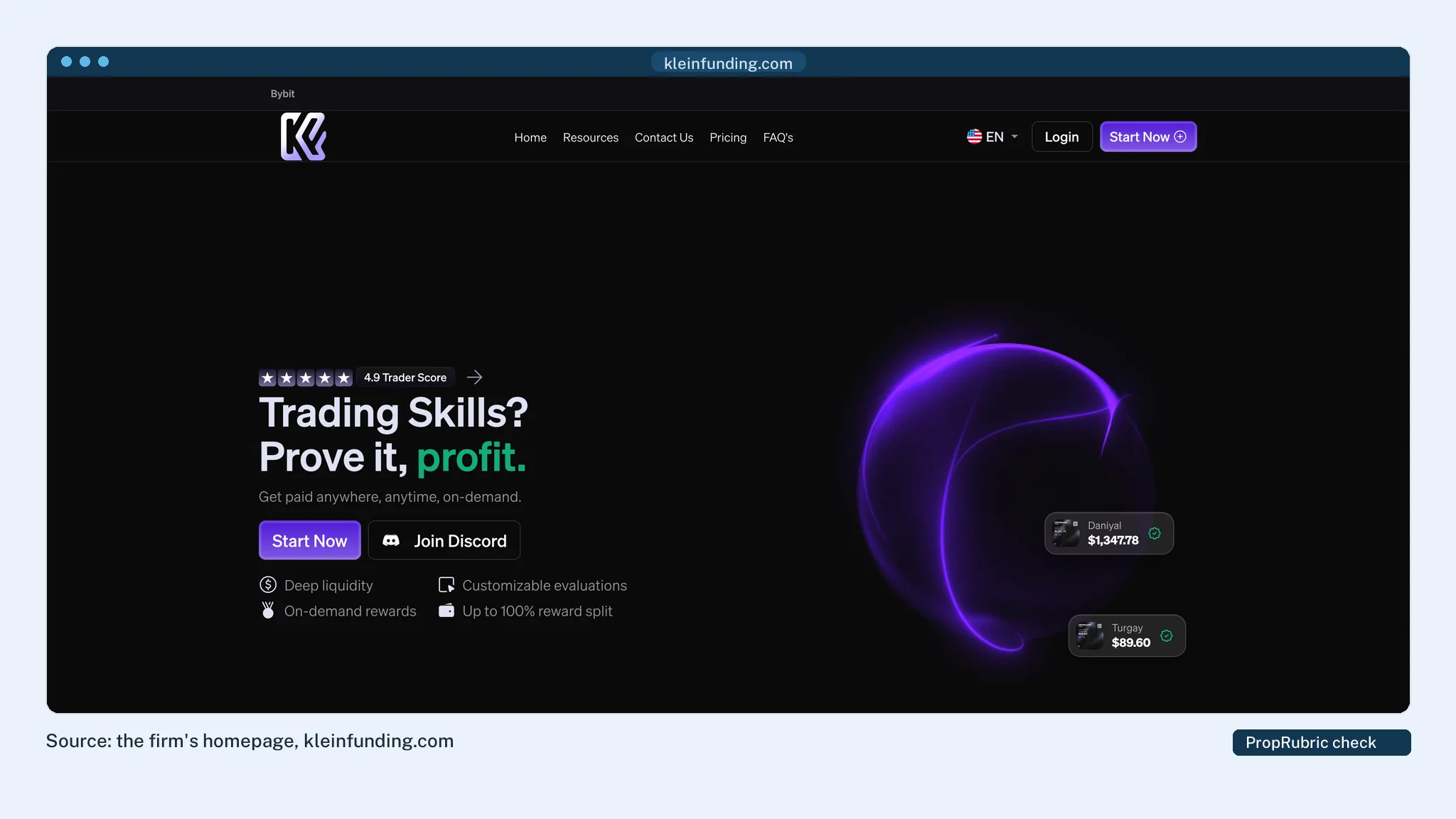 Klein Funding is a crypto prop firm run by a Delaware company that sells five plans across two venues, the trader’s own Bybit account by API and the Cleo platform.
The plans are priced from $35.63, with a profit split the trader chooses at checkout from 40% to 100%. Yes, Klein Funding is a legitimate, operating crypto prop firm: its terms name the company, its rules for every plan are in a public help centre, and its Bybit partnership was reported by Finance Magnates. Against the firm, its Trustpilot rating is withheld after fake reviews were removed and its pages give three different company addresses.
The accounts at the firm are demo accounts by its own terms, and its daily limit resets at 00:05 UTC. The floors on those accounts are static on three plans and trailing or “Smart” on two, while the FAQ says all are static. Payouts on every plan are on demand subject to a Stability Score, and the firm publishes no country list.
The Bybit plans block payouts until the best day is under 45% or 30% of profit, a rule few crypto prop firms apply in evaluation. Compare it with all crypto prop firms PropRubric tracks before you choose.
At a glance
| status | category | venue | entry fee from | daily DD + reset | max DD + type | per-trade cap / stop-loss | split | payout | US access |
|---|---|---|---|---|---|---|---|---|---|
| active | crypto-native, Bybit by API or Cleo | simulated demo accounts; Bybit via API key (tracking only) or the Cleo platform | $35.63 (Cleo Flex $5K, displayed price) | 3% on every plan, 00:05 UTC | 6% static (Cleo One Step, Bybit One and Two Step); 3% fixed trailing (Cleo Flex); 6% “Smart” (Instant Pro) | none; no stop-loss required; Bybit trades must stay open ≥ 50 seconds | 70% default; 40% → 100% chosen at checkout | on demand, subject to the Stability Score; 4–24 hours | not published |
Total-cost calculator
total-cost (fee + one reset per size; formula stated in §3.1)
Pick a model and a size to see the fee, the cost with resets and the price per $10,000 (needs JavaScript; the price table below has every value).
Visit Klein Funding →What is Klein Funding?
Klein Funding is a crypto prop firm that sells Cleo One Step, Cleo Flex, Bybit One Step, Bybit Two Step and Bybit Instant Pro plans on more than 700 Bybit USDT pairs or the Cleo platform’s assets. The firm pays a profit share the trader sets between 40% and 100% at checkout. The terms of the firm name KUENTECH LLC, at 131 Continental Drive in Newark, Delaware, as the company, in a clause that also calls it “registered in England and Wales” with a blank company number.
The Trustpilot contact address for the company is a Covent Garden street in London. The terms of the company say every account is “a demo account operating in a simulated environment with virtual funds”.
Finance Magnates reported in January 2025 that the company, “a newcomer to the prop trading market that launched late last year”, had partnered with Bybit, and the firm’s Trustpilot profile holds 471 reviews with its rating withheld.
| operator | legal entity | operating since | status | category |
|---|---|---|---|---|
| Klein Funding (kleinfunding.com) | KUENTECH LLC, 131 Continental Dr, Suite 305, Newark, DE 19713, USA (the terms also say “registered in England and Wales”, company number blank) | late 2024 (Finance Magnates, 23 Jan 2025) | active | crypto-native; Bybit by API or Cleo |
How does Klein Funding work?
Klein Funding’s cycle has four steps, and each step is set out in the firm’s help centre.
- Buy a plan from $5,000 to $100,000 ($1,250 to $50,000 on Instant Pro), priced from $35.63, choosing the venue (Bybit or Cleo), the plan and the profit share at checkout, and connect a Bybit API key for tracking on the Bybit plans.
- Pass the profit target of 10% (Cleo One Step), 9% (Cleo Flex), 6% (Bybit One Step) or 6% then 3% (Bybit Two Step) within the 3% daily limit and the floor, with no minimum days; Instant Pro has no target.
- Complete identity verification when the firm asks, which it “may require at any stage”, and unverified traders may be denied withdrawals.
- Request a payout on demand, once the Stability Score is met on the Bybit plans, and receive it by bank transfer, Wise, USDT, BTC or ETH within 4 to 24 hours.
The step most buyers misread is the floor, because the FAQ says every drawdown is static, and the next section reads the plan cards.
Are all Klein Funding drawdowns static?
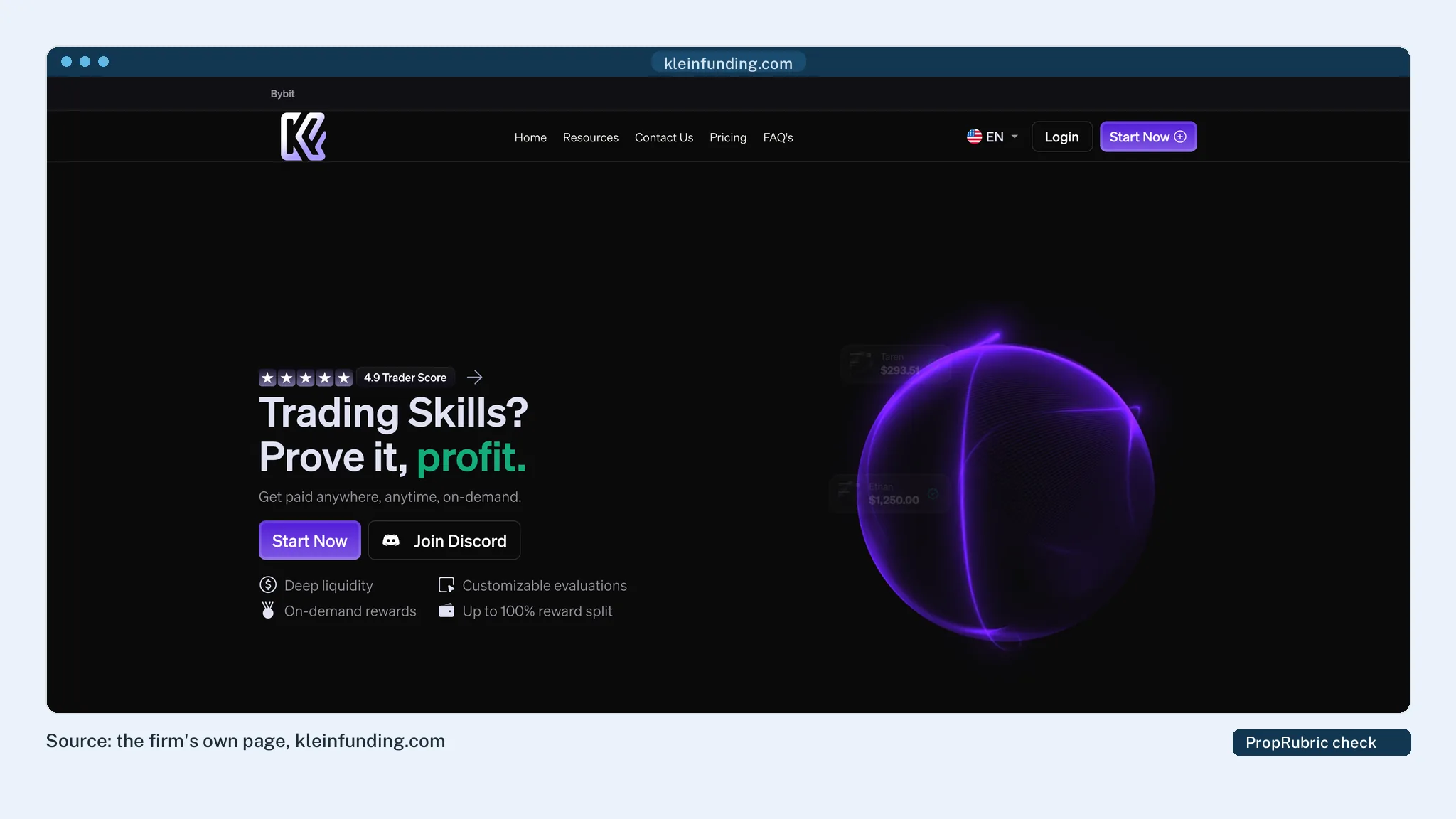
No, not all Klein Funding drawdowns are static. Cleo One Step and the Bybit One and Two Step plans use a static floor, Cleo Flex uses a fixed trailing floor, and Bybit Instant Pro uses a “Smart” floor that trails until 3% profit and then locks 3% below the starting balance. The FAQ, by contrast, says every floor is static. On a $10,000 account the three floors read differently: the static floor stays at $9,400, the Flex floor of 3% follows equity upward and never comes down.
The Smart floor starts at $9,400, rises with profit and locks at $9,700 once the account is 3% up. The second rule the plan cards name only by a tag, beside the floor, is the Stability Score, which the Cleo cards mark “No Stability Rule!” and the Bybit cards carry.
Evidence
| quote | source |
|---|---|
| “All drawdowns are static” | Klein Funding FAQ |
| “Smart drawdown moves upward as your equity increases. However, once your account reaches +3% profit, the drawdown locks at -3% of the original starting balance — and it stays there permanently” | Klein Funding help centre, “What is Smart Drawdown?” |
| Cleo Flex plan card: “dd_type Fixed Trailing Drawdown 3%” | kleinfunding.com pricing page |
The Smart floor is the most unusual of the three and the least forgiving after a good start: a trader who reaches 3% profit and then gives back 6% is out, because the locked floor sits only 3% under the starting balance. The Bybit plans, whose floor is static, connect the trader’s own exchange account by an API key that Klein uses for tracking only. That Bybit model sits on the page about Bybit crypto prop firms beside the Bybit demo accounts that HyroTrader and Dolvero connect by API.
How much does a Klein Funding challenge cost?
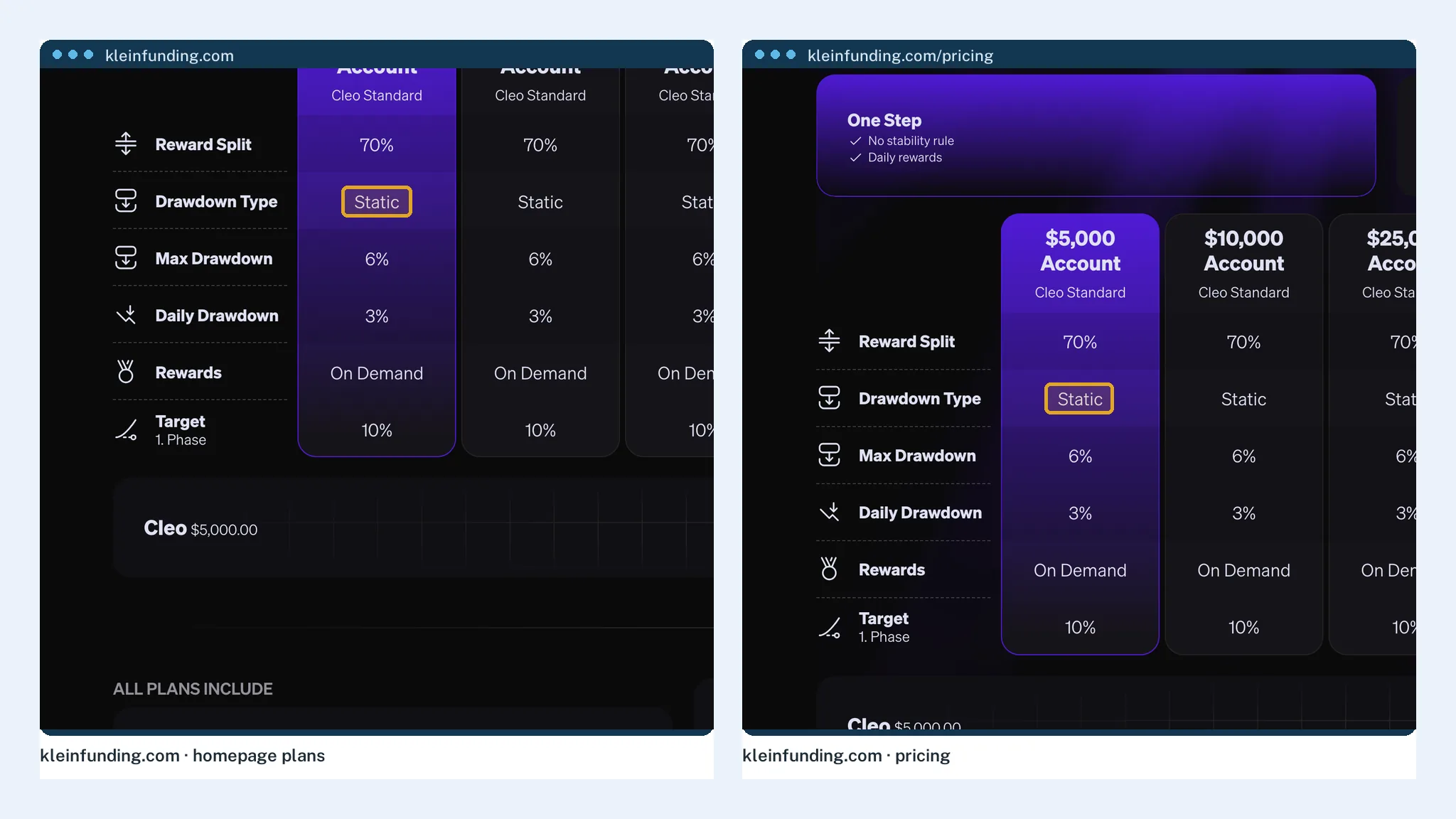
Klein Funding challenges cost $35.63 to $1,315.75 at the displayed prices, from the $5,000 Cleo Flex to the $50,000 Bybit Instant Pro, with the profit share priced at checkout and every card showing a struck-through list price beside the displayed one.
| Account size | cleo-one-step | cleo-flex | bybit-instant-pro | bybit-one-step | bybit-two-step |
|---|---|---|---|---|---|
| $1,250 | — | — | $56.05 | — | — |
| $2,500 | — | — | $99.75 | — | — |
| $5,000 | $52.25 | $35.63 | $150.10 | $52.25 | $61.75 |
| $10,000 | $95 | $65.31 | $281.20 | $99.75 | $80.75 |
| $25,000 | $209 | $154.38 | $688.75 | $237.50 | $190 |
| $50,000 | $399 | $285 | $1,315.75 | $465.50 | $375.25 |
| $100,000 | $769.50 | $522.50 | — | $902.50 | $831.25 |
Values from each firm's own pages, checked by PropRubric
One paid choice exists, and three price notes apply. The choice is the profit share: 70% is the default on every card, and the FAQ says a share from 40% to 100% can be selected at checkout, priced accordingly. The first price note is the two prices per card: every plan shows a struck-through list price and a lower displayed price, and PropRubric records the displayed price with that label, because the discount had no end date on the page.
The second note is the Bybit One Step and Two Step ladders, which start at $52.25 at $5,000, the same displayed price as the Cleo One Step. The third note is the refund: “all purchases are final”, and only one evaluation may run at a time, with two at once counted as a breach.
What does Klein Funding cost per $10,000 of funding?
Klein Funding costs $104.50 per $10,000 of funding on the $100,000 Cleo Flex and $526.30 on the $50,000 Bybit Instant Pro, computed as the displayed fee plus one reset at the same price, divided by the account size in $10,000 units.
| account size | Cleo Flex | Cleo One Step | Bybit One Step | Bybit Two Step | Bybit Instant Pro |
|---|---|---|---|---|---|
| $5,000 | $142.52 | $209.00 | $209.00 | $247.00 | $600.40 |
| $10,000 | $130.62 | $190.00 | $199.50 | $161.50 | $562.40 |
| $25,000 | $123.50 | $167.20 | $190.00 | $152.00 | $551.00 |
| $50,000 | $114.00 | $159.60 | $186.20 | $150.10 | $526.30 |
| $100,000 | $104.50 | $153.90 | $180.50 | $166.25 | — |
Instant Pro is the dearest funding per $10,000 by a factor of four because it skips the evaluation, and Cleo Flex is the cheapest because its 3% trailing floor is the tightest. The floor decides whether any fee is recovered, and the rules are the next section.
What are Klein Funding’s trading rules?
Klein Funding’s trading rules are a 3% daily limit reset at 00:05 UTC, three floor types across five plans and no minimum days in evaluation. The rules add a Stability Score on the Bybit plans, a 50-second minimum hold on Bybit trades, no bots and one evaluation at a time. The three sections below cover those rules: the drawdown limits, the restrictions and the instruments.
| Rule | Value | Source |
|---|---|---|
| Daily drawdown | 3% 3% on every plan shown. | kleinfunding.com |
| Daily reset (UTC) | 00:05 'calculated from your starting balance at 12:05 AM UTC' | kleinfunding.com |
| Maximum drawdown | cleo-one-step: 6%; cleo-flex: 3%; bybit-one-step: 6%; bybit-two-step: 6%; bybit-instant-pro: 6% The Two Step tab says 'Up to 10% drawdown' while its table shows 6%, so the higher figure may be an add-on. Instant Pro uses the 'Smart' drawdown (see dd_type). | kleinfunding.com |
| Drawdown type | cleo-one-step: static; cleo-flex: fixed trailing; bybit-one/two-step: static; bybit-instant-pro: Smart: moves up with equity; once +3% profit is reached it locks at 3% below the original starting balance permanently The FAQ claim 'All drawdowns are static' is contradicted by Cleo Flex (trailing) and Instant Pro (Smart). | kleinfunding.com |
| Per-trade loss cap | none stated; Bybit trades must stay open ≥ 50 seconds | landing.kleinfunding.com |
| Stop-loss required | no (not listed among the rules) | kleinfunding.com |
| Consistency rule | bybit: Stability Score: no single day's profit may equal or exceed 45% (2-phase) or 30% (1-phase) of total profit / profit target; evaluation and funded; not a breach; cleo: none | landing.kleinfunding.com |
| Profit target | cleo-one-step: 10%; cleo-flex: 9%; bybit-one-step: 6%; bybit-two-step: 6% then 3%; bybit-instant-pro: none (funded directly) | kleinfunding.com |
| Minimum trading days | evaluation: 0; instant-pro payout: 3 days each ≥ +0.5%, plus 4% total profit | kleinfunding.com |
| Weekend trading | yes — "the cryptocurrency market operates 24/7" | landing.kleinfunding.com |
| Bots and API | no — EAs, bots and automated copy-trading prohibited (Bybit account connects by API key for tracking only) | kleinfunding.com |
| Leverage | bybit: 'Bybit offers leverage up to 1:100 for most of the tradeable coins'; cleo: 1:5 BTC/ETH, 1:2 all other assets The Bybit answer describes Bybit's own maximum, not a Klein cap; whether Klein caps it is not stated. | landing.kleinfunding.com |
| Account limits | $300,000 funded per trader; only one evaluation at a time (two at once = breach) | kleinfunding.com |
What are Klein Funding’s drawdown limits?
Klein Funding allows a 3% daily drawdown on every plan and a 6% maximum drawdown on four of them, with 3% on Cleo Flex. The daily limit is “calculated from your starting balance at 12:05 AM UTC” while the maximum floor takes one of three forms. The floor is static on Cleo One Step and the Bybit One and Two Step plans, fixed trailing on Cleo Flex, and Smart on Instant Pro.
The Two Step card adds one more wrinkle: its tab reads “up to 10% drawdown” while its table shows 6%, so the higher figure may be an add-on, and PropRubric records the table. How three floor types at one firm end accounts on different days is the clearest case in PropRubric’s comparison of trailing and static drawdown.
Which trading restrictions does Klein Funding have?
PropRubric checks twelve restriction rules at Klein Funding, and the firm publishes eleven; the news rule is not stated.
- Stop-loss required: ✗ not required.
- Per-trade loss cap: ✗ none stated; Bybit trades must stay open at least 50 seconds.
- Consistency rule: ✓ Stability Score on the Bybit plans, in evaluation and when funded: no single day’s profit may equal or exceed 45% of total profit (two-phase) or 30% (one-phase); a breach does not end the account, and the trader keeps trading until the ratio falls; ✗ none on Cleo.
- Minimum trading days: ✗ none in evaluation; Instant Pro needs 3 days of at least 0.5% and 4% total profit before a payout.
- Time limit: none; an inactivity period applies on Bybit accounts, per the help centre’s rule list.
- News trading: not published.
- Weekend holding: ✓ “the cryptocurrency market operates 24/7”.
- Hedging: ✗ between accounts.
- Copy trading: ✗ automated copy trading prohibited.
- Bots and API: ✗ EAs and bots prohibited; the Bybit API key is for tracking only, with restricted API actions listed.
- Multiple accounts: ✗ one evaluation at a time; two at once is a breach; $300,000 funded per trader.
- Prohibited strategies: group trading, spamming the order book, tick scalping, account sharing, and a “prohibited trading styles” list in the help centre.
The Stability Score is the rule to model before choosing a Bybit plan over a Cleo one. On a $10,000 Bybit One Step with a 6% target, a first day of $320 profit needs three more days before the score passes, per the firm’s own worked example.
What can you trade at Klein Funding, and with how much leverage?
You can trade more than 700 USDT perpetuals and crypto pairs on your own Bybit account at Klein Funding, or the Cleo platform’s assets, at Bybit’s own leverage on one venue and a capped 1:5 on the other.
| venue | leverage | fees |
|---|---|---|
| Bybit (own account, API key for tracking) | Bybit’s own, “up to 1:100 for most of the tradeable coins”; whether Klein caps it is not stated | 0.055% taker / 0.02% maker |
| Cleo | 1:5 on BTC and ETH; 1:2 on all other assets | not published |
The Bybit answer describes the exchange’s maximum rather than a firm cap, and the difference between 1:100 and 1:5 is the difference between the two venues’ risk.
How do Klein Funding payouts work?
Klein Funding pays the profit share chosen at checkout, 70% by default and 40% to 100% by selection, on demand once the Stability Score is met on the Bybit plans. Payouts on every plan go by bank transfer, Wise, USDT on Ethereum or Tron, BTC or ETH, within 4 to 24 hours and usually within 4.
Payout terms
| split | first payout | frequency | minimum | currency + network | speed | proof |
|---|---|---|---|---|---|---|
| 70% default; 40% → 100% at checkout | on demand once funded (Instant Pro: 3 days ≥ 0.5% plus 4% profit) | on demand, subject to the Stability Score | not published | bank EUR/USD, Wise, USDT (ERC-20, TRC-20), BTC, ETH | 4–24 hours, usually within 4 | none published |
Three payout conditions apply. Firstly, the Stability Score has to be met on a Bybit plan at the payout request, with the best day under 45% or 30% of total profit. Secondly, identity verification has to be complete when the firm asks for it, because “non-verified users may be denied withdrawals” at the same request. Finally, the Instant Pro plan’s request requires three days of at least 0.5% and 4% total profit before its first payout.
Payout Junction, which counts only payouts matched to a public blockchain wallet, did not list Klein Funding. The split, the rail and the proof are compared across every firm in PropRubric’s explanation of how prop firm payouts work.
Who can trade with Klein Funding?
Klein Funding publishes no usable country list, so the US status is recorded as not published. Its help centre says restricted countries “may include those subject to international sanctions or where financial services regulations prevent us from operating”.
The help centre also points to a list “maintained and updated regularly on our website” that PropRubric could not find on the site or in the terms. The operator’s registered address in those terms is in Delaware, which the firm’s pages do not connect to any statement about US traders.
Who can join
| US status | restricted countries | KYC timing | platform exceptions |
|---|---|---|---|
| not published | not published (sanctions-based wording; no list found) | “may require … at any stage”; unverified users may be denied withdrawals | Bybit plans need a Bybit account in an eligible country; Cleo plans do not |
A trader on a Bybit plan is subject to Bybit’s own country rules as well as Klein’s, because the challenge runs on the trader’s own exchange account.
Is Klein Funding legit?
Yes, Klein Funding is a legitimate, operating crypto prop firm. The evidence for that firm is that its terms name KUENTECH LLC, its help centre publishes its rules, and Finance Magnates reported its Bybit partnership in January 2025. The two cautions PropRubric found beside that evidence are a Trustpilot rating withheld after fake reviews were removed from a 460-review profile, and three company addresses on three pages with no statement of which one contracts with traders.
- Status: active.
- Operator and jurisdiction: KUENTECH LLC, 131 Continental Drive, Suite 305, Newark, Delaware; the terms also describe the company as “registered in England and Wales under company number [blank]”; the Trustpilot contact is 71-75 Shelton Street, Covent Garden, London.
- Operating since: late 2024, per Finance Magnates on 23 January 2025; the Trustpilot profile dates from October 2023 by its identifier.
- Payout evidence: none published; reviewers report requesting first payouts; absent from Payout Junction.
- Complaint signal: Trustpilot showed “rating unavailable due to a breach of our guidelines” with the notice “We’ve removed a number of fake reviews for this company”, with 471 reviews and 342 within twelve months, most of them five-star praise naming support agents; Propvator scored sentiment 4 out of 5 on 9 August 2026; The Godfunded reports 95% satisfaction; one Reddit thread from 2025 asks whether the firm is reliable.
- Contradictions found: “all drawdowns are static” against the Flex and Instant Pro cards; Delaware against “England and Wales”; the Two Step tab’s “up to 10%” against its table’s 6%.
- Named people: none on the site; support agents are named in reviews; Eman Abpeikaran wrote the Propvator review cited.
A firm’s rules and status change over time, so the last question is what has changed at Klein Funding recently.
What has changed at Klein Funding?
The change log for Klein Funding holds 1 rows, 0 of them changes the firm made, and the displayed prices, which sit below struck-through list prices on every card, are recorded as displayed prices. The rows in the table are PropRubric’s additions to its own record.
| Date | Firm | What changed | Source |
|---|---|---|---|
| 5 Oct 2026PropRubric addition |  Klein Funding | Founded Not published → 2024 ("launched late last year", Finance Magnates, 23 January 2025); no founding date on the firm's site not a rule change) | financemagnates.com |
1 logged change at Klein Funding
Every change at every firm, with the same columns, is in the log of crypto prop firm rule changes, and the Instant Pro plan is compared with the other no-evaluation accounts on the list of instant funding crypto prop firms.
What are the alternatives to Klein Funding?
Three firms differ from Klein Funding on its weakest attributes, the withheld rating, the Stability Score and the missing country list, and each card names the difference.
- HyroTrader: a Bybit or BloFin demo account connected by API, a Trustpilot score of 4.0 from 229 reviews and a published restricted-country list, from $59; a UAE and BVI firm with no per-trade cap.
- Fundedbit: a Bybit demo account with no consistency rule in evaluation and a published restricted list, from $55; a Dubai firm with a 21-day first payout.
- Mubite: Bybit or Cleo with instant funding and a funded score of its own; a Prague firm whose Trustpilot rating is withheld too, from $44.
PropRubric’s ranking of the best crypto prop firms scores every firm on the same five criteria, set out in how PropRubric scores firms, and the cards above are where Klein Funding’s three weak attributes are absent.