How to Pass a Crypto Prop Firm Challenge: A Rules-First Plan
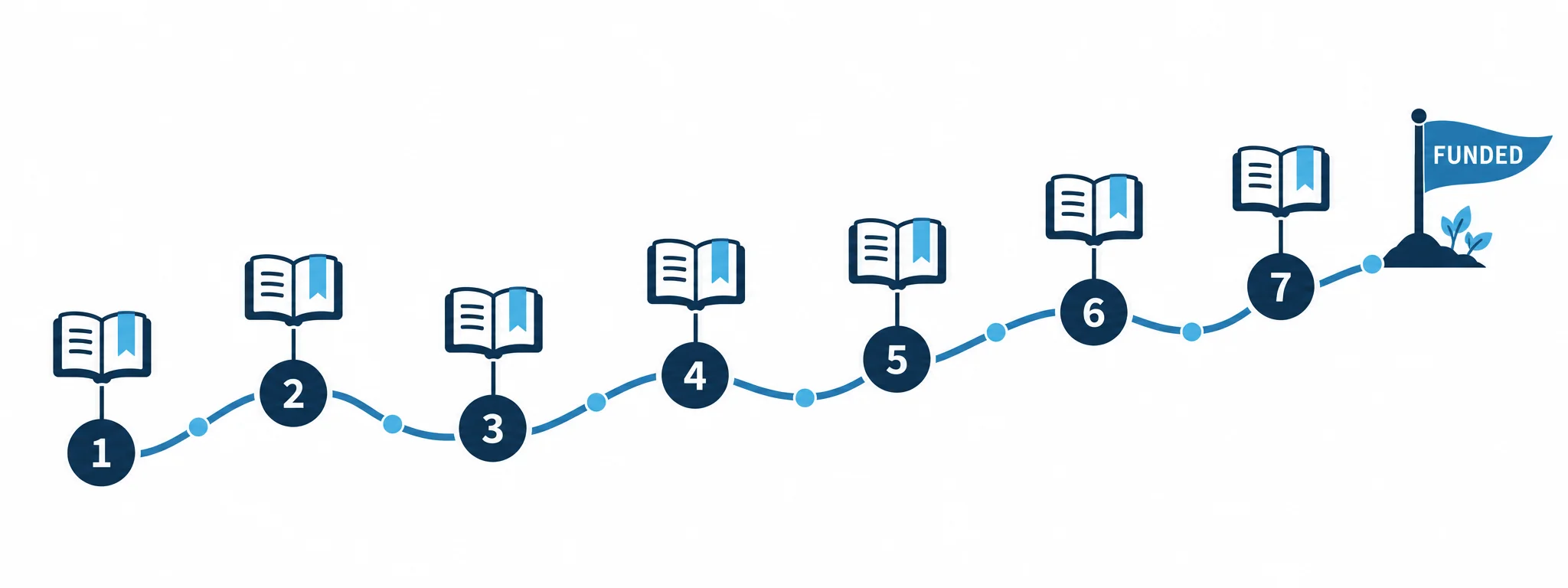
To pass a crypto prop firm challenge, pick the model your strategy fits, size every trade so a losing streak cannot reach the daily limit. Then plan for 24/7 moves and the UTC reset at the firm, and spread the profit over enough days to meet the minimum-days and consistency rules. The plan has seven steps, each tied to a rule that ends accounts, and the page gives the number each step needs.
The sections cover which model fits which strategy, how much to risk per trade from the daily limit and the per-trade cap, and how the reset clock and the weekend change the plan.
The later sections cover how long a pass takes, how to meet the target without breaking a consistency rule, how many traders pass, and what to do after a fail. Every value a trader needs comes from the firms’ own rules, the strategy-to-model fits lead to the ranked firms, and PropRubric’s rules of thumb are labelled as its own.
- Choose the model your strategy fits (a static floor for swing trades, no per-trade cap for scalps, Bybit’s leverage for leveraged trades).
- Compute your daily room (the daily limit in dollars) and your per-trade risk (the daily room ÷ 4, or the firm’s cap if smaller).
- Convert the firm’s reset time to your clock and never hold a losing position across it at an equity-based firm.
- Size for a 5% bitcoin day, which happened 16 times in the year to 29 September 2026.
- Count the minimum days and the qualifying-day thresholds before the first trade.
- Set a daily profit ceiling from the consistency rule (the target ÷ the days you plan).
- Stop after a fail and compare the reset price with a new firm’s entry before buying again.
How do you pass a crypto prop firm challenge?
You pass a crypto prop firm challenge by meeting the profit target without touching any of the rules that end the account, and the seven steps below put the rules in the order a challenge meets them.
- Pick the model your strategy fits. A swing strategy needs a static maximum drawdown and weekend holding; a scalping strategy needs no per-trade cap and no minimum days; a leveraged strategy needs a venue whose leverage the per-trade cap does not cancel.
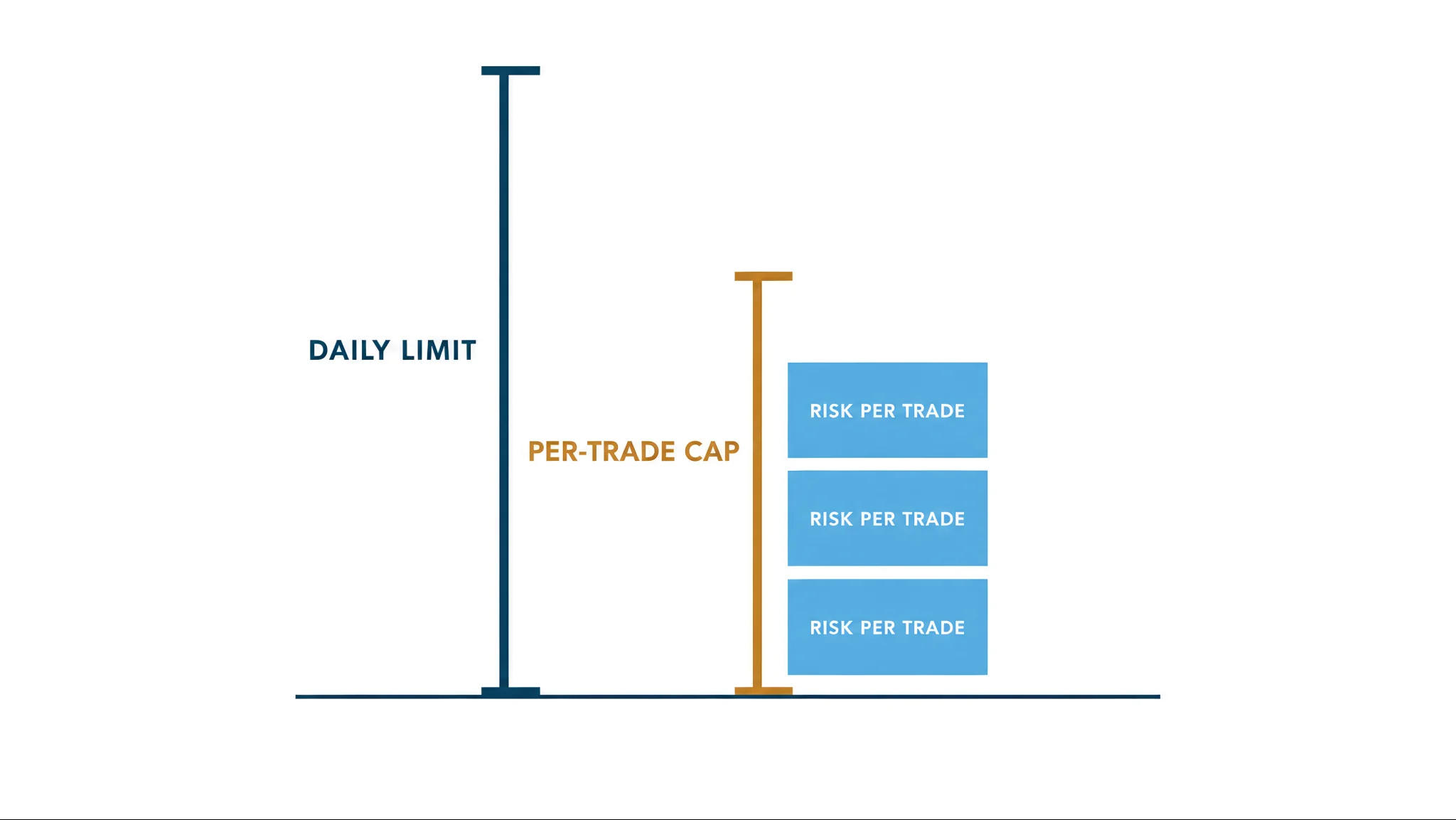
- Size every trade from the daily room. Divide the daily limit in dollars by the number of consecutive losses you want to survive; PropRubric’s rule of thumb is four, so a 4% limit on a $10,000 account gives $100 of risk per trade.
- Respect the firm’s per-trade cap where one exists. Mubite’s 3%, Dolvero’s 2% and Fundedbit’s 2% per pair bind before the daily limit on a single trade.
- Plan the day around the reset. The firm’s UTC reset decides where one day ends for the daily limit and the consistency rule, and the weekend is two trading days.
- Spread the target over the minimum days. Five days at HyroTrader’s One-Step and Velotrade, three winning days at WenCrypto, none at Breakout and Crypto Fund Trader.
- Keep the best day under the consistency cap. A 40% rule means a $1,000 day needs a $2,500 total before it passes.
- Stop at the first breach and review before buying again. The reset is a new fee; the trade that breached is the lesson.
Fourteen percent of challenge accounts passed in the largest published dataset, 300,000 accounts compiled by FPFX Technologies and reported by Finance Magnates in 2024, and The Funded Trader’s CEO Angelo Ciaramello put his firm’s figure at 5% to 10% in March 2025. The plan is therefore built for the rules that fail the other 86% of accounts, starting with the choice of model.
Which challenge model fits your strategy?
The model that fits your strategy is the one whose rules your trades never meet, and the table matches five strategies to the rule that decides them and the firm whose rulebook fits.
| strategy | the rule that decides | the model that fits | a firm whose rules fit |
|---|---|---|---|
| scalping, many small trades | no per-trade cap, no minimum days, a fixed daily floor | a 1-step with two balance-based limits | Breakout: 3% daily, static 3% to 6% maximum, no cap, no minimum days, from $20 |
| swing trades held for days | a static maximum drawdown, weekend holding, no inactivity trap | a 2-step with a static floor | Velotrade: static floor on every plan, weekend trading, 5 qualifying days, from $40 |
| leveraged trades on majors | a venue whose leverage is real and a daily floor you can size for | a Bybit-connected account | HyroTrader: up to 150x on BTC and ETH, 50x to 100x on most pairs, no per-trade cap, a static daily limit from the day’s starting equity, from $59 |
| one large trade a week | no consistency rule, a wide daily limit | a 2-step with a 5% daily limit | Crypto Fund Trader 2-Phase: 5% daily from the 00:05 UTC balance, static 10%, no per-trade cap, $10,000 daily profit cap, from $58 |
| low upfront cost for $100,000 | the fee lost on a failed attempt and the rules it buys | the Break account | Crypto Fund Trader Break: $199 upfront for $100,000, $328 more only after passing, with a 40% consistency rule and a 3% highest-balance loss rule |
The fit decides which rules the rest of the plan has to size for, and a trader who picks the wrong model is sizing against a rule a different firm does not have. The firms whose rules fit each style are ranked on five criteria on the shortlist of the best crypto prop firms, and the next step is the size of one trade.
How much should you risk per trade in a crypto challenge?
You should risk at most a quarter of the daily limit on one trade, so that four consecutive losses stay inside the day, and less where the firm’s per-trade cap is smaller; this is PropRubric’s rule of thumb, and the firm’s cap is the rule.
Formula
daily room = account size × daily limit % risk per trade = daily room ÷ 4 (PropRubric’s rule of thumb), or the firm’s per-trade cap if it is smaller position size = risk per trade ÷ stop distance (as a fraction of the entry price) example: $10,000 × 4% = $400 of daily room → $100 per trade → at a 2% stop, a $5,000 position
The stop distance is the trader’s choice, and bitcoin’s daily standard deviation in the year to 29 September 2026 was 2.26% on the FRED Coinbase series, so a 2% stop sits inside one ordinary day’s move and a 1% stop inside half of one. FundingPips’ guide to passing a challenge, the page that ranks for the query, gives the forex arithmetic: “a typical daily drawdown limit of 5% ($5,000), you can absorb up to five full losses” at 1% risk.
The crypto arithmetic is tighter, because crypto-first daily limits are 3% to 4% at most firms and three firms cap one trade at 2% to 3%, so the same 1% risk absorbs three losses at Breakout, not five.
The size that fits each firm’s limit and cap at any stop distance is computed on the crypto prop firm position size calculator.
How do 24/7 markets and UTC resets change the plan?
A 24/7 market changes the plan in three ways that a forex challenge never meets: the firm’s reset time defines the day, the weekend counts, and an open perpetual pays funding at fixed intervals.
Firstly, the daily limit and the consistency rule both run on the firm’s day, which is cut at the firm’s reset time. A position held across the reset is measured at it, and at an equity-based firm such as HyperPNL the open gain or loss moves the next day’s floor. Secondly, Saturday and Sunday are trading days at every crypto-first firm: the reset happens on Sunday as on a Tuesday, and a weekend candle counts against the daily limit.
Bitcoin moved 5% or more on 16 days in the year to 29 September 2026, including a 13.2% fall on 5 February 2026, per the FRED Coinbase daily series, with no rule that such days avoid weekends.
Finally, a perpetual position pays or receives funding every eight hours on Bybit, at 00:00, 08:00 and 16:00 UTC per its help centre, and every hour on Hyperliquid per its docs, so an open position loses part of the daily room without a price move. The plan’s answer to all three is the reset clock, starting with the firm’s daily reset.
When does your daily limit reset?
Your daily limit resets at the firm’s published time, and most crypto-first firms reset in the first half hour of the UTC day.
| reset time (UTC) | firms |
|---|---|
| 00:00 | HyperPNL (from equity), HyroTrader (from the day’s starting equity), Propr, Upscale, Dolvero, WenCrypto |
| 00:05 | Crypto Fund Trader (balance), Klein Funding |
| 00:15 | Fundedbit |
| 00:30 | Breakout (balance excluding open positions), Kraken Prop, Velotrade |
| 16:00 (the UTC+8 trading day) | PropW |
| 20:00 | SizeProp |
| 5 PM New York (21:00 / 22:00) | TradeXProp |
| not published | Bitfunded, Mubite, Cointracts |
A trader who converts the reset once to their own clock, and re-checks it in March and November for the firms on a daylight-saving anchor, has the one number this section needs. The full mechanics of balance-based and equity-based resets are on the page about daily drawdown in crypto prop challenges.
How long does it take to pass a crypto prop firm challenge?
Passing a crypto prop firm challenge takes as long as the minimum trading days require and no longer than the time limit allows, and at most crypto-first firms the limit is none and the minimum is zero to five days.
| firm | minimum days | what counts as a day | time limit |
|---|---|---|---|
| Breakout, Kraken Prop, Propr, SizeProp | none | — | none |
| Crypto Fund Trader | none (FAQ); an older page says 5 per phase | a day with a trade | none |
| Bitfunded, TradeXProp | none | — | none |
| WenCrypto | 3 winning days | a day closing more than 1% up | none; one trade every 28 days |
| HyperPNL | 2, then 3 profitable days (2-step) | a day closing at least 0.5% up | none |
| PropW, Cointracts (2-step), Upscale, Goat Funded Trader, FundingPips | 3 | a profitable day at PropW and Upscale (0.5% to 0.7%); any day at Cointracts | none at most; PropW’s $1,000 two-step: 15 days |
| Fundedbit, FTMO (2-step) | 4 | a day with a trade | none |
| HyroTrader, Velotrade, Dolvero, BrightFunded, RebelsFunding | 5 | any day at HyroTrader; a day closing 0.8% up at Velotrade; 0.5% up at Dolvero; 5 “real trades” at RebelsFunding | none |
| Mubite | 10 to 13 (two-step); 10 (one-step) | a day with a trade; a paid add-on removes the minimum | none; 30 days of inactivity deactivates |
The fastest pass on paper is one trade at Breakout, which its pricing page states as “Pass in one trade if your edge is that sharp”; the slowest is Mubite’s 13 days. The qualifying-day thresholds are the trap in the table of days.
A 0.8% qualifying day at Velotrade on a $10,000 account is $80 of closed profit, so five such days are $400 of the $1,000 target, and a trader who makes the target in two days still waits for three more qualifying ones. The minimum days set the floor on the calendar, and the consistency rule sets the ceiling on each day.
How do you meet the target without breaking the consistency rule?
You meet the target without breaking the consistency rule by setting a daily profit ceiling before the first trade, the target divided by the days you plan to trade. Any day that runs past the ceiling is diluted with more days before you request a pass or a payout.
The ceiling is cheap to respect and expensive to repair: a day stopped at $400 of a $1,000 target costs nothing, while a $700 day costs $1,050 of further profit before the ratio clears. The four kinds of consistency rule behind that ratio, their caps and the phase each one binds in are on the page about how consistency rules are calculated.
How many traders pass a prop firm challenge?
Fourteen percent of challenge accounts passed and 7% were paid in the FPFX dataset of 300,000 accounts reported by Finance Magnates in September 2024. The Funded Trader’s CEO Angelo Ciaramello told the same publication on 18 March 2025 that 5% to 10% of his firm’s traders pass and 1% to 2% of all buyers receive a payout.
No crypto-specific pass rate has been published, and the same figures are weighed as trust evidence on the page about whether crypto prop firms are legit. Most traders fail at least once by those figures, and what they do next decides the second attempt.
What should you do after failing a challenge?
You should do four things after failing a challenge, in order, and the fourth is the one most traders skip.
- Read the breach reason in the dashboard. A daily-limit breach, a maximum-drawdown breach and a per-trade cap breach are three different mistakes with three different fixes, and the firm’s email names which one it was.
- Journal the trade that breached and the three before it. The size, the stop distance, the time against the reset and the day’s running total are the four numbers the next attempt needs.
- Do not buy the reset or the new challenge the same day. Richard H. Thaler and Eric J. Johnson showed in “Gambling with the House Money and Trying to Break Even” (Management Science, 1990) that people who have just lost seek risk that offers a chance to break even, and a fee bought in that state is bought for the wrong reason.
- Compare the reset price with a new firm’s entry. Breakout sells no reset and a new Turbo costs $20; HyroTrader’s 2-step costs $59 and refunds it with the first payout; a firm whose rules caused the breach is not the firm to buy from again.
The journal in the second step tracks the rules as well as the trades: give it a column for the daily room left, one for the per-trade cap and one for the best day’s share of the profit. A breach then shows up on the journal row before it shows up in the dashboard.