Are Crypto Prop Firm Payouts Taxed? Fees and Stablecoins
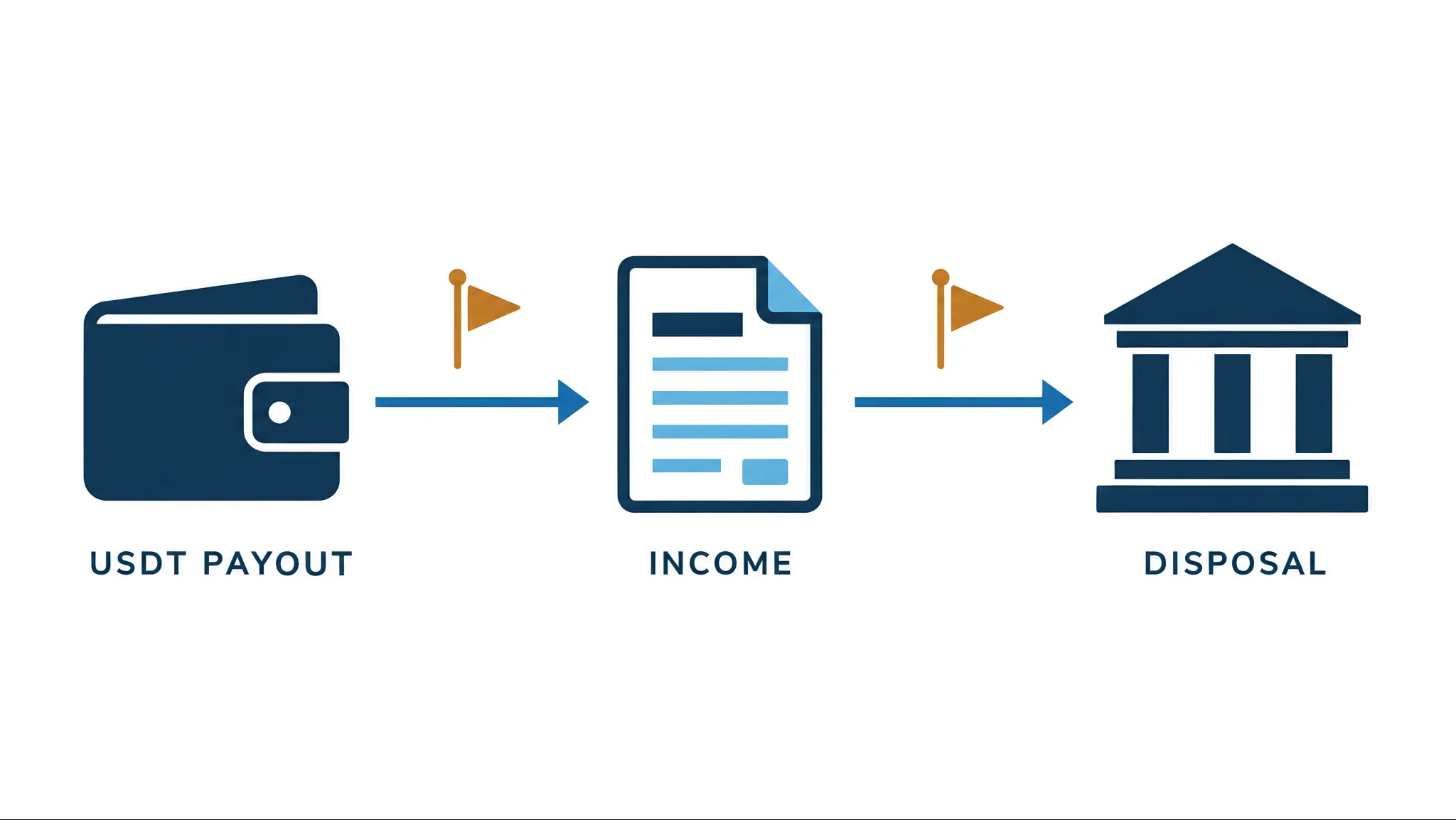
Yes, crypto prop firm payouts are taxed in the United States, the United Kingdom and India as income rather than as trading gains, because the trader receives a share of simulated profit for a service rather than a gain on their own capital. A payout that arrives in USDT or USDC is valued in your currency on the day it arrives, with any later sale of the coins a second, separate event.
The answer is given first with the reason the firms’ own terms supply, then whether a payout is income or a capital gain, what changes when it is paid in a stablecoin, and whether challenge fees can be deducted. The page then covers how each of the three countries treats the payout, what eight more countries say, which records to keep, and why a calculator can give the payout before tax but not the tax.
Every tax rule below names the authority that publishes it and the document it comes from, and the firms that pay in stablecoins, and on which networks, are listed on the page about prop firms that pay out in crypto.
United States. Self-employment income on Schedule C, with self-employment tax of 15.3% on net earnings, per the IRS; a return is required from $400 of net self-employment earnings; virtual currency received for services is income at its fair market value when received (IRS FAQ Q9). No open question on classification on the IRS side; the thresholds change yearly.
United Kingdom. Trading income in the United Kingdom under Self Assessment when the activity amounts to a trade, with Income Tax taking priority over Capital Gains Tax, per HMRC’s Cryptoassets Manual (CRYPTO20250); a return is required above £1,000 of self-employed income. Open question: whether a simulated-account payout is a trade or miscellaneous income, which the manual does not address for prop firms.
India. Business income under the Income Tax Act in the common reading, which no authority document PropRubric read confirms, with the virtual-digital-asset rules (30% under section 115BBH, 1% TDS under section 194S) applying to transfers of the coins. Whether a stablecoin payout is itself a VDA transfer is unsettled, as on PropRubric’s India page. Open question: the classification of the payout itself.
Are crypto prop firm payouts taxed?
Yes, crypto prop firm payouts are taxed as income in the United States, the United Kingdom and India, because a payout is a fee for a service, trading a simulated account, not a gain on your own money. The firms’ own terms supply the classification.
Crypto Fund Trader calls its payouts a “scholarship reward”, Goat Funded Trader and Funded Trader Markets call theirs a “performance reward”, and every crypto-first firm PropRubric tracks describes the funded account as simulated. The money a trader receives is therefore the firm’s payment to the trader, not the trader’s realized trading profit.
The IRS states the US side in one sentence of its virtual currency FAQ, question 9: “Generally, self-employment income includes all gross income derived by an individual from any trade or business carried on by the individual as other than an employee”.
HMRC’s Cryptoassets Manual states the UK side in another: “If the taxpayer’s activity is considered to be trading then Income Tax will take priority over Capital Gains Tax and will apply to profits (or losses).” Income is the word both authorities use, and the next question is why the gains label does not apply.
Are prop firm payouts income or capital gains?
Prop firm payouts are income, not capital gains, in the three countries this page covers. A capital gain needs an asset the trader owned and sold, and a simulated account is neither owned nor sold; the trader is paid a percentage of a number on the firm’s system.
Robert A. Green, CPA, whose firm GreenTraderTax has written on proprietary traders since 2016, puts the US classification for independent-contractor prop traders in the terms the IRS uses. The sentence from Green reads: “Schedule C net income is subject to federal and state income taxes … That net income is deemed ‘earned income’ subject to the self-employment (SE) tax.”
The distinction a Reddit thread on the subject draws, between a live-funded account and a simulated one, may change the answer for a trader who is given a real-money account under a separate agreement, which HyroTrader’s terms describe as a discretionary stage. That real-money account case is one for an adviser.
For the simulated funded accounts that every crypto-first firm in the census describes, the payout is a fee for a service, and a fee is income. The classification does not change when the fee is paid in a stablecoin, but the number of taxable events does.
What changes when a payout arrives in USDT or USDC?
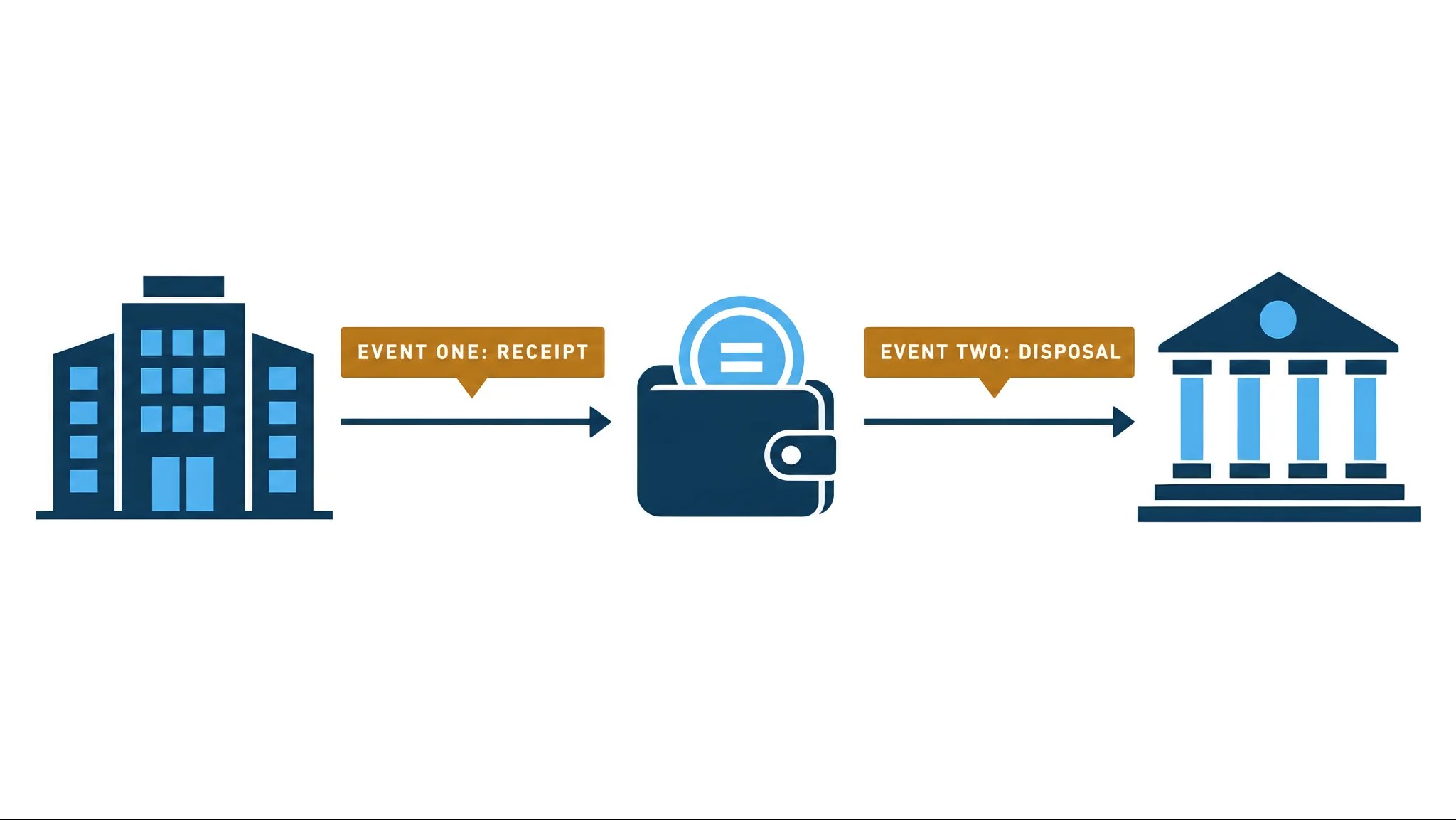
A payout in USDT or USDC creates two taxable events where a bank transfer creates one. The first event, the receipt of the coins, is income at their value in your currency on the day they arrive, and the later sale, swap or spending of those coins is a separate disposal with its own gain or loss.
Event 1: receipt. The IRS treats virtual currency received for services as income at its fair market value in US dollars when received (virtual currency FAQ, applying Notice 2014-21). HMRC’s manual states that tokens received as earnings “are subject to Income Tax and National Insurance contributions on the value of the asset” (CRYPTO21100, for employment income, with trading income following the same valuation principle). A $2,000 USDT payout is $2,000 of income on the day it lands in the wallet, whatever it is later sold for.
Event 2: disposal. The coins now have a cost basis equal to the value at receipt. Selling the coins for dollars, swapping them for bitcoin or spending them is a disposal: “Any disposal of the token received through employment may result in a chargeable gain for Capital Gains Tax”, per the same HMRC page. The IRS treats the sale of property received as income the same way, as a disposal. A stablecoin received at $1.00 and sold at $0.999 produces a loss of $2 on $2,000, small but reportable as a disposal.
The network fee paid to move the coins, and the exchange fee paid to sell them, are costs of the disposal rather than of the income, and a trader who keeps both events separate has the records the next section describes. The coins and networks each firm pays in, from USDT on Tron to USDC on Ethereum and Solana, are on the list of prop firms that pay out in crypto.
Are prop firm challenge fees tax deductible?
Yes, prop firm challenge fees are deductible in the United States and the United Kingdom when the activity is a trade, and the position in India is unsettled. In the United States a challenge fee is a business expense on Schedule C against prop firm income, and in the United Kingdom it is an allowable expense where the activity amounts to a trade.
| country | challenge and reset fees | failed-challenge fees | source |
|---|---|---|---|
| United States | deductible as ordinary and necessary business expenses on Schedule C against prop firm income, per TraderTax’s 2026 guide | deductible on the same basis when the activity is a trade or business; Green describes a lost deposit as a business bad debt on Schedule C | TraderTax; GreenTraderTax |
| United Kingdom | allowable expenses of the trade, unless the £1,000 trading allowance is claimed instead, in which case actual expenses cannot also be deducted | the same test; the activity must be a trade for either to apply | GOV.UK (trading allowance); HMRC CRYPTO20250 on what is trading |
| India | unsettled for a payout classed as business income; expenses of a business are deductible under the Income Tax Act, and no guidance addresses evaluation fees | unsettled | Income Tax Department (no guidance read) |
The fee is deductible only against the income it produced. A trader who buys five evaluations, fails four and is paid on one has, in the US and UK readings above, five fees against one income. A trader who never passes has fees with no trade to set them against, which is the case an adviser has to classify. The condition on every row is the same: the activity has to be a trade or a business in the authority’s own test, and the three countries apply that test differently.
How are prop firm payouts taxed in the US, the UK and India?
Prop firm payouts are taxed under three different sets of rules in the three countries, and each country has its own threshold, form and open question.
United States
In the United States a prop firm payout is self-employment income reported on Schedule C, subject to income tax at the trader’s rate and to self-employment tax, and a return is required once net self-employment earnings reach $400.
| rule | value | source |
|---|---|---|
| classification | self-employment income from a trade or business carried on other than as an employee | IRS virtual currency FAQ, Q9 |
| filing threshold | “You have to file an income tax return if your net earnings from self-employment were $400 or more.” | IRS, Self-Employed Individuals Tax Center |
| self-employment tax | “The self-employment tax rate is 15.3%. The rate consists of two parts: 12.4% for social security … and 2.9% for Medicare” | IRS, Self-Employment Tax |
| Social Security wage base | the 12.4% part applies up to an annual base the IRS updates each year; TraderTax’s 2026 guide gives $184,500 for 2026 | IRS; TraderTax (secondary) |
| forms | Schedule C for the income and expenses; Schedule SE for the tax | IRS |
| 1099 | an offshore firm may issue none; the income is reportable whether or not a form arrives | GreenTraderTax |
A hypothetical $10,000 payout to a US trader with no other self-employment income is $10,000 of Schedule C revenue, less the challenge fees that produced it. Self-employment tax applies at 15.3% on the net figure after the IRS’s own adjustment on Schedule SE, and the arithmetic is the IRS’s, not advice.
United Kingdom
In the United Kingdom a prop firm payout is trading income where the activity amounts to a trade, reported through Self Assessment, with Class 4 National Insurance on profits above the threshold, and a return is required once self-employed income passes £1,000.
| rule | value | source |
|---|---|---|
| classification | Income Tax takes priority over Capital Gains Tax when the activity is trading | HMRC Cryptoassets Manual, CRYPTO20250 |
| filing threshold | “you were self-employed as a ‘sole trader’ and earned more than £1,000” | GOV.UK, who must send a tax return |
| trading allowance | £1,000 a year; claiming it excludes deducting actual expenses | GOV.UK |
| National Insurance | Class 4 at 6% on profits from £12,570 to £50,270 and 2% above, for 2026–27 | GOV.UK, self-employed National Insurance rates |
| stablecoin valuation | tokens received as earnings are taxed “on the value of the asset” at receipt; a later disposal may be a chargeable gain | HMRC, CRYPTO21100 |
HMRC’s manual adds that “Only in exceptional circumstances would HMRC expect individuals to buy and sell exchange tokens with such frequency, level of organisation and sophistication that the activity amounts to a financial trade in itself”, a sentence written about trading one’s own tokens.
A prop firm payout is a fee for a service rather than a trade in tokens, so whether the payout is trading income or miscellaneous income is the question a UK adviser answers. The firms that accept UK residents, and the absence of FCA authorisation at every one of them, are an access question rather than a tax one.
India
In India a prop firm payout may be treated as business income under the Income Tax Act, and no authority document PropRubric read classifies the payout itself. The virtual-digital-asset rules apply to what the trader then does with the coins, and the classification of the payout itself is unsettled.
| rule | value | source |
|---|---|---|
| VDA tax | income from virtual digital assets taxed at 30% under section 115BBH; 1% tax deducted at source on transfers under section 194S, both from the Finance Act 2022 | Income Tax Act, as recorded on PropRubric’s India page |
| the payout | may be business income at slab rates, valued in rupees at the date of receipt, with the later conversion to INR a VDA transfer under section 115BBH; no authority document read classifies the payout itself | Income Tax Act (sections 115BBH and 194S for the transfer); the classification is unsettled |
| regulator context | the RBI Alert List of 19 November 2025 names FTMO, Smart Prop Trader and FundedNext among unauthorised forex trading platforms | RBI |
The open question in India is whether receiving USDT as a payout is itself a transfer of a VDA taxed at 30%, or business income taxed at slab rates with the 30% rule applying only when the USDT is sold. No authority document PropRubric read settles the question for Indian residents. The firms that accept Indian residents and the RBI list’s effect on them are an access question rather than a tax one.
How are prop firm payouts taxed in other countries?
Prop firm payouts are taxed as income in every other country PropRubric read an authority document for. The eight countries below differ on three points only: the name of the income head, whether a later sale of the coins is a separate taxed event, and whether any tax applies at all.
The rule that repeats in every document is the same one the US, UK and India sections use for a payout. A payout received in USDT or USDC is valued in the local currency on the day it arrives, and that value is the income; what happens to the coins afterwards is a second question. Each section below names the authority, the document and the open question, and none of it is advice.
Canada
In Canada a prop firm payout received in crypto is a barter transaction whose value is income, reported as business income on the T4002 return when the activity is a business, and a later sale of the coins is a separate disposition.
| rule | value | source |
|---|---|---|
| classification | payment in cryptocurrency “is treated as a barter transaction for income tax purposes”; the recipient “must include in their income the value of the goods or services provided or the value of the cryptocurrency accepted as payment, whichever is more readily valued” | CRA, Reporting income from crypto-asset transactions (modified 3 December 2025) |
| business or capital | business income when the “course of conduct” matches “a trader or dealer in securities”, judged on frequency, period of ownership, knowledge, time spent, financing and advertising | CRA, citing Interpretation Bulletin IT-479R |
| forms | business income on Guide T4002; a later disposition of the coins on Guide T4037, with half of a capital gain taxable | CRA |
The open question is whether a trader who only receives payouts, and never trades their own coins, is “carrying on a business” for the CRA’s factors, and the CRA page answers it for crypto dealing rather than for a fee paid in crypto.
Australia
In Australia a prop firm payout received in crypto is ordinary income at its Australian-dollar value on the day it is derived, and the coins then carry that value as their cost base for capital gains tax.
| rule | value | source |
|---|---|---|
| classification | “If you receive crypto assets as a reward or payment for services … the money value of the crypto assets is ordinary income of the business. The money value of the crypto assets is worked out at the time the income is derived.” | ATO, Crypto assets used in business (updated 1 October 2026) |
| later sale | “When Dora later sells her tokens, their cost base for CGT purposes is their market value at the time she acquired them.” | ATO, same page, worked example |
| business test | commercial purpose, intention to profit, planned and organised activity, repetition; size alone “doesn’t necessarily mean you are carrying on a business” | ATO, Are you carrying on a business? |
The ATO page is written for a business receiving tokens for services, which is the closest published analogue to a funded trader paid a share of simulated profit, and no ATO document names prop firms.
Germany
In Germany crypto received for a service is valued at its market price when it arrives. The income from that service falls under whichever head the activity belongs to, from self-employed income to other income under §22 Nr. 3, with a one-year holding rule for a later private sale.
| rule | value | source |
|---|---|---|
| valuation at receipt | acquisition cost “entspricht dem Marktkurs im Zeitpunkt der Anschaffung”, with an exchange price or a public price list accepted and a daily price tolerated | BMF letter of 6 March 2025, Einzelfragen zur ertragsteuerrechtlichen Behandlung bestimmter Kryptowerte, Rn. 43 |
| income head | activities with crypto “können … zu Einkünften aus allen Einkunftsarten (§ 2 Absatz 1 Satz 1 EStG) führen”; income from a service (Leistung) in private assets is other income under §22 Nr. 3 EStG | BMF letter, Rn. 30 and Rn. 65 |
| later sale | a private sale within one year of acquisition is a private disposal under §23 EStG; after one year it is outside the charge | BMF letter, Rn. 53 ff. |
The open question is the head of income for a funded trader. A regular, organised activity points to §15 or §18 rather than §22 Nr. 3, and the choice of head changes the deductions and the thresholds, which is a question for a Steuerberater rather than this page.
Malaysia
In Malaysia a payout received in digital currency is income at its ringgit value at the time of payment when the activity is a business or a service, and gains on later disposal of the coins are not subject to capital gains tax at present.
| rule | value | source |
|---|---|---|
| classification | a person who provides services and “receives 10 Ether as payment for his services” recognises the ringgit value “at the time of payment” as income | LHDN, Guidelines on Tax Treatment of Digital Currency Transaction (5 December 2025), worked example |
| business income | gains are revenue, and taxable under section 3 of the ITA 1967, when the badges of trade point to trading; “no single badge of trade is a decisive pointer” | LHDN, same guidelines, Appendix |
| later sale | “At present, CGT is not imposed on gains or profits from the disposal of capital assets in the form of digital currency that are capital in nature” | LHDN, same guidelines, §3.1.5 |
The open question is whether a funded trader’s payouts are income from a service or revenue from trading, and the guidelines treat the two the same way for the receipt, so the difference matters only for deductions.
Pakistan
In Pakistan there is no separate crypto tax law, and a payout is taxed under the general heads of the Income Tax Ordinance 2001, as business income at slab rates when the activity is organised, with the rupee value at receipt as the income.
| rule | value | source |
|---|---|---|
| framework | the Virtual Assets Ordinance 2025 created PVARA to regulate platforms, and the Virtual Assets Act 2026 “regulates exchanges through PVARA but imposes no tax” | BACO Consultants, Crypto Tax in Pakistan 2026 (9 September 2026), a tax firm’s guide, not an authority document |
| heads of income | business income under section 18, capital gains under section 37, income from other sources under section 39 | Income Tax Ordinance 2001, as explained by BACO Consultants |
| payment for services | “If you receive cryptocurrency in exchange for services, its PKR value at the date of receipt is your income”; “A subsequent disposal of that crypto is a separate taxable event.” | BACO Consultants |
The open question in Pakistan is the rate. A dedicated crypto rate has been proposed at figures from 10% to 30% in budget reporting and none was in the statute at PropRubric’s last check, so the slab rates of the Ordinance apply to a payout classified as business income.
Nigeria
In Nigeria the Nigeria Tax Act 2025, in force from 1 January 2026, taxes residents on worldwide income, names digital assets as chargeable, and taxes gains on them at the personal income tax rates. A prop firm payout is therefore income at its naira value, and a later sale of the coins is a second chargeable event.
| rule | value | source |
|---|---|---|
| scope | residents “are now liable for tax on worldwide income”; the Act “recognises profits or gains from transactions in digital or virtual assets as taxable income for individuals” | PwC Nigeria, Worldwide Tax Summaries, on the Nigeria Tax Act 2025 |
| valuation | market value is “the price it might reasonably be expected to fetch on a sale conducted at arm’s length or in the open market”; a disposal for non-monetary consideration is valued at market value on the date of disposal | PwC Nigeria, same summary |
| rates | personal income tax from 0% on the first NGN 800,000 to 25% above NGN 50 million; capital gains for individuals now at the same rates | PwC Nigeria, same summary |
| losses | “Losses from digital asset transactions can only offset gains from similar transactions” | PwC Nigeria, same summary |
The open question is the income head for the payout itself, which the Act does not name, and the Act’s treatment of the coins’ later sale as a digital-asset gain is the part that is clear.
Singapore
In Singapore a payout received in payment tokens is taxed on the value of the services performed, or on the value of the tokens when the income accrues. A later sale of the tokens is a separate question that turns on whether the trader is trading them.
| rule | value | source |
|---|---|---|
| classification | “where a business receives payment tokens for the goods or services it has provided, the business would be taxed on the value of the underlying goods provided/services performed” | IRAS, e-Tax Guide: Income Tax Treatment of Digital Tokens, §5.2 |
| agreed token amount | where a person “contracts to perform services for an agreed number of payment tokens, he needs to record his income based on the value of the payment tokens received” | IRAS, same guide, §5.4 |
| source | income is Singapore-sourced, and taxable, when “the bulk of the business operations are performed in Singapore” | IRAS, same guide, §5.8 |
The open question is whether a funded trader at home in Singapore is “performing services” for a foreign firm, which the guide’s barter-trade framing covers, and nothing in the guide names prop firms.
United Arab Emirates
In the United Arab Emirates there is no personal income tax, and a resident trader’s payouts fall under corporate tax only when they conduct a business whose turnover exceeds AED 1 million in a calendar year.
| rule | value | source |
|---|---|---|
| personal income tax | “There is currently no personal income tax in the United Arab Emirates” | PwC, Worldwide Tax Summaries, UAE individual taxes |
| natural persons | subject to corporate tax only if they “Conduct Business or Business Activity in the UAE” and “Total Turnover derived from Business or Business Activities exceeds AED 1 million within the calendar year” | Federal Tax Authority, Basis of Taxation: Natural Person |
| excluded income | wages, personal investment income and real estate investment income “are not considered as Business or Business Activities” | Federal Tax Authority, same page |
| rate | 0% on taxable income up to AED 375,000 and 9% above it, for a person within the charge | UAE Corporate Tax Law, as summarised by PwC |
The open question is whether a full-time funded trader’s payouts are “personal investment income”, which is outside the charge, or a business activity, which is inside it above the threshold, and the FTA page lists the exclusions without naming trading for a prop firm.
What records should you keep for prop firm payouts?
You should keep seven records for every prop firm payout, and each one answers a question an authority asks.
- The firm’s payout confirmation with the gross amount, the split and the date, because the gross figure is the income.
- The transaction hash of the stablecoin transfer, because it fixes the date and the amount received on chain.
- The value in your currency on the day of receipt, from a published price, because that value is the income and the cost basis.
- The wallet address the payout went to and any later transfer, because a disposal is traced from it.
- Every challenge, reset and add-on invoice, because the fees are the expenses.
- The network and exchange fees on the later sale, because they belong to the disposal.
- The KYC name on the account, because the payout is reported by the person the firm verified, and a mismatch is a problem on both sides.
A calculator can give the payout before tax; the tax itself depends on the rest of your income.
Can a calculator work out tax on a prop firm payout?
No, a calculator cannot work out the tax on a prop firm payout, because the tax depends on the trader’s other income, country, filing status and expenses, which no payout calculator holds. A calculator can work out the payout before tax, from the profit, the split and the firm’s payout fee, which is what the prop firm profit split calculator does.
Canada, Malaysia and six more countries are covered in the section on other countries above, and the steps a payout takes before it becomes income, from eligibility to the transfer, are on the page about how crypto prop firm payouts work.