Crypto Prop Firm vs Your Own Account: Which Pays More?
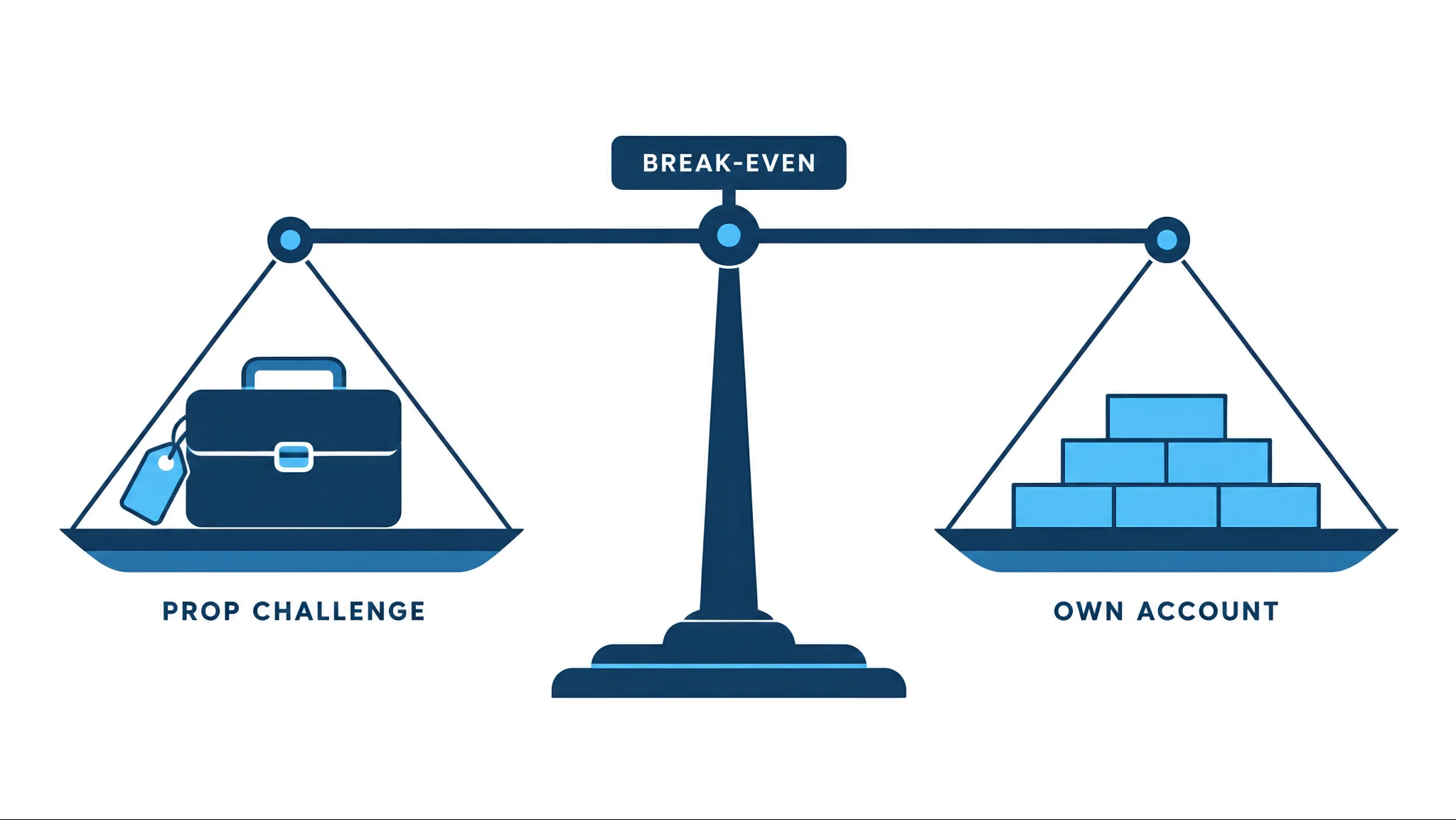
A crypto prop firm pays more than your own account when your capital is small and you pass within a few attempts. Your own account pays more once your capital is large enough that the 20% the firm keeps exceeds the fees you would spend failing challenges. The comparison is made with the numbers a firm’s own page leaves out. The numbers below cover how many buyers pass and get paid, and what a challenge costs on each route at three pass rates with resets and refunds counted.
The numbers then cover how much of the same $10,000 profit each route keeps after the split, the exchange fees and the funding payments. The last sections cover what each route lets you do that the other forbids, and the cases in which your own money is the better tool.
The firms whose fees and splits set the numbers are ranked by five criteria on the shortlist of the best crypto prop firms, and the break-even arithmetic below is the step before that shortlist.
- $597 · three $199 Break challenges at Crypto Fund Trader, passed on the third try
- 0.746% · the gain on a $100,000 funded account that recovers $597 at an 80% split
- 125% · the return $597 of your own capital needs to earn the same $746 of gross profit
- 7% · the share of 300,000 challenge accounts that ever received a payout (FPFX data, 2024)
Is a crypto prop firm better than trading your own account?
A crypto prop firm is better than your own account when the fees you spend to get funded are smaller than the 20% of profit the firm keeps. The answer depends on two numbers, your capital and the number of attempts you expect to need, and the fees win for small accounts and few attempts.
| your capital | attempts you expect | the better route | why |
|---|---|---|---|
| under $5,000 | 1 to 3 | the prop firm | $597 of fees buys $100,000 of simulated capital; $5,000 of your own needs a 15% return to earn what 0.75% earns on the funded account |
| under $5,000 | 5 or more | neither pays; the prop firm costs less | five $199 fees are $995 against the same $5,000, and 93% of buyers in the FPFX data never received a payout |
| $25,000 to $50,000 | 1 to 3 | close; the prop firm wins on leverage, your account on freedom | the firm’s 20% of a $10,000 profit is $2,000, three to ten times the fee of one challenge |
| $100,000 or more | any | your own account | 20% of the profit on $100,000 exceeds any challenge fee after the first month of payouts, and no daily limit, consistency rule or KYC-at-payout applies |
The formula behind the table is break-even capital: the capital at which 20% of a year’s expected profit equals your expected challenge spend. For a trader who earns 2% a month, 24% a year before compounding, and passes on the third try at $199 a challenge, the break-even is about $12,400 of own capital ($597 ÷ 0.24 ÷ 0.2 = $12,438). Above that capital, the firm’s 20% costs more over a year than the fees. The two inputs are the pass rate and the fee, and the pass rate is the number the firms do not print.
How many traders pass and get paid?
Fourteen percent of challenge accounts passed and 7% received a payout in the largest published dataset. That dataset is 300,000 accounts across 10 firms, compiled by FPFX Technologies and reported by Finance Magnates in September 2024, and no crypto-specific pass rate has been published by any firm or data provider PropRubric read.
| metric | value | source |
|---|---|---|
| accounts passed | 14% of 300,000+ | FPFX Technologies via Finance Magnates, September 2024 |
| accounts paid | 7% of all; 45% of those that passed | the same dataset |
| average spend per trader | $800; 93% never received a payout | the same dataset |
| pass rate, firm-reported | 5–10% of traders; 1–2% of all buyers paid | Angelo Ciaramello, CEO and founder of The Funded Trader, to Finance Magnates, 18 March 2025 |
| crypto-specific rate | none published, except Propr’s own dashboard figure of 16.3% on 29 September 2026, a firm’s live number and not an audit | PropRubric’s reads |
The two sources agree on the shape: between one in seven and one in twenty buyers pass, and between one in fourteen and one in fifty are paid. The FPFX average spend of $800 per buyer is four challenges at Crypto Fund Trader’s Break price. The rates are industry-wide and forex-weighted, and they are read as evidence on whether the firms are a fair deal on the page about whether crypto prop firms are legit; here they are the odds that set the expected cost of a challenge.
How much does a prop firm challenge really cost compared with your own capital?
A prop firm challenge really costs the fee divided by your pass rate, because every failed attempt is paid for. At the industry’s 14% pass rate a $199 challenge costs $1,421 in expectation, a $330 challenge $2,357 and a $749 challenge $5,350, before any refund.
| challenge ($100,000 account) | fee | expected cost at 14% | at 30% | at 50% | refund rule |
|---|---|---|---|---|---|
| Crypto Fund Trader Break | $199 | $1,421 | $663 | $398 | not published |
| Breakout Turbo | $330 | $2,357 | $1,100 | $660 | none |
| HyroTrader 2-step | $579 | $4,136 | $1,930 | $1,158 | fee returned with the first payout |
| HyroTrader 1-step | $749 | $5,350 | $2,497 | $1,498 | fee returned with the first payout |
The refund changes the last two rows for the trader who passes. HyroTrader returns the fee of the passing attempt with the first payout, so the expected cost at 14% falls by one fee to $3,557 on the 2-step, while the fees of the failed attempts stay spent. The same $1,421 placed in your own account is $1,421 of capital that cannot be lost to a rule, and a 2% month on it is $28, against the $1,600 that 2% on a $100,000 funded account returns at an 80% split.
The split arithmetic favours the firm on the first payout, and the expected-cost column shows why most buyers never reach that payout. A trader can run their own fee, pass rate and split through the prop firm profit split calculator before buying.
How much do you keep from the same profit?
You keep $8,000 of a $10,000 profit at a crypto prop firm with an 80% split and no payout fee. You keep $7,600 at a firm with a 5% crypto payout fee, and about $9,890 of the same $10,000 in your own exchange account after taker fees and before funding, and the difference is the price of the firm’s capital.
| item | prop firm, 80% split | your own Bybit account |
|---|---|---|
| gross profit | $10,000 | $10,000 |
| the firm’s share | −$2,000 | — |
| payout fee | $0 at most crypto-first firms; −$500 at Funded Trader Markets (5% on crypto rewards); −$350 at The5ers (3.5%); −$300 at AquaFunded (3%) | — |
| exchange trading fees | paid inside the simulated account at the firm’s rate (0.04% per side at Breakout and Bitfunded; native Bybit fees on Crypto Fund Trader’s Bybit venue) | taker 0.055%, maker 0.02% on USDT perpetuals for non-VIP users, per Bybit’s help centre; about $110 on $100,000 of round-trip taker volume |
| funding payments | debited inside the account every 8 hours on Bybit-priced venues | debited every 8 hours at 00:00, 08:00 and 16:00 UTC; the amount depends on the rate |
| capital at risk | the challenge fee only | the full account |
| what you keep | $8,000 (or $7,500 to $7,700 with a payout fee) | about $9,890 before funding, all of it yours |
The 20% the firm keeps is the rent on its capital, and the rent is cheap when the capital is large and the trader’s own is small. The $2,000 of rent on a $100,000 funded account that earned $10,000 is the same money a trader with $10,000 of their own would have earned at a 100% return. The split is the price of the account; the rules are the price of using it.
What can a prop firm do that your own account can’t, and the reverse?
A prop firm account and your own account each allow six things the other does not, and the list is the reason the choice is not only arithmetic.
Only a prop firm account gives you six things:
- Capital you do not have: an account of $5,000 to $200,000 of simulated balance for a challenge fee from $20.
- A loss capped at the fee: a breached account costs the challenge price and nothing more.
- Leverage without liquidation risk to your own money: 10x at Breakout, Bybit’s limits at HyroTrader, on the firm’s account balance.
- Enforced discipline: a daily limit, a maximum drawdown and, at some firms, a per-trade cap that end the account before a catastrophic loss.
- A payout in stablecoins on demand from the funded account at ten crypto-first firms, without selling a position.
- A refund of the fee with the first payout from the account at HyroTrader, the second at Dolvero, the third at Bitfunded and the fourth at Goat Funded Trader.
Only your own account gives you six things:
- No daily limit, no consistency rule and no minimum days: a position in your account can be held through a 10% drawdown and a month can be made in one day.
- Spot trading: none of the 28 firms offers spot on a funded account; every funded position is a perpetual or a CFD.
- Any leverage the exchange allows on your account, in either direction, including none.
- Profits that compound in the account instead of leaving it at each payout.
- No KYC at the payout step that can hold your own account’s money, and no firm reviewing your trades.
- No counterparty risk from the firm: 80 to 100 prop firms shut down in 2024, per Finance Magnates Intelligence, and a funded account at a closed firm is a number on a system that no longer exists.
Murthy Thevar, writing for JournalX on 19 July 2026, gives the frame for the sixth point: “The uncomfortable truth of the modern prop industry is that the majority of ‘funded accounts’ are simulated”. A simulated account is a contract with the firm, whose value is the firm’s willingness and ability to pay. The two lists are the qualitative half of the choice between a firm’s account and your own, and most traders who compare the two end up asking when their own money is the better tool.
When does trading your own account make more sense?
You should trade your own account instead of a prop firm when any of four conditions holds, and each condition comes from a number or a list above.
- You have more than the break-even capital. At a 2% monthly edge and three attempts at $199, that is about $12,400; at a 1% edge it is about $24,900, because 20% of a smaller profit is a smaller rent.
- Your strategy needs spot, holding through drawdowns or weeks without a trade. No firm offers spot, every firm has a daily limit, and inactivity rules of 7 to 90 days apply at Dolvero, Velotrade, Breakout and others.
- Your strategy breaks a consistency rule or a per-trade cap by design. A burst strategy stalls under HyroTrader’s 40% rule, where one day counts for at most 40% of the profit target, and a wide-stop strategy fails Mubite’s 3% per-trade cap, where your own account has neither.
- You have failed twice and want to buy a third attempt the same day. Richard H. Thaler and Eric J. Johnson showed in “Gambling with the House Money and Trying to Break Even” (Management Science, 1990) that a prior loss makes people seek risk that offers a chance to break even, and a third challenge fee bought on that impulse is the expected-cost column in action.
The pass and payout rates behind the first condition are weighed as trust evidence on the page about whether crypto prop firms are legit. The fees behind the second condition are ranked three ways on the list of the cheapest crypto prop firm challenges. The tax that a payout attracts, as income rather than a trading gain, is explained on the page about whether crypto prop firm payouts are taxed.