Breakout vs BrightFunded: Fees, Rules and Payouts (2026)
Affiliate link: PropRubric may earn a commission if you buy, at no extra cost to you. It never changes a score or a ranking.
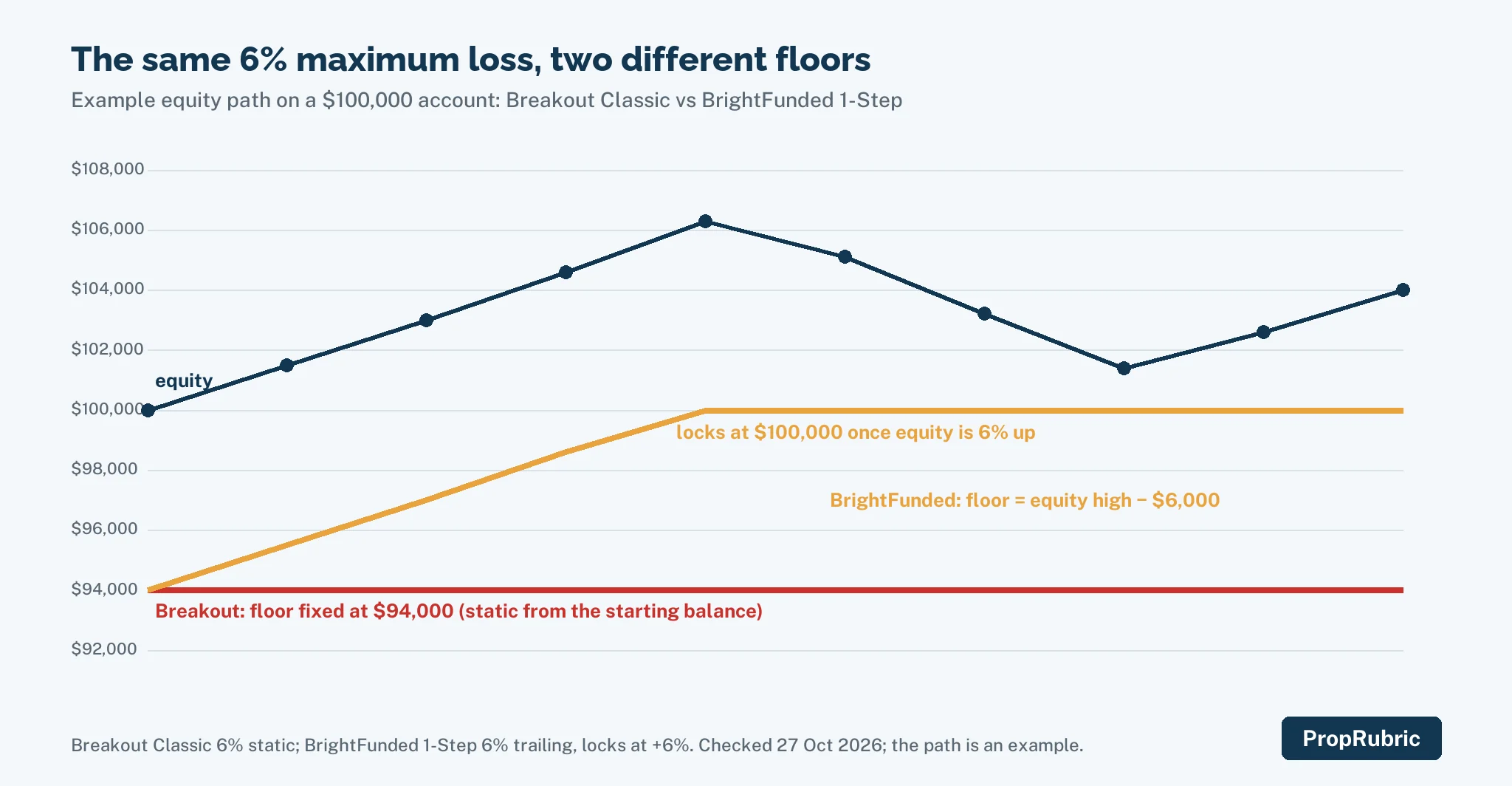
Breakout and BrightFunded differ most on how the same 6% maximum loss moves: Breakout’s floor stays 6% below the starting balance, while BrightFunded’s 1-Step floor trails equity until it locks. Breakout pays on demand; BrightFunded pays first after 30 days, and the two firms price their plans in different currencies. Breakout’s cheapest 1-step costs $20 for $5,000 and BrightFunded’s cheapest plan costs €47, a euro price that this page does not convert, and both firms run simulated accounts, by their own terms.
Nine differences follow, ordered by weight, then the prices by size, the rules side by side, the payout terms, who can join, the trust evidence and the conditions under which each firm is the right choice.
| attribute | Breakout | BrightFunded | edge |
|---|---|---|---|
| maximum-loss type (1-step, 6%) | static from the starting balance (Classic) | trailing the equity high, locks at the starting balance once equity is 6% up (1-Step) | Breakout |
| first payout | on demand once funded, approval 12–24 hours | 30 days after the first funded trade, then every 14 days | Breakout |
| BTC leverage | 10x | 1:5 | Breakout |
| small-alt leverage | 2x | 1:5 on all 48 pairs | BrightFunded |
| 1-step price at $10,000 | $85 (Classic); $65 (Pro); $40 (Turbo) | €97 (1-Step) | depends (USD vs EUR) |
| platforms | Breakout Terminal (DXtrade legacy only) | DXtrade, cTrader, MT5 | BrightFunded |
| crypto pairs | 60 crypto symbols (63 markets) | 48 crypto pairs vs USD | Breakout |
| refund | none | refund if no trades and within 30 days of purchase | BrightFunded |
| minimum days | 0 | 5 (1-Step and 2-Step product pages) | Breakout |
| consistency rule | none | none | same |
| split | 80% → 90% with a +20% fee add-on | 80%, up to 90% | same |
| payout rail | USDC on Ethereum (ERC-20) only | USDC (ERC-20) or EUR bank transfer | BrightFunded |
| funded capital ceiling | $200,000 total | up to $400,000, with a scaling plan | BrightFunded |
| US residents | not listed as restricted | not on the restricted list; MT5 not offered to US residents | Breakout |
| operator | Breakout Trading Group, LLC (Delaware); Payward Oceanic Ltd. (BVI), Kraken group | Bright Global FZCO (Dubai); BrightFunded Ltd (Saint Lucia) for CFDs | depends |
Pick Breakout if you… want a 6% floor that never moves on the Classic 1-step · want a payout the day you ask for it, with approval in 12 to 24 hours · want 10x on BTC and the cheapest 1-step entry at $20 for $5,000 on Turbo.Breakout review →Visit Breakout →
Pick BrightFunded if you… want MT5, cTrader or DXtrade instead of one terminal · want the same 1:5 on every coin, small alts included, and a EUR bank payout option · can wait 30 days for the first reward and accept a trailing floor on the 1-Step, or buy the static 2-Step instead.BrightFunded review →Visit BrightFunded →
What is the difference between Breakout and BrightFunded?
Breakout and BrightFunded differ in nine ways that change what you pay or how you can fail, and the first is the type of maximum loss on the same headline rules. Breakout is a Kraken-owned crypto prop firm founded in 2023 that sells three 1-step plans on its own terminal, run by Breakout Trading Group, LLC in Delaware. BrightFunded is a Dubai multi-asset prop firm founded in 2023 whose crypto offer is 48 CFD pairs at 1:5, contracted by BrightFunded Ltd in Saint Lucia.
Is BrightFunded a crypto prop firm? BrightFunded is a multi-asset prop firm with crypto as one of its markets, so this page compares only its crypto offer, and its forex leverage of 1:100 appears here as a contrast only.
- Maximum-loss type: Breakout’s Classic and BrightFunded’s 1-Step both set a 10% target, a 3% daily loss and a 6% maximum loss; Breakout’s 6% floor is static from the starting balance, while BrightFunded’s trails the equity high and locks at the starting balance once equity reaches 6% above it. BrightFunded’s 2-Step keeps a static floor, 8% on Bright and 10% on Classic, across two phases.
- Payout timing: Breakout pays on demand, 24/7, from $50 after the split; BrightFunded pays the first reward 30 days after the first funded trade, then every 14 days, with weekly and bi-weekly add-ons.
- Leverage by coin: Breakout allows 10x on BTC, 5x on ETH, SOL, XRP, BNB, DOGE and about 20 others, 3x on ENA, HYPE, PEPE and about 8 others, and 2x on smaller coins; BrightFunded allows 1:5 on all 48 pairs.
- Entry price: Breakout’s Classic costs $85 at $10,000 and BrightFunded’s 1-Step costs €97 at $10,000, both with a 10% target, 3% daily and 6% maximum loss.
- Platforms: Breakout runs the Breakout Terminal only, with DXtrade kept for legacy accounts; BrightFunded offers DXtrade, cTrader and MT5.
- Crypto pairs: Breakout lists 60 crypto symbols among 63 markets; BrightFunded lists 48 crypto pairs against the US dollar.
- Minimum days: Breakout requires none; BrightFunded’s product pages list 5 minimum trading days on the 1-Step and the 2-Step.
- Refund: Breakout’s fees are non-refundable; BrightFunded refunds a challenge with no trades within 30 days of purchase.
- Capital ceiling: Breakout caps funded capital at $200,000 in total; BrightFunded allows up to $400,000 at the start, with a scaling plan.
The full record of Breakout’s values, with the source and date for each, is in its review, the Breakout Prop review; the difference most buyers weigh after the floor is the price, and the next section prices both firms by size.
Which is cheaper, Breakout or BrightFunded?
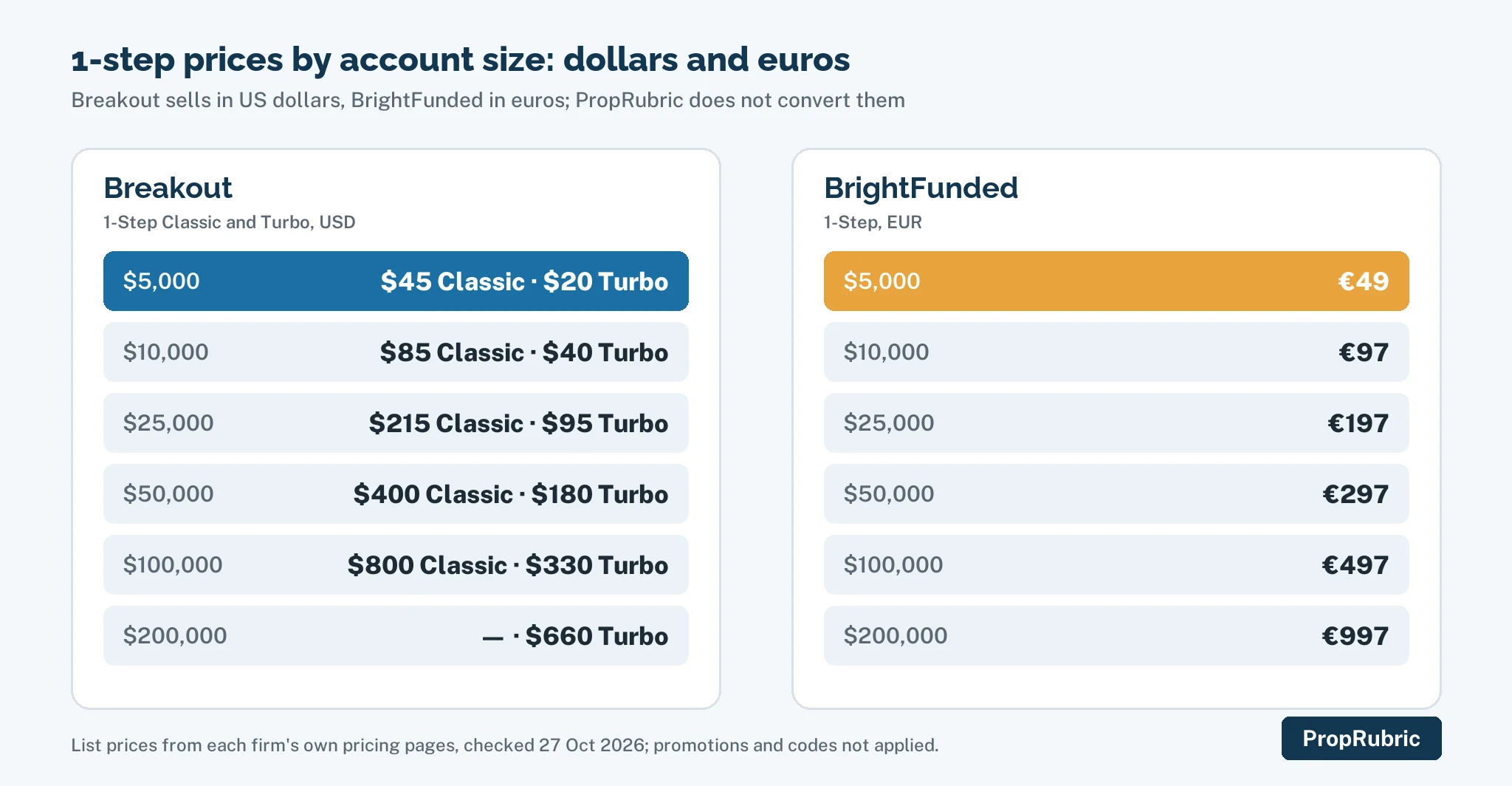
Breakout or BrightFunded being cheaper depends on the plan and the currency: Breakout’s cheapest 1-step account costs $20 (Turbo, $5,000), and BrightFunded’s cheapest costs €47 (2-Step Bright, $5,000). The like-for-like pair is $85 for Breakout Classic and €97 for BrightFunded 1-Step at $10,000, both 10% / 3% / 6%, and BrightFunded bills in euros, so this page marks no winner.
| Plan | $5K | $10K | $25K | $50K | $100K | $200K |
|---|---|---|---|---|---|---|
 Breakout · classic | $45 | $85 | $215 | $400 | $800 | — |
| Breakout · pro | $33 | $65 | $150 | $280 | $545 | $1,090 |
| Breakout · turbo | $20 | $40 | $95 | $180 | $330 | $660 |
| Breakout · spark | — | — | — | $139 | — | — |
Values from each firm's own pages, checked by PropRubric
Add-ons change the dollar side: Breakout’s 90% split costs 20% more at checkout, so the $10,000 Classic rises from $85 to $102. Refunds change the euro side: BrightFunded returns the fee of a challenge with no trades placed within 30 days of purchase, and a “100% Challenge Fee Refund” also appears on its homepage, while Breakout keeps the fee at any outcome.
Breakout’s sold-out Spark ($139 for $50,000, a $1,500 trailing floor) and BrightFunded’s Free $1K Challenge (one phase, 10% target, 5 minimum days, 6% trailing) sit outside the table.
How do Breakout’s and BrightFunded’s rules compare?
Breakout’s and BrightFunded’s rules set the same 3% daily and 6% maximum on their 1-step plans and measure them differently, and the row that decides the most accounts is the maximum-loss type.
| Rule | Breakout |  BrightFunded |
|---|---|---|
| Daily drawdown ● | classic: 3%; pro: 3%; turbo: 3%; spark: none | 1-step: 3%; 2-step-bright: 4%; 2-step-classic: 5% |
| Daily reset (UTC) ● | 00:30 | Not published |
| Maximum drawdown ● | classic: 6%; pro: 5%; turbo: 3%; spark: $1,500 trailing | 1-step: 6% trailing (locks once equity is 6% above initial); 2-step-bright: 8%; 2-step-classic: 10% |
| Drawdown type ● | classic/pro/turbo: static from initial balance; spark: trailing $1,500 below the closed-balance high, updated daily at 00:30 UTC; never locks | 1-step: trailing (locks once equity is 6% above the initial balance); 2-step: static |
| Per-trade loss cap ● | none | Not published |
| Stop-loss required ● | no | no — "using a Stop Loss is not mandatory at BrightFunded" |
| Consistency rule ● | none | none — "we do not currently enforce a consistency rule" |
| Profit target ● | classic: 10%; pro: 12%; turbo: 9%; spark: $3,000 (6%) | 1-step: 10%; 2-step (default card): 8% then 5% |
| Minimum trading days ● | 0 | 1-step: 5 days; 2-step: 5 days |
| Time limit ● | unlimited (90 days without a trade suspends a funded account) | Not published |
| News trading ● | Not published | evaluation: news trading unrestricted; funded: no opening or closing trades from 5 minutes before to 5 minutes after major news (the profit on such a trade is deducted; the account is not breached) |
| Weekend trading ● | yes | crypto may be traded and held over weekends |
| Hedging ● | within one account allowed (Hedge Mode on by default); across accounts or traders prohibited | Not published |
| Copy trading ● | not allowed (third-party signals and cross-user copying prohibited) | Not published |
| Leverage ● | BTC: 10x; ETH, SOL, XRP, BNB, DOGE and ~20 others: 5x; ENA, HYPE, PEPE and ~8 others: 3x; smaller alts: 2x; XYZ100/S&P500: 10x; spark indices: up to 40x | crypto: 1:5; forex: 1:100 |
| Account limits ● | $200,000 total across funded accounts | up to $400,000 initially, with a scaling plan |
The maximum-loss type is the worked example, on a $10,000 1-step account at both firms. Breakout’s floor on that account sits at $9,400 and stays there, while BrightFunded’s floor starts at $9,400 and rises with the equity high: at $10,300 it sits at $9,700, and once equity reaches $10,600 it locks at $10,000, the starting balance.
BrightFunded’s help article says the floor updates in real time and counts open profit, so a trade that peaks at +$400 and closes at −$350 can breach the trailing floor that the same trade never touches at Breakout.
Leverage is the second row that splits the pair: 10x on BTC, 5x on ETH, SOL, XRP, BNB and DOGE, 3x on ENA, HYPE and PEPE, 2x on smaller coins at Breakout; 1:5 on all 48 pairs at BrightFunded. Breakout’s agreement annex still lists 5x leverage for the indices, while its live symbol list shows 10x, and the symbol list is the firm’s stated source. BrightFunded’s own values, including its crypto list and the news rule, are on the page about BrightFunded crypto trading.
Which pays out faster, Breakout or BrightFunded?
Breakout pays out faster: you can request a payout at any time once funded, with approval in 12 to 24 hours, while BrightFunded pays the first reward 30 days after your first funded trade, then every 14 days. BrightFunded sells weekly and bi-weekly payout add-ons that shorten the cycle after the first payout.
| Payout term | Breakout | BrightFunded |
|---|---|---|
| Payout terms ● | frequency: on demand, 24/7; min usd: 50 (after split); method: USDC on Ethereum (ERC-20) only; speed: approval 12–24h, usually quicker; conditions: no open positions; not breached; KYC done | methods: crypto (USDC, ERC-20) or bank transfer (EUR); first payout: 30 days after the first funded trade, then every 14 days; weekly and bi-weekly add-ons exist; minimum: no minimum ($0.01 qualifies) |
| Initial split | 80% | 80% |
| Maximum split | 90% | 90% |
| Payout proof ● | public payout leaderboard (lifetime payouts by trader name); not on-chain links | Not published |
| Fee refund ● | none — evaluation fees are non-refundable | refund if no trades placed and within 30 days of purchase; homepage also advertises a '100% Challenge Fee Refund' (conditions not read) |
The condition on Breakout’s side is the rail, USDC on Ethereum with no alternative; the condition on BrightFunded’s side is the 30-day wait, which a weekly add-on does not remove for the first reward. Neither firm’s payout wait or approval time is measured by an independent tracker, so both figures are the firms’ own.
Who can join Breakout and BrightFunded?
Breakout and BrightFunded both accept crypto at checkout and neither lists the United States as restricted, and they differ on where a US trader can trade. Breakout’s restricted list holds 24 sanctions-based entries, while BrightFunded’s holds 6 and keeps MT5 closed to US and UAE residents and citizens.
| Access | Breakout | BrightFunded |
|---|---|---|
| US residents ● | not listed as restricted | not on the restricted list, but MT5 is not offered to US (or UAE) residents or citizens |
| Restricted countries ● | Afghanistan · Belarus · Myanmar · Cambodia · Central African Republic · Cuba · DR Congo · Ethiopia · Eritrea · Haiti · Iran · Iraq · Lebanon · Libya · Nicaragua · North Korea · Russia · Somalia · South Sudan · Sudan · Syria · Venezuela · Zimbabwe · Ukraine (Crimea, Donetsk, Luhansk) | Cuba · Iran · North Korea · Syria · Vietnam · Pakistan (existing accounts may continue) |
| KYC timing ● | none to buy or trade the evaluation; mandatory before the funded account or any payout (SumSub: photo ID + selfie, proof of residence if applicable) | SumSub KYC (ID + proof of address); timing not stated in the article read |
| Platforms ● | Breakout Terminal (proprietary; DXtrade legacy only) | DXtrade · cTrader · MT5 |
| Legal entity ● | Breakout Trading Group, LLC, a Delaware limited liability company (evaluations); Payward Oceanic Ltd., BVI (funded accounts) | Bright Global FZCO t/a BrightFunded (Dubai Silicon Oasis, UAE); CFD simulated trading offered solely by BrightFunded Ltd (Saint Lucia, 2025-00358); futures by BrightFunded LLC (Wyoming); affiliate Bright Transact Ltd (Cyprus, HE 478945) |
The same Breakout programme sold inside Kraken Pro as Kraken Prop also excludes Canada, India and the United Kingdom, which the Breakout storefront does not.
Is Breakout or BrightFunded more trustworthy?
Breakout carries the stronger ownership and payout evidence of the two, an exchange group and a public payout leaderboard, and both are operating firms with named legal entities and published rules. BrightFunded names four companies across three jurisdictions, publishes no payout proof in the pages read, and its Trustpilot rating is withheld.
| evidence | Breakout | BrightFunded |
|---|---|---|
| operator | Breakout Trading Group, LLC (Delaware); Payward Oceanic Ltd. (BVI, Kraken group) | Bright Global FZCO t/a BrightFunded (Dubai Silicon Oasis); BrightFunded Ltd (Saint Lucia, 2025-00358) for CFDs |
| operating since | 2023; Kraken-owned since 1 Sep 2025 | 2023 (firm-stated) |
| payout proof | public leaderboard of lifetime payouts | not published |
| capital disclosure | “a demo account funded with simulated capital”; funded trades may be A- or B-booked | “online demo trading evaluation firm” |
| RBI Alert List | not listed | not listed |
| PropRubric score | 8.2 of 10 | 5.3 of 10 |
| change log rows | 10 (7 firm changes) | 13 (1 firm changes) |
| shared programme | Breakout and Kraken Prop are one programme (Classic = Starter, Pro = Intermediate, Turbo = Advanced) | — |
Breakout’s ownership is on record in Kraken’s acquisition announcement, where Breakout co-founder and CEO Alex Miningham said “Breakout gives traders a performance-based starting point”, and Trustpilot showed Breakout at 4.7 from 1,211 reviews with a high-risk category notice.
BrightFunded’s Trustpilot profile showed its rating as unavailable for a guidelines breach, with the notice “We’ve removed a number of fake reviews for this company”, across 571 reviews, and BrightFunded’s own pages, as read for this comparison, name no executive.
Should you choose Breakout or BrightFunded?
Breakout is the choice for a trader who buys the static floor, the on-demand payout and 10x on BTC, and BrightFunded is the choice for a trader who buys platform choice, flat 1:5 on every coin and a EUR payout option. Breakout wins the floor, payout-timing, BTC-leverage and minimum-days rows; BrightFunded wins the platform, small-alt-leverage, refund and capital-ceiling rows, so the deciding row is the one your strategy meets first.
Choose Breakout if you:
- want a 6% floor that never moves, because Breakout’s Classic floor is static from the starting balance;
- want to be paid the day you ask, with approval in 12 to 24 hours;
- trade BTC at up to 10x;
- want the cheapest 1-step entry at $20 for $5,000 on Turbo, and no minimum days;
- trust an exchange-group owner, because Kraken owns Breakout.
Choose BrightFunded if you:
- want MT5, cTrader or DXtrade rather than one proprietary terminal;
- trade small alts, because BrightFunded keeps 1:5 on all 48 pairs;
- want a EUR bank transfer as well as USDC;
- want a static floor and accept two phases, because the 2-Step Bright keeps 8% static;
- want room to grow to $400,000 at the start, with a scaling plan.
The closest alternatives differ on exactly the drawdown and payout rows, for a trader whom neither firm’s terms fit.
What if neither Breakout nor BrightFunded fits?
Three alternatives differ from the pair on the drawdown type or the payout terms, and each card names the attribute.
- Kraken Prop: the same programme as Breakout, sold inside Kraken Pro, with on-demand payouts to the Kraken wallet in USD or USDG and 5x on BTC and ETH per its own agreement annex; Canada, India and the United Kingdom are excluded.
- Velotrade: a static maximum loss on every plan, weekly payouts in USDC or USDT on Arbitrum, and FX, stocks and indices beside 104 crypto perpetuals, like BrightFunded but crypto-first.
- HyroTrader: a static daily and maximum loss on every model and on-demand payouts in USDT or USDC within 24 hours, on your own Bybit or BloFin demo account.
Every firm whose floor never trails is compared on the list of crypto prop firms with static drawdown. The best fit across every need is on the shortlist of the top 10 crypto prop firms. The firms that beat Breakout on leverage are listed among the Breakout alternatives with higher leverage, and the multi-asset firms in BrightFunded’s class are compared among the forex prop firms with crypto trading.