How Much Do Crypto Prop Traders Make? Payouts and Costs
Affiliate link: PropRubric may earn a commission if you buy, at no extra cost to you. A commission never changes a value, a score or a ranking.
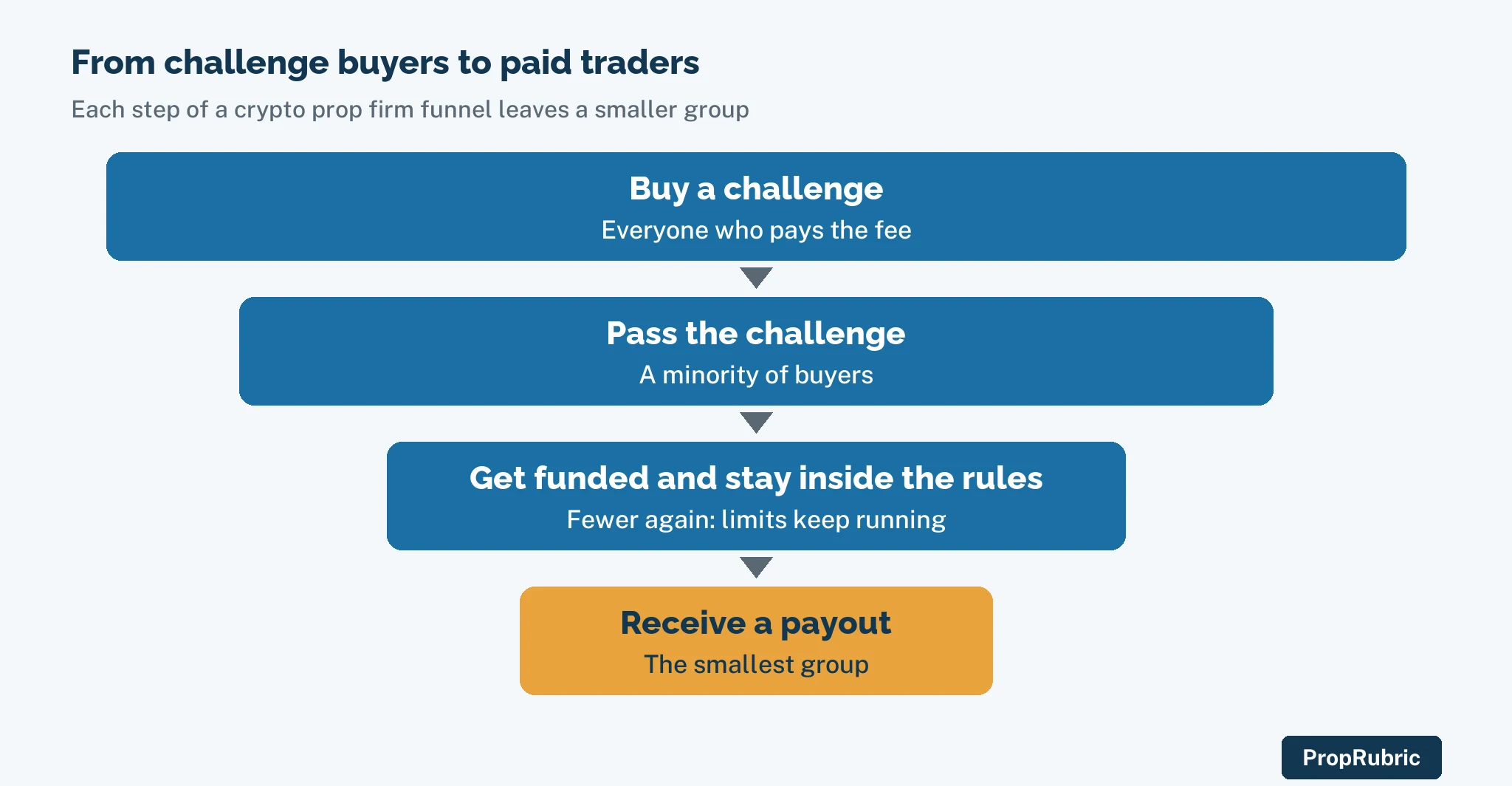
Most crypto prop traders make nothing, on the nearest records: 7% of 300,000 prop accounts received a payout. A typical payment is about $1,000, with a 30-day median of $988 across 44 forex, futures and crypto firms.
| source | what was counted | passed the challenge | paid, of those who passed | paid, of everyone |
|---|---|---|---|---|
| FPFX Tech, via Finance Magnates (2024) | 300,000 accounts, 100,000 traders, 10 firms, forex-led | 14% | about 45% | 7% |
| The Funded Trader CEO, via Finance Magnates (2025) | one forex-led firm’s clients | 5–10% | about 20% | 1–2% |
| Propr’s dashboard | 37,954 finished paid evaluations at one crypto firm (13 Nov 2026) | 15.7% | not published | not published |
PropRubric found no crypto-only dataset of who gets paid, so these three records are the nearest measure. Turned into money, they show what traders receive, how many get there and how large a payout is. They also show how to work out your own figure, what it costs first and why none of it is a salary.
How much do crypto prop traders make?
Crypto prop traders make $0 in most cases on the nearest published records, and the typical payment across all tracked prop firms is about $1,000. No record shows a reliable monthly income. A crypto prop trader’s income is a series of payouts from a profit split, so the honest unit is the payout rather than the month.
The tracker Payout Junction, which matches payouts to public blockchain transactions, counted $128,318,968 across 99,732 payouts from 44 prop firms in the 30 days before PropRubric’s last check. The median payout in that count was $988 and the average was $1,287. Those payouts cover forex and futures firms as well as crypto firms, and they count payments, not people.
| payout size | share of payouts | share of dollars |
|---|---|---|
| under $500 | 29.2% | 5.1% |
| $500–$999 | 21.2% | 12.1% |
| $1,000–$1,999 | 30.4% | 32.9% |
| $2,000–$4,999 | 17.5% | 37.1% |
| $5,000–$9,999 | 1.4% | 7.1% |
| $10,000 and above | 0.4% | 5.7% |
Large payouts are rare in that count: 402 of the 99,732 payouts reached $10,000, while 80.7% stayed under $2,000. Justin Hertzberg, CEO of FPFX Tech, told Finance Magnates’ Damian Chmiel that the average payout in his data was “4% of the plan size”, which is $4,000 on a $100,000 account and $400 on a $10,000 account.
Monthly income figures are a different thing from those records. In Trader’s Second Brain’s guide “How Much Can You Make With a Prop Firm?”, Igor Manuilov writes “there is no defensible universal ‘average prop-firm income.’” A monthly figure needs a denominator that no tracker publishes: how many traders were paid, how often, and how many paid nothing. The route of each payment is set out in the steps behind a prop firm payout, where the split, the wait and the fees are followed from request to wallet.
How many crypto prop traders get paid?
Between 1% and 7% of prop challenge buyers get paid, according to the two published datasets, and neither one covers crypto firms alone.
FPFX Tech’s data is the larger record: 300,000 accounts from 10 firms. In Finance Magnates’ report of September 2024, Hertzberg said 14% of traders in that record passed and “about 45% achieved a payout (7% of all traders)”. The second dataset comes from Angelo Ciaramello, CEO of The Funded Trader, who shared a 5–10% pass rate with about 20% of funded traders paid, which Finance Magnates put at 1–2% of all clients in March 2025.
The Funded Trader’s clients were also waiting on overdue payments at the time, by the same report. Another firm, PipFarm, reported a far higher 41% from a survey of 450 respondents at that one firm, a figure Finance Magnates described as profitable traders in 2024 and as clients reaching the payout stage in 2025.
Propr is the one crypto firm PropRubric found publishing a live pass rate. Its dashboard showed 5,942 passes against 32,012 fails, or 15.7% of finished paid evaluations, with 4,486 evaluations still running, on 13 November 2026. That pass rate counts evaluations while FPFX Tech’s 14% counts traders, and Propr does not publish how many who passed were later paid.
A pass rate also depends on what is counted. Manuilov’s guide cites Topstep’s 2025 disclosure, a futures firm’s record, to show it: 16.8% of evaluations advanced, while 51.8% of individual traders advanced at least once. A trader who buys several attempts therefore passes more often than a per-attempt rate suggests, and pays for each attempt.
How big is a typical crypto prop firm payout?
A typical crypto prop firm payout averages between $576 and $2,995 at the 10 firms below that Payout Junction tracks, and seven of those firms mix crypto with other products.
| firm | verified payouts | total verified | average payout | Visit |
|---|---|---|---|---|
| Breakout | 52,169 | $78,630,721 | $1,507 | Visit Breakout → |
| HyroTrader | 2,093 | $1,612,743 | $771 | Visit HyroTrader → |
| Propr | 6,894 | $3,968,338 | $576 | Visit Propr → |
| FundingPips | 71,169 | $158,046,454 | $2,221 | Visit FundingPips → |
| The5ers | 47,702 | $100,333,766 | $2,103 | Visit The5ers → |
| E8 Markets | 15,646 | $46,851,996 | $2,995 | Visit E8 Markets → |
| Goat Funded Trader | 45,797 | $27,444,621 | $599 | Visit Goat Funded Trader → |
| BrightFunded | 6,918 | $11,682,332 | $1,689 | Visit BrightFunded → |
| Funded Trader Markets | 7,331 | $11,442,525 | $1,561 | Visit Funded Trader Markets → |
| AquaFunded | 9,229 | $13,157,432 | $1,426 | Visit AquaFunded → |
Every count above is Payout Junction’s all-time figure on 13 November 2026, verified on-chain, and it “may not represent a firm’s total payout volume”. HyroTrader shows why that warning matters. The tracker sees only the Solana payouts the firm publishes, so its $771 average covers a part of the $9,496,114 the firm reports paying; the firm’s own page shows a $1,547 average.
Propr’s two averages also differ, at $576 on the tracker and $411.32 on its own dashboard. Breakout, HyroTrader and Propr are the crypto-first firms in the table. The seven others mix crypto with forex and other products, so their averages are not crypto-only.
Payout averages say nothing about how often a firm pays, and PropRubric lists the firms that pay most often, where each firm’s cadence is read from its own terms. Those averages describe other traders’ accounts; your own figure comes from a calculation.
How do you work out what a funded account could pay you?
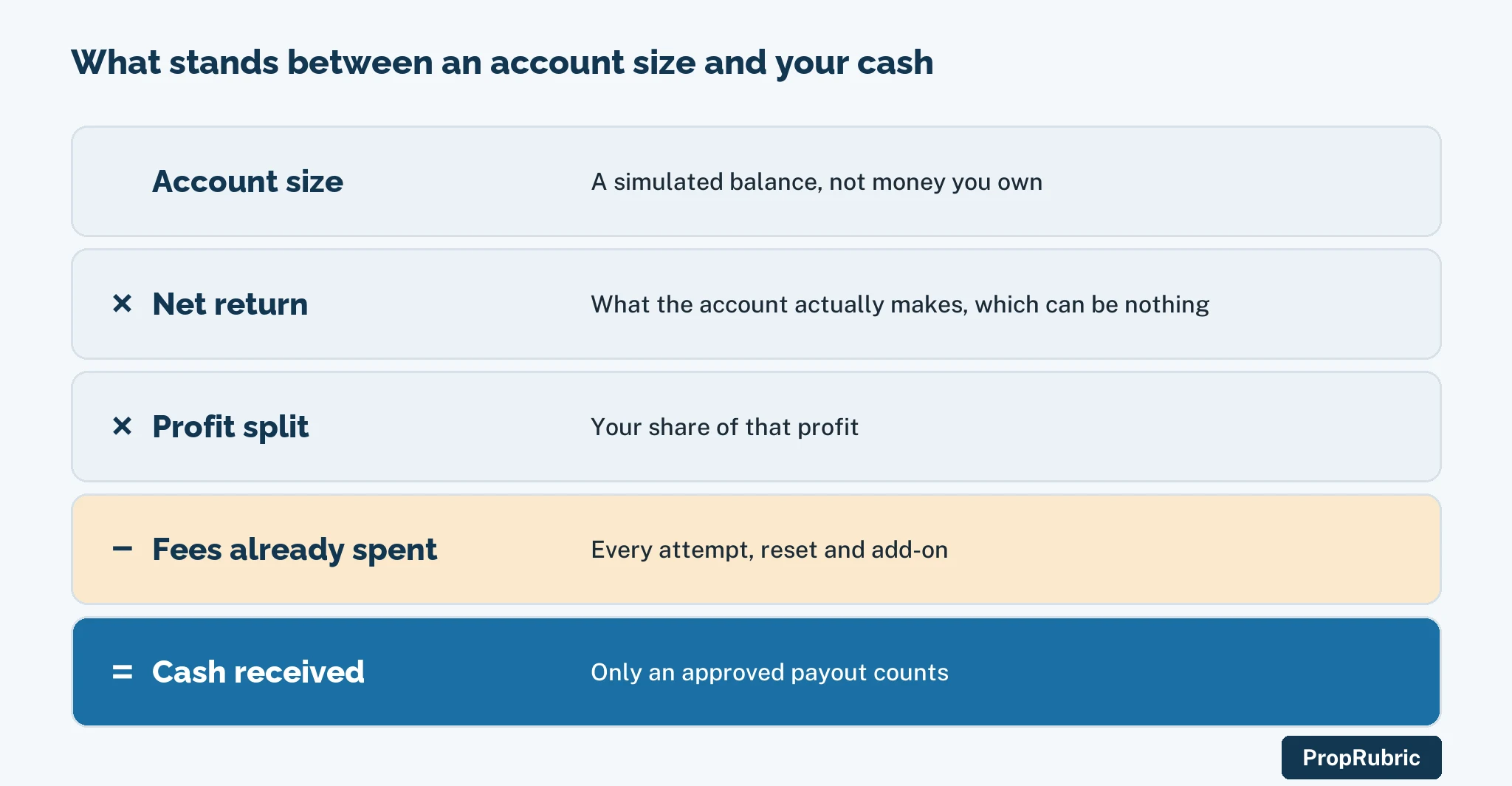
You work out what a funded account could pay you by multiplying the account size by your net return and your profit split, then subtracting what you paid to get there.
Formula
net cash = account size × net return × profit split − fees already spent scenario, not a forecast: $100,000 × 3% × 80% = $2,400, minus Breakout’s $800 Classic fee = $1,600 after one attempt scenario, not a forecast: $10,000 × 3% × 80% = $240, minus Breakout’s $85 Classic fee = $155 after one attempt
The 3% return is a scenario from Manuilov’s guide, not a forecast, and a funded account can return nothing. The fee comes from Breakout, which publishes its default 80% split and its fee for each size. One failed attempt before the pass would take the $100,000 result from $1,600 to $800. A payout cap can cut the result further: The5ers caps a $100,000 High Stakes payout at $4,000.
You can run your own payout with your account size, split and return on the profit split calculator, which applies each firm’s published split. That split calculation counts one fee, and FPFX Tech’s data suggests most accounts pay more than one.
What does it cost to get to the first payout?
A prop account costs $800 in challenge fees over its whole life on average in FPFX Tech’s data, typically across three challenges, so an average payout on a small account may not cover it.
Finance Magnates reported that a single account “spends an average of $800 on challenge purchases throughout its entire activity cycle”. Set against the 4% average payout, one payout matches that $800 average only on an account of $20,000 or more, although a smaller account usually costs less. Manuilov’s break-even example makes the same point: “If costs total $900 and the first received payout is $700, you are still $200 below break-even.”
Time is the second cost before a first payout, and firms set it differently. Propr and SizeProp publish no waiting period before the first payout. FTMO, The5ers, PropW and Upscale wait 14 days, and BrightFunded waits 30 days after the first funded trade. Those waits start after the evaluation is passed, so the first payout comes well after the purchase, and it comes as a contractor’s payment rather than a wage.
Do crypto prop traders earn a salary?
No, crypto prop traders do not earn a salary: they receive a share of simulated profit under an independent contractor arrangement, with no wage and no guaranteed amount.
Propr’s funded terms say a trader acts “solely as an independent contractor”, and Kraken, TradeXProp and Upscale use the same term. ZipRecruiter’s $96,774 average for a “prop trader” is drawn from employer postings and third-party data, and describes a different job from buying a challenge.
A US challenge buyer who is paid as a contractor also carries a tax duty, and the IRS says you must file “if your net earnings from self-employment were $400 or more”. The answers for your own country are in the tax treatment of prop firm payouts, where US and UK treatment are set out with their official sources.
How do crypto prop firms make money?
Crypto prop firms make most of their money from challenge fees, which is the other side of a 7% payout rate. Propr’s dashboard showed $6.16 million of lifetime revenue against $4.00 million of payouts on 13 November 2026, firm-reported figures that put payouts at 65% of revenue at one firm.
The full answer, including what that model means for a buyer, sits in the check on whether these firms are legitimate, where the business model is weighed against the payout records. The wider guides to how crypto prop firms work cover the model itself, from the challenge to the payout.