By the PropRubric Research Team · Last verified: 15 November 2026 · Checked against each firm’s own terms
Affiliate link: PropRubric may earn a commission if you buy, at no extra cost to you. A commission never changes a value, a score or a ranking.
The best crypto prop firms for swing trading at the 15 November 2026 check are Funded Trader Markets, Breakout and Kraken Prop, whose rules, prices and payout terms are each dated and sourced to its own page. Funded Trader Markets’ 2-Step Plus plan shows 0% swap on a static floor, and Breakout and Kraken Prop charge $23.10 a week per $10,000.
Eight of the 27 firms publish a fixed holding rate, and FTMO’s is the highest at $57.53. The wider ranking is the list of crypto prop firms PropRubric scores highest, where every firm is scored on five equal criteria read from its own terms.
no overnight charge shown
lowest fixed rate at a crypto-first firm
funding that can pay you
Funded Trader MarketsVisit Funded Trader Markets →swap 0% on every instrument and “swap-free accounts” on all accounts, with a static floor on 2-Step Plus
Breakout and Kraken PropVisit Breakout →0.033% a day, no stated holding limit, static floors on the main plans; from $20
ProprVisit Propr →Hyperliquid funding “deducted or credited”, no holding limit; from $25
daily 4–5%max 6–10% · fixedsplit 75–80% → up to 90%scored on Copperoutside the score ranking: no $100K plan, so cost is not scoredPayout: RiseWorks, a supported cryptocurrency method, bank transfer or another…
daily 3–5%max 5–9% · staticsplit 80%scored on 2-stepoutside the score ranking: no $100K plan, so cost is not scoredPayout: USDC on-chain by smart contract to the HyperPNL wallet
daily 2.5–3%max 6–8% · dynamic (One) · static (Pro)split 80% → 100%scored on E8 Pro Perpetual at $100KPayout: Rise, WorkMarket, Aeropay — 'There are no direct crypto payment…
daily 3–5%max 6–10% · mixed by plansplit 80–100%Payout: crypto or bank wire
Values from each firm's own pages, checked by PropRubric
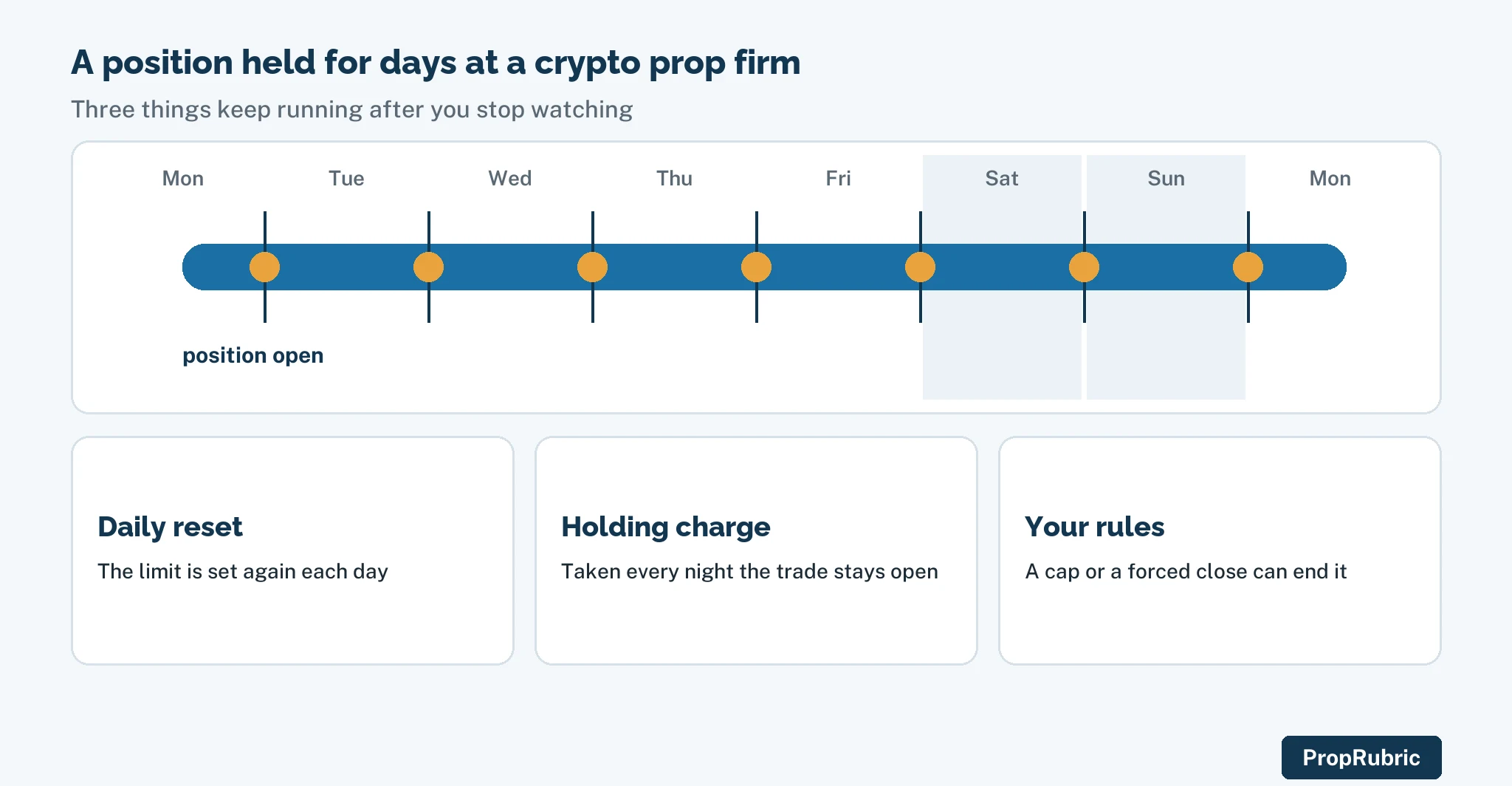
Swing trading at a crypto prop firm: a position held for days, with the holding charge and the rules that can end it
The order is the published cost of a seven-day hold, then funding that varies, then swaps with no published rate, then firms that state nothing, with PropRubric’s score inside each group. RebelsFunding charges the least of the eight fixed rates on bitcoin and still sits ninth, last of the eight, because no new crypto trade opens at its weekends. A week in that order is a $10,000 position held for seven nights, and Fundedbit sits last while its site is down.
No firm paid to be on this list.
Which crypto prop firms are best for swing trading?
The crypto prop firms best for swing trading are the ones that publish a low holding cost and set no holding limit, and four groups cover all 27 firms.
Funded Trader Markets holds #1 because it shows swap at 0% on every instrument, and the Funded Trader Markets review sets out each plan's floor. Breakout holds #2 at $23.10 a week on a static floor, and the Breakout review records the charge. WenCrypto holds #4 at the same $23.10 with no stated holding limit, and the WenCrypto review records its rules by plan. RebelsFunding comes last of the eight fixed rates although its bitcoin rate is the least of them, because no new crypto trade opens at weekends, and the RebelsFunding rulebook with every source quotes that rule. E8 Markets holds #11 because its cost is Hyperliquid funding with no fixed figure, and the full E8 Markets record covers its perpetual accounts. TradeXProp holds #20 because a swap is possible and its rate is not published, and the TradeXProp review with dated values records the rest of its rules.
Eight firms publish a fixed rate: RebelsFunding, Breakout, Kraken Prop, WenCrypto, Upscale, Velotrade, SizeProp and FTMO, from about $17 to $57.53 a week per $10,000.
Two firms state no overnight charge: Funded Trader Markets, whose specification page shows swap at 0%, and Fundedbit, which says “no overnight swap fees” and does not address Bybit funding.
A firm in the fourth group may still charge, and HyroTrader’s terms say simulated costs “may include” funding, so a trader should read the platform before the first hold. A rate shown only in the platform is still a cost you can check before you hold.
What is swing trading at a crypto prop firm?
A swing trade therefore carries three costs a day trade avoids: the nightly charge, the daily limit tested on live equity, and any rule that closes or penalises the position. The nightly charge is simple arithmetic on the published rate.
Formula
holding cost = position value × daily rate × nights held
example: $10,000 × 0.033% × 7 = $23.10 at Breakout, Kraken Prop or WenCrypto; $10,000 × 0.05% × 7 = $35.00 at Velotrade
example: $10,000 × 30% ÷ 365 × 7 = $57.53 at FTMO
A $100,000 position multiplies each figure by ten, so a week at FTMO costs $575.30, and every charge reduces the same balance your drawdown is measured against. The drawdown risk of a price move is larger than the fee: bitcoin’s daily close moved 5% or more on 16 days in the 365 days to 29 September 2026, per the Coinbase series published by the Federal Reserve Bank of St. Louis. A 5% move against a $10,000 position is a $500 loss, which breaches a 3% daily limit on a $10,000 account.
A multi-day position therefore has to be sized for the daily limit. The same sum for a two-day hold is worked through on the page about what a weekend hold costs, where each firm’s weekend rule is quoted.
How do crypto prop firms for swing trading compare?
Crypto prop firms for swing trading compare on the weekly cost, the holding limit and the drawdown type, and seven firms show the range.
Funded Trader Markets: Swap at 0% on Every Row
Funded Trader Markets is a multi-asset prop firm whose instrument specification lists swap at 0% and whose homepage offers “swap-free accounts” on all accounts at no extra charge. No overnight charge appears anywhere PropRubric read, and its news rule states “no blackout windows”.
The swing plan is 2-Step Plus, whose 10% floor is static. 1-Step Nitro, the plan PropRubric scores, trails 6% from the highest balance until the account is 6% up. Its daily stop-out is set each day at 5 PM EST from the higher of balance or equity.
Breakout and Kraken Prop: 0.033% a Day and a Static Floor
Breakout and Kraken Prop are crypto-first programmes on shared terms, with funded accounts at Payward Oceanic Ltd. For a swing trader they pair a fixed rate with a static floor, so an open winner never pulls the limit up behind it. Breakout deducts the charge at 00:25 UTC on positions open at 00:00 UTC, and Kraken Prop splits the same rate across six 4-hour periods.
Velotrade: 0.05% a Day and a Static Floor on Every Plan
Velotrade is a crypto-first, multi-asset prop firm run from Hong Kong, with a static floor on every plan and a flat 0.05% a day on any position open at 00:30 UTC, weekends included.
FTMO: the Highest Published Rate, and a Swing Account
FTMO is a Prague prop firm whose 30 crypto CFDs carry a swap of 30% a year, long and short. FTMO also sells a Swing account type exempt from its news window and its market-break rule, at the highest published holding cost on this list.
RebelsFunding: the Lowest Published Rate, With a Weekend Gap
RebelsFunding is a multi-asset prop firm with a rollover of 7% a year on BTC and ETH, rising to 15% on other coins. RebelsFunding has the lowest published rate on bitcoin, tripled on Friday, beside a rule that opens no new crypto trade at weekends.
Propr: Exchange Funding, Credited or Charged
Propr is an on-chain crypto prop firm run by Propr Limited in the British Virgin Islands. Propr’s cost is Hyperliquid’s own funding, “deducted or credited” automatically, so a position on the receiving side of funding is paid to hold. That funding has no fixed weekly figure for the same reason.
How do you choose a crypto prop firm for swing trading?
You choose a crypto prop firm for swing trading by costing the hold before the entry fee, and five checks cover it.
Multiply the rate by your usual holding time. A three-week hold at 0.05% a day costs $105 per $10,000. Lowest fixed rate on this page: RebelsFunding on bitcoin.
Check for a holding limit in hours. Bitfunded counts days “in exact hours”, and PropW closes every position after 10 calendar days.
Prefer a static floor for an open winner. A trailing floor rises behind unrealised profit, so a pullback can breach an account that is still in profit. Breakout, Kraken Prop and Velotrade keep static floors on their main plans, and Funded Trader Markets keeps one on 2-Step Plus.
Check what a release does to a held trade. FundingPips exempts trades opened 5 hours or more before an event, and BrightFunded exempts take-profits on trades 48 hours old.
Keep the inactivity clock in mind. An open position counts as activity at Velotrade and BrightFunded, and it does not at FundingPips, where a trade must close inside 30 days.
On this list, as on every PropRubric list, the segment’s own value comes first: a firm with no published figure sits below the firms that publish one, and a firm named in the closing section stays out of the top eight. The evidence rule behind every value is on the page on how PropRubric sources, where the re-check cadence and the evidence rule behind every value are set out.
Which crypto prop firms suit swing traders least?
Five crypto prop firms suit swing traders least, because a rule closes the position, removes its profit or blocks new trades.
FundingPips: Master accounts close open trades every day unless the Swing add-on is bought, and Zero accounts must be flat for the weekend.
PropW: every position closes automatically after 10 calendar days.
Bitfunded: its FAQ requires a position closed within 10 days on major crypto and 7 on other crypto, while its terms state a flat 10 days and say the profit may be removed.
Goat Funded Trader: funded accounts lose the profit on trades opened in Friday’s last 3 market hours and closed in Monday’s first 3, though the rule does not say whether crypto is covered.
RebelsFunding: an open crypto position may stay, but no new crypto trade opens at the weekend.